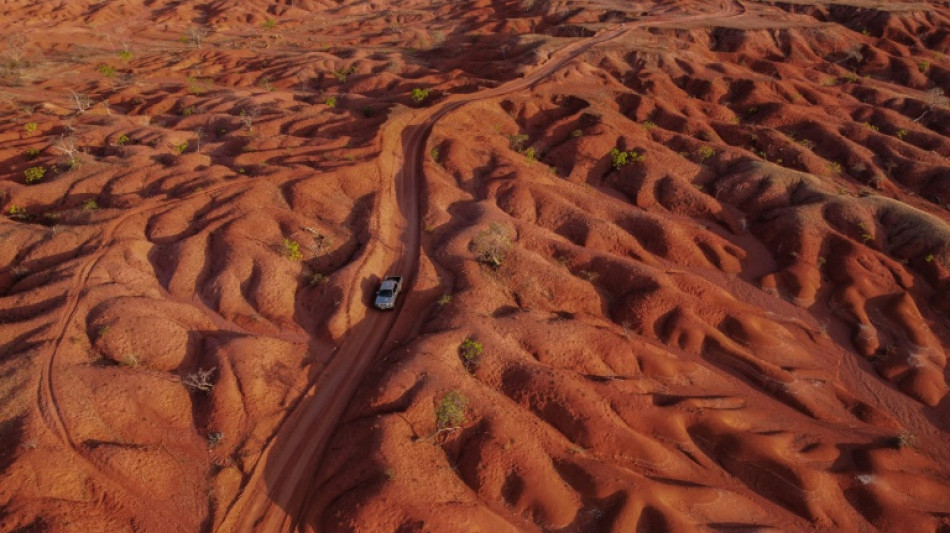
From Bolivia to Indonesia, deforestation continues apace / Photo: Nelson ALMEIDA - AFP/File

 Abdul El-Sayed declares victory in Michigan Senate contest

 Democrats capture US Congress in sweeping midterm victory

 Manchester United rallies past Roma as PSG dominates in Champions League

 Qatar sees tentative opening for renewed regional diplomacy

 Qatar Tourism joins Pacific Asia Travel Association at London travel market

 Abdul El-Sayed Wins Michigan Senate Seat in Historic Election

 Qatar media bodies discuss support for humanitarian initiatives

 Galloway accuser could not foresee publishing-sector fallout, lawyer argues

 New York City Center revives In the Heights as a timely community story

 Godzilla Minus Zero shifts focus toward postwar human drama
Deforestation continued last year at a rate far beyond pledges to end the practice by 2030, according to a major study published Tuesday.
Forests nearly the size of Ireland were lost in 2023, according to two dozen research organisations, NGOs and advocacy groups, with 6.37 million hectares (15.7 million acres) of trees felled and burned.
This "significantly exceeded" levels that would have kept the world on track to eliminate deforestation by the end of the decade, a commitment made in 2021 by more than 140 leaders.
Forests are home to 80 percent of the world's terrestrial plant and animal species and crucial for regulating water cycles and sequestering CO2, the main greenhouse gas responsible for global warming.
"Globally, deforestation has gotten worse, not better, since the beginning of the decade," said Ivan Palmegiani, a biodiversity and land use consultant at Climate Focus and lead author of the "Forest Declaration Assessment" report.
"We're only six years away from a critical global deadline to end deforestation, and forests continue to be chopped down, degraded, and set ablaze at alarming rates."
In 2023, 3.7 million hectares of tropical primary forest -- particularly carbon rich and ecologically biodiverse environments -- disappeared, a figure that should have fallen significantly to meet the 2030 objective.
- Soya and nickel -
In high-risk regions, researchers pointed to backsliding in Bolivia and in Indonesia.
The report said there was an "alarming rise" in deforestation in Bolivia, which jumped 351 percent between 2015 and 2023.
The "trend shows no sign of abating", it added, with forests largely cleared for agriculture, notably for soya but also beef and sugar.
In Indonesia, deforestation slumped between 2020-2022 but started rising sharply last year.
Ironically, that is partly down to demand for materials often seen as eco-friendly, such as viscose for clothing, and a surge in nickel mining for electric vehicle batteries and renewable energy technologies.
There was better news from Brazil.
While it remains the country with the highest deforestation rates in the world, it has made key progress.
The situation has significantly improved in the Amazon, which has benefited from protective measures put in place by President Luiz Inacio Lula da Silva.
However, in the Cerrado, a key tropical savannah below the Amazon, deforestation has increased.
- Degraded forests -
The report also highlights the role of logging, road building and fires in forest degradation, when land is damaged but not razed entirely.
In 2022, the last year data was available, a forest area twice the size of Germany was degraded.
Erin Matson, senior consultant at Climate Focus, and co-author of the report, said "strong policies and strong enforcement" were needed.
"To meet global forest protection targets, we must make forest protection immune to political and economic whims," she said.
The report comes in the wake of the European Commission's proposal last week to postpone by a year (to the end of 2025) the entry into force of its anti-deforestation law, despite protests from NGOs.
"We have to fundamentally rethink our relationship with consumption and our models of production to shift away from a reliance on over exploiting natural resources," said Matson.
A.Motta--PC