Overshooting 1.5C risks 'irreversible' climate impact: study / Photo: NILMAR LAGE - AFP

 Indians living in Japan on stand-by to house Asian Games athletes
 Trump signs bill authorizing sweeping Russia sanctions

 Protesters form human chain at Kennedy Center after Trump threat

 Death toll from attack at police HQ in Pakistan rises to 31

 Trump says Denmark to give US 'permanent control' over Greenland security

 Kennedy Center: future unclear for iconic Washington arts hub

 Trump claims 'infinite' Greenland security deal with Denmark

 Helicopters battle wildfire threatening Ecuador's capital

 Brentford batter Chelsea to undo Alonso's promising start

 Kane hits Bundesliga century as Bayern rout Union

 Trump says CNN, MS NOW, Politico banned from White House

 Hushing and hedging: US companies retreat on climate

 Springboks to face Fiji before 2027 Rugby World Cup

 Nigeria miners struggled to breathe in cell before 37 died: survivors

 McIlroy on the charge at PGA Championship as Reed withdraws

 McIlroy on the charge at PGA Championship

 Crisis-wracked Volkswagen warns of 10-bn-euro hit to profits

 Costa Rica's Grynspan tops third informal poll for UN chief: diplomat

 Stock markets retreat after central bank rate hikes

 Russia labels director of Cannes Grand Prix winner a 'foreign agent'

 Macron warns of Russian 'hybrid' threat after meeting presidential hopefuls

 UN holds third informal poll for new chief

 Kulusevski return can spark Spurs: De Zerbi

 Shakira to cap off world tour with Madrid 12-gig run

 Isolated Syrian-Druze city blames Damascus for shortages

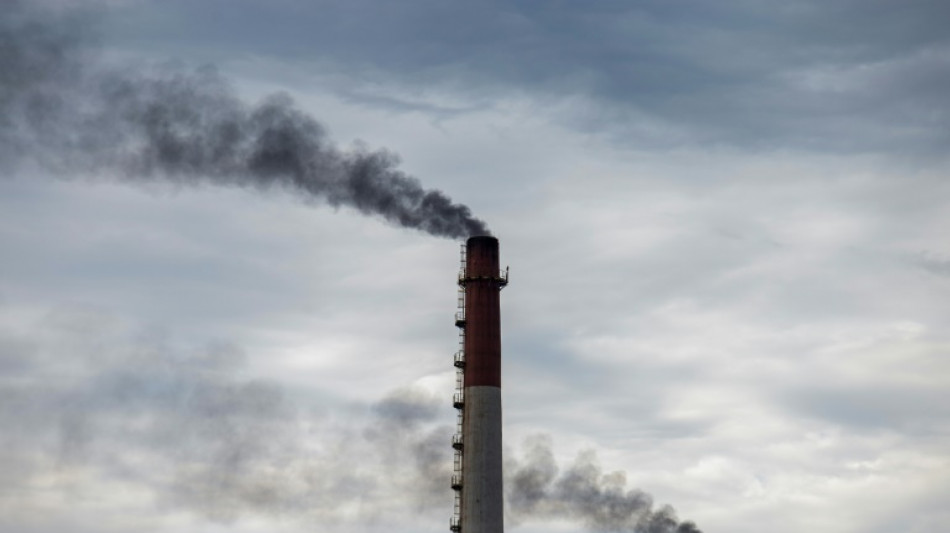
Any breach of what climate scientists agree is the safer limit on global warming would result in "irreversible consequences" for the planet, said a major academic study published on Wednesday.
Even temporarily exceeding 1.5 degrees Celsius before bringing temperatures back down -- a scenario known as an "overshoot" -- could cause sea level rises and other disastrous repercussions that might last millenia.
This "does away with the notion that overshoot delivers a similar climate outcome" to a future where more was done earlier to curb global warming, said Carl-Friedrich Schleussner, who led the study co-authored by 30 scientists.
The findings, three years in the making, are urgent, as the goal of capping global temperature rises at 1.5C above pre-industrial levels is slipping out of reach.
Emissions of heat-trapping greenhouse gases must nearly halve by 2030 if the world is to reach 1.5C -- the more ambitious target enshrined in the 2015 Paris climate accord.
Currently however, they are still rising.
Some kind of overshoot of 1.5C is increasingly being seen as inevitable by scientists and policymakers.
This new study, published in the peer-reviewed journal Nature, cautions against "overconfidence" in such a scenario when the dangers are not fully appreciated.
An overshoot could trigger impacts that last hundreds if not thousands of years, or cross "tipping points" that prompt large and unrepairable changes in earth's climate system, the scientists warn.
It could mean the thawing of permafrost and peatlands, carbon-rich landscapes that would release huge volumes of planet-heating greenhouse gases if lost.
And sea levels could rise an additional 40 centimetres (16 inches) if 1.5C is exceeded for a century, the authors said, an existential difference for vulnerable low-level island nations.
"For most climate indicators, there are irreversible consequences due to the temporary exceedance of, for example, the 1.5 degree limit," said Schleussner from the Austria-based International Institute of Applied Systems Analysis.
"Even if you brought temperatures back down again, the world that we are looking at is not the same as if you didn't overshoot."
- Act now -
Taken together, the world's existing pledges for climate action would result in nearly 3C of warming by 2100, according to the UN.
To reach 1.5C, emissions must be at net zero by 2050, which means balancing the amount of carbon dioxide produced against the amount humanity can remove from the atmosphere via technology.
This process, known as carbon removal, would need to be massively scaled up to pull global temperatures back down in the event of an overshoot, something that is far from guaranteed.
"We cannot be confident that temperature decline after overshoot is achievable within the timescales expected today," the authors wrote.
Schleussner said their findings reinforced "the urgency of governments acting to reduce emissions now and not later down the line, to keep peak warming as low as possible".
"If you want to limit the climate risks in an effective manner, the race to net zero needs to be seen for what it is," he said.
S.Caetano--PC