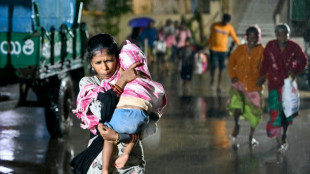
World heading into 'the Age of Electricity': IEA / Photo: Justin TALLIS - AFP/File

 Abdul El-Sayed declares victory in Michigan Senate contest

 Democrats capture US Congress in sweeping midterm victory

 Manchester United rallies past Roma as PSG dominates in Champions League

 Qatar sees tentative opening for renewed regional diplomacy

 Qatar Tourism joins Pacific Asia Travel Association at London travel market

 Abdul El-Sayed Wins Michigan Senate Seat in Historic Election

 Qatar media bodies discuss support for humanitarian initiatives

 Galloway accuser could not foresee publishing-sector fallout, lawyer argues

 New York City Center revives In the Heights as a timely community story

 Godzilla Minus Zero shifts focus toward postwar human drama
More than half of the world's electricity will be produced by low-emission sources before 2030 but the deployment of clean energy is "far from uniform" across the globe, the International Energy Agency said Wednesday.
Demand for oil, gas and coal is still projected to peak by the end of the decade, possibly creating a surplus of fossil fuels, the IEA said in its annual World Energy Outlook.
"In energy history, we've witnessed the Age of Coal and the Age of Oil," said IEA Executive Director Fatih Birol.
"We're now moving at speed into the Age of Electricity, which will define the global energy system going forward and increasingly be based on clean sources of electricity," he said.
The report said clean energy "is entering the energy system at an unprecedented rate" with 560 gigawatts (GW) of renewables capacity added in 2023.
Almost $2 trillion in investments are flowing into clean energy projects each year, nearly double the amount spent on fossil fuel supplies, according to the Paris-based agency.
"Together with nuclear power, which is the subject of renewed interest in many countries, low-emissions sources are set to generate more than half of the world's electricity before 2030," it said.
But the IEA noted that the deployment of clean energy "is far from uniform across technologies and countries".
The report comes a month before Azerbaijan hosts the UN's annual climate conference, COP29, in Baku, from November 11 to November 22.
F.Moura--PC