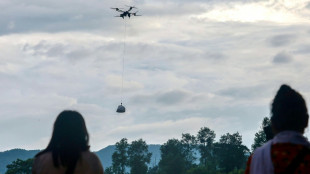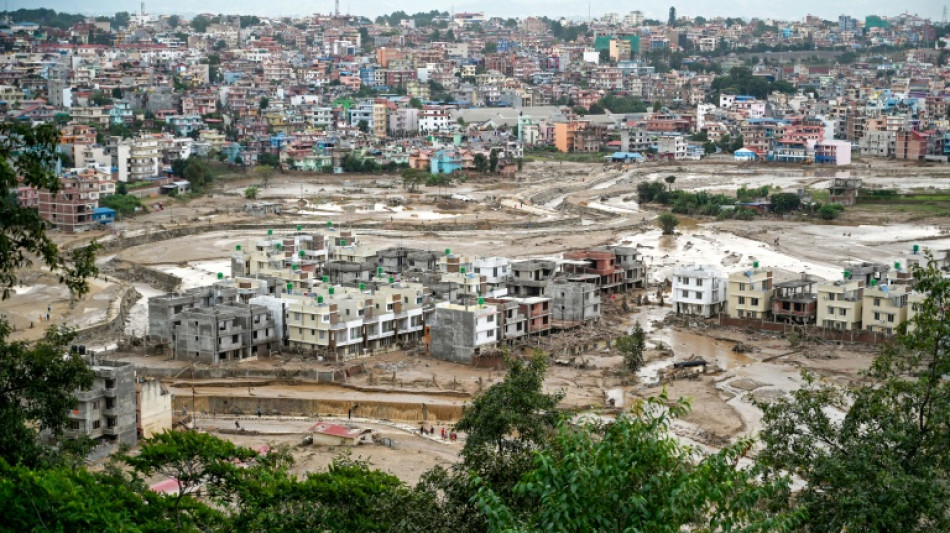
Climate change worsened deadly Nepal floods, scientists say / Photo: Prakash MATHEMA - AFP

 Indians living in Japan on stand-by to house Asian Games athletes

 Trump signs bill authorizing sweeping Russia sanctions

 Protesters form human chain at Kennedy Center after Trump threat

 Death toll from attack at police HQ in Pakistan rises to 31

 Trump says Denmark to give US 'permanent control' over Greenland security

 Kennedy Center: future unclear for iconic Washington arts hub

 Trump claims 'infinite' Greenland security deal with Denmark

 Helicopters battle wildfire threatening Ecuador's capital

 Brentford batter Chelsea to undo Alonso's promising start

 Kane hits Bundesliga century as Bayern rout Union

 Trump says CNN, MS NOW, Politico banned from White House

 Hushing and hedging: US companies retreat on climate

 Springboks to face Fiji before 2027 Rugby World Cup

 Nigeria miners struggled to breathe in cell before 37 died: survivors

 McIlroy on the charge at PGA Championship as Reed withdraws

 McIlroy on the charge at PGA Championship

 Crisis-wracked Volkswagen warns of 10-bn-euro hit to profits

 Costa Rica's Grynspan tops third informal poll for UN chief: diplomat

 Stock markets retreat after central bank rate hikes

 Russia labels director of Cannes Grand Prix winner a 'foreign agent'

 Macron warns of Russian 'hybrid' threat after meeting presidential hopefuls

 UN holds third informal poll for new chief

 Kulusevski return can spark Spurs: De Zerbi

 Shakira to cap off world tour with Madrid 12-gig run

 Isolated Syrian-Druze city blames Damascus for shortages

Climate change, along with rapid urbanisation and deforestation, turbocharged floods in Nepal that killed more than 240 people last month, scientists said on Thursday.
Nepal suffered its worst flooding in decades in late September after ferocious monsoon rains swelled rivers, swamping entire neighbourhoods in the capital Kathmandu and other districts.
World Weather Attribution (WWA), a network of scientists who assess the role of human-induced climate change on extreme weather events, said the link between the intense rainfall and a warming planet was clear.
"If the atmosphere wasn't overloaded with fossil fuel emissions, these floods would have been less intense, less destructive and less deadly," said researcher Mariam Zachariah, from Imperial College London.
Their analysis found the relentless rain, which fell on saturated ground in the late monsoon, was made at least 10 percent heavier and 70 percent more likely by climate change.
They warned that such "explosive" rain bursts will "become even heavier, risking more destructive floods" if the world does not stop burning fossil fuels.
Lashing rain from September 26 sparked floods and landslides that killed 246 people and left 18 missing, according to Nepal's government.
WWA, which uses modelling to compare weather patterns in our world and one without human-induced climate change, said there was a high level of uncertainty in the results because of the complex rain dynamics in the small, mountainous region affected.
However, the results were in line with growing scientific evidence on large-scale extreme rain in a warming climate, in which the atmosphere holds more water.
The role of climate change was also compounded by other man-made problems, they said, including rapid urbanisation, with a nearly four-fold increase in built-up areas in Kathmandu since 1990.
That was coupled with major deforestation that disrupted the natural flow of water, with tree cover slashed by more than a quarter since 1989.
The floods smashed hydropower plants, washed away homes and ripped away bridges. It was the latest disastrous flood to hit the Himalayan nation this year.
"Climate change is no longer a distant threat," said Roshan Jha, Researcher at the Indian Institute of Technology in Mumbai.
"With every fraction of a degree of warming, the atmosphere can potentially hold more moisture, leading to much heavier downpours, and catastrophic floods like these."
Nepal has embarked on a giant hydropower dam building spree, generating 99 percent of its power, with output increasing fourfold in the past eight years.
It has signed deals to export surplus power to neighbouring coal-dependent India.
Earlier this month, the UN's World Meteorological Organization said that increasingly intense floods and droughts are a "distress signal" of what is to come as climate change makes the planet's water cycle ever more unpredictable.
WMO chief Celeste Saulo called water the "canary in the coal mine of climate change".
A.Magalhes--PC