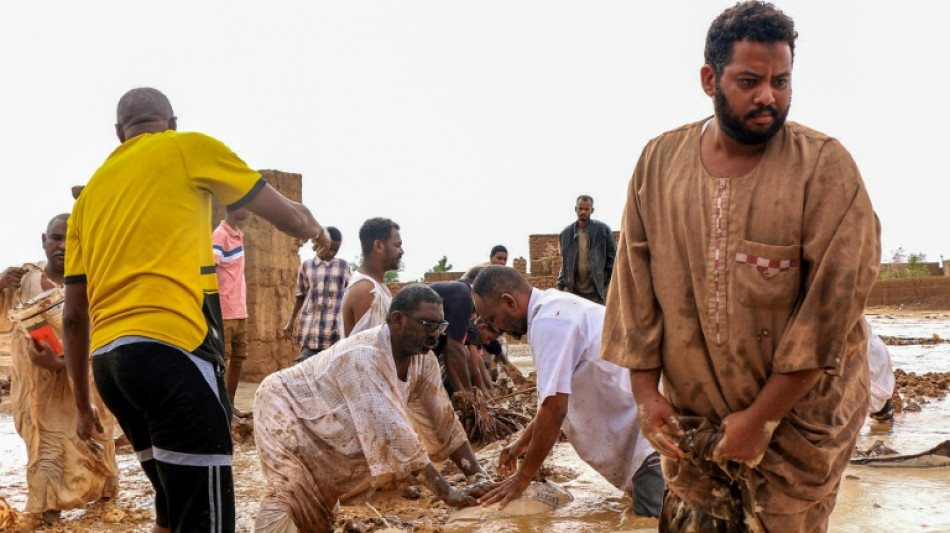
Climate change worsened deadly Africa floods, scientists say / Photo: - - AFP

 Ed Sheeran returns to stage after Palestinian controversy

 Asian Games to open in Japan after troubled build-up

 Drone owners rush to offload devices ahead of Beijing ban

 Trump's beef policies irk Texas ranchers, testing their loyalty

 Nvidia, OpenAI CEOs to attend Xi dinner at White House

 Anthropic picks Accenture for in-house AI safety evaluation

 Balogun returns as Monaco beat Lens to continue strong Ligue 1 start

 'Pause' on overt repression in Venezuela, but reforms still needed: HRW

 Global stocks mixed as yen falls despite Bank of Japan rate hike

 Cuba hit with seventh major blackout of the year

 Murray out with concussion so Wentz will start for Vikings

 UN chief 'deeply regrets' US visa refusal to Abbas for annual meeting

 England quick Carse to face no charges over alleged nightclub assault

 Mancini brings nine newcomers into the first squad of his Italy comeback

 Czechs level Davis Cup tie against USA as South Korea eye Finals

 New France boss Zidane confirms Mbappe as captain after naming first squad

 California governor signs order to explore AI 'kill switch'

 Head leads run spree as Australia win Zimbabwe ODI series

 In-form Raphinha wants to finish career at Barcelona

 Warren Buffett steps down as Berkshire Hathaway chairman

 Carrick confident Man Utd can 'work through' tough time

 Mbappe ends Nike partnership to join Swiss brand On

 Liverpool boss Iraola puts Bournemouth love affair on hold

 'A disaster' if Man City do not win says Maresca after flawless start

 Kerry James Marshall: American 'blackness' painter celebrated in Europe

Human-caused climate change worsened floods that have killed hundreds of people and displaced millions in Cameroon, Chad, Niger, Nigeria and Sudan this year, according to a study published on Wednesday.
The intense rainy season has unleashed a humanitarian crisis across large areas of the Sahel region bordering the Sahara desert.
A new analysis by the World Weather Attribution (WWA) network of scientists found warming driven by the use of fossil fuels had exacerbated the flooding in Sudan.
The researchers also said climate change would have made this year's torrential rains around five to 20 percent more intense across the Niger and Lake Chad basins, citing a previous WWA study of similar floods in 2022.
"This is only going to keep getting worse if we keep burning fossil fuels," said Clair Barnes from the Centre for Environmental Policy at Imperial College London.
Speaking at a briefing ahead of the study's publication, she said such downpours "could happen every year" if global temperatures increase to two degrees Celsius (35.6 Fahrenheit) above pre-industrial levels.
"It's pretty serious," she said.
- Downpours and storms -
Global warming is not just about rising temperatures -- the extra heat trapped in the atmosphere and seas has knock-on effects and can result in more intense downpours and storms.
The researchers said there was a clear link between the extreme rainfall and a warming planet.
In the study, they focused on war-torn Sudan, where millions of displaced people have been uprooted by conflict and driven into flood-prone areas.
The scientists used modelling to compare weather patterns in our world and one without human-induced warming, and found that month-long spells of intense rainfall in parts of Sudan had become heavier and more likely due to climate change.
At the current 1.3 degrees Celsius of warming, they said similar periods of rainfall are expected to occur on average about once every three years, and have become about 10 percent heavier due to climate change.
- 'Incredibly concerning' -
"These results are incredibly concerning," said Izidine Pinto, one of the study's authors and a researcher at the Royal Netherlands Meteorological Institute.
He warned that "with every fraction of a degree of warming, the risk of extreme floods will keep increasing", and called for the UN's COP29 climate summit to "accelerate the transition away from fossil fuels" when it meets in Azerbaijan next month.
Joyce Kimutai, a researcher at Imperial's Centre for Environmental Policy, said the floods underscored the need for a loss and damage fund for nations devastated by climate change.
A key meeting ahead of COP29 earlier this month ended with countries making little progress over how to finance a deal for poorer nations.
"Africa has contributed a tiny amount of carbon emissions globally, but is being hit the hardest by extreme weather," Kimutai said.
The role of climate change in the floods was compounded by other human-made problems, the researchers said, and they called for better maintenance of dams and investment in early warning systems.
T.Batista--PC


