Are bioplastics really the wonder alternative to petro plastics? / Photo: PEDRO PARDO - AFP/File

 Ed Sheeran returns to stage after Palestinian controversy

 Asian Games to open in Japan after troubled build-up

 Drone owners rush to offload devices ahead of Beijing ban

 Trump's beef policies irk Texas ranchers, testing their loyalty

 Nvidia, OpenAI CEOs to attend Xi dinner at White House

 Anthropic picks Accenture for in-house AI safety evaluation

 Balogun returns as Monaco beat Lens to continue strong Ligue 1 start

 'Pause' on overt repression in Venezuela, but reforms still needed: HRW

 Global stocks mixed as yen falls despite Bank of Japan rate hike

 Cuba hit with seventh major blackout of the year

 Murray out with concussion so Wentz will start for Vikings

 UN chief 'deeply regrets' US visa refusal to Abbas for annual meeting

 England quick Carse to face no charges over alleged nightclub assault

 Mancini brings nine newcomers into the first squad of his Italy comeback

 Czechs level Davis Cup tie against USA as South Korea eye Finals

 New France boss Zidane confirms Mbappe as captain after naming first squad

 California governor signs order to explore AI 'kill switch'

 Head leads run spree as Australia win Zimbabwe ODI series

 In-form Raphinha wants to finish career at Barcelona

 Warren Buffett steps down as Berkshire Hathaway chairman

 Carrick confident Man Utd can 'work through' tough time

 Mbappe ends Nike partnership to join Swiss brand On

 Liverpool boss Iraola puts Bournemouth love affair on hold

 'A disaster' if Man City do not win says Maresca after flawless start

 Kerry James Marshall: American 'blackness' painter celebrated in Europe

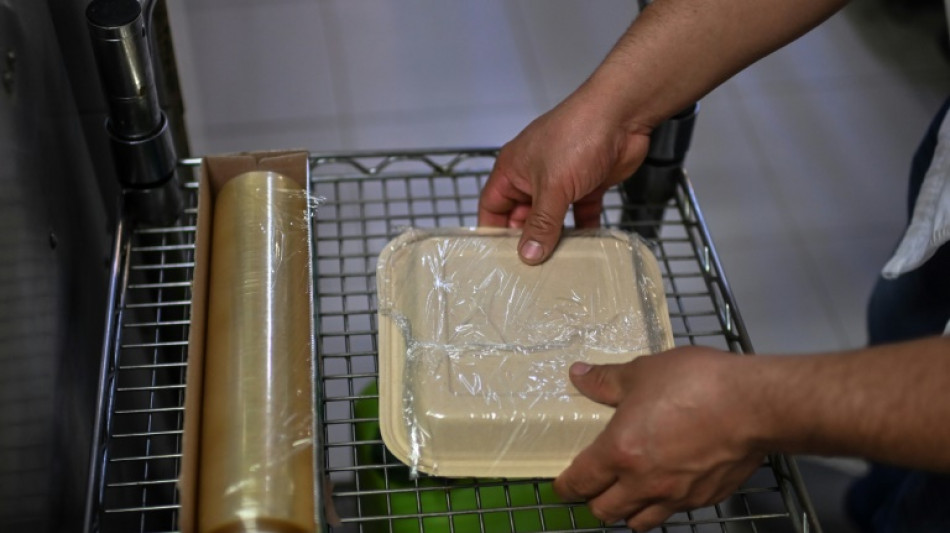
Alternatives to petrochemical-based plastics are emerging, made from everything from banana leaves to tomato skins, especially for food packaging.
But questions remain about how biodegradable and compostable they are, as well as their impact on the environment.
- What is biosourced plastic? -
Biosourced means made with less petrol, using non-fossil agricultural products such as sugarcane waste, corn, or wheat starch. Primarily used in packaging, these biosourced plastics account for less than one percent of global plastic production.
But labs around the world are coming up with more and more new plastics derived from tomato skins or banana leaves.
The French chemicals company Arkema, for instance, is pushing PBAT, made from castor oil, which is used to make sports shoes and car interiors.
Bananatex is a biodegradable textile made from banana leaves that has been developed by a Swiss brand and its Taiwanese partners.
However, "biosourced doesn't necessarily have to be 100 percent" from natural materials, warned Christophe Doukhi de Boissoudy, president of the French association for biosourced compostables.
In Europe, the minimum 50 percent requirement to be considered biosourced "will rise to 60 percent in January 2025", he added.
- What is a bioplastic? -
The generic term "bioplastic" can be confusing, as it can mean either biosourced or compostable: the definition varies by country.
But in Europe, the term is clearly defined -- a bioplastic is a polymer that is both biosourced and compostable, either in soil or industrially.
Not all bioplastics completely degrade under natural conditions.
Some, like PLA (polylactic acid), need to be composted industrially at temperatures between 35 and 60 degrees Centigrade (140 degrees Fahrenheit).
One of the most highly developed bioplastics currently used in textiles or for food packaging, PLA was originally fossil-based but is now being made from fermented plant biomass (corn, beet or sugarcane).
"What alarms us is the speed at which China is advancing its legislation to convert its packaging to PLA, aiming to abandon petrochemical plastics, while Europe is stagnating," said Frederic Van Gansberghe, founder of Belgium-based bioplastics company Futerro, which has a factory in China and plans to open one in France in 2026.
- What environmental impact? -
In its "Atlas of Plastic", the Heinrich Boll Foundation estimates that most biosourced plastics are neither completely biodegradable or compostable, and "actually just sidestep the problem".
For Nathalie Gontard, research director at the French National Institute for Agriculture, Food and the Environment, biosourced plastic "has absolutely no benefit" because these polymers don't degrade in natural conditions but instead fragment into micro- and then nano-plastics.
"What matters is biodegradability under natural conditions," she said.
"Biodegradable" is not well-defined, she argued, as some use it for materials that completely degrade in a few months or years, while others refer to much longer periods.
The environmental benefit of biosourced plastic lies in how they reduce the CO2 emissions of the plastics sector. But caution is needed here, experts warn.
"Additional demand for land to grow the raw materials for biosourced plastics can lead to land-use changes or deforestation," the OECD warned, which in turn can increase CO2 emissions.
"By developing bioplastics, we place the burden of manufacturing these materials on agricultural land that should primarily serve to feed the population," insisted Pauline Debrabandere from the NGO Zero Waste.
A.Silveira--PC