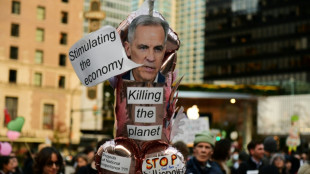
2024 'virtually certain' to be hottest year on record: EU monitor / Photo: JOSE JORDAN - AFP

 Indian crude-sensitive shares gain after 13% oil-price decline

 Stocks and dollar fall as Democratic election gains reshape markets

 Kuwait marks key events and anniversaries from national history

 Trump congratulates Democrats and signals willingness to cooperate

 Qatar prime minister advances mediation through diplomatic calls

 Greenland parliament approves security agreement with United States

 Qatar envoy meets incoming UN General Assembly president

 Trump Signals Willingness to Work With Democrats After Midterm Defeat

 Pitches and Keynote Speakers Are Confirmed for Blue Magic Netherlands on November 17
This year is "virtually certain" to be the hottest in recorded history with warming above 1.5C, EU climate monitor Copernicus said Thursday, days before nations are due to gather for crunch UN climate talks.
The European agency said the world was passing a "new milestone" of temperature records that should serve to accelerate action to cut planet-heating emissions at the UN negotiations in Azerbaijan next week.
Last month, marked by deadly flooding in Spain and Hurricane Milton in the United States, was the second hottest October on record, with average global temperatures second only to the same period in 2023.
Copernicus said 2024 would likely be more than 1.55 degrees Celsius above the 1850-1900 average -- the period before the industrial-scale burning of fossil fuels.
This does not amount to a breach of the Paris deal, which strives to limit global warming to below 2C and preferably 1.5C, because that is measured over decades and not individual years.
"It is now virtually certain that 2024 will be the warmest year on record and the first year of more than 1.5C above pre-industrial levels," said Copernicus Climate Change Service (C3S) Deputy Director Samantha Burgess.
"This marks a new milestone in global temperature records and should serve as a catalyst to raise ambition for the upcoming Climate Change Conference, COP29."
- Wild weather -
The UN climate negotiations in Azerbaijan, which will set the stage for a new round of crucial carbon-cutting targets, will take place in the wake of the United States election victory by Donald Trump.
Trump, a climate change denier, pulled the US out of the Paris Agreement during his first presidency -- and while his successor Joe Biden took the United States back in, he has threatened to do so again.
Meanwhile, average global temperatures have reached new peaks, as have concentrations of planet-heating gases in the atmosphere.
Scientists say the safer 1.5C limit is rapidly slipping out of reach, while stressing that every tenth of a degree of temperature rise heralds progressively more damaging impacts.
Last month the UN said the current pace of climate action would result in a catastrophic 3.1C of warming this century, while all current climate pledges taken in full would still amount to a devastating 2.6C temperature rise.
Global warming is not just about rising temperatures, but the knock-on effect of all the extra heat in the atmosphere and seas.
Warmer air can hold more water vapour, and warmer oceans mean greater evaporation, resulting in more intense downpours and storms.
In a month of weather extremes, October saw above-average rainfall across swathes of Europe, as well as parts of China, the US, Brazil and Australia, Copernicus said.
The US is also experiencing ongoing drought, which affected record numbers of people, the EU monitor added.
Copernicus said average sea surface temperatures in the area it monitors were the second highest on record for the month of October.
C3S uses billions of measurements from satellites, ships, aircraft and weather stations to aid its calculations.
Copernicus records go back to 1940 but other sources of climate data such as ice cores, tree rings and coral skeletons allow scientists to expand their conclusions using evidence from much deeper in the past.
Climate scientists say the period being lived through right now is likely the warmest the earth has been for the last 100,000 years, back at the start of the last Ice Age.
P.Cavaco--PC