Sacred cow: coal-hungry India eyes bioenergy to cut carbon / Photo: Punit PARANJPE - AFP

 Ed Sheeran returns to stage after Palestinian controversy

 Asian Games to open in Japan after troubled build-up

 Drone owners rush to offload devices ahead of Beijing ban

 Trump's beef policies irk Texas ranchers, testing their loyalty

 Nvidia, OpenAI CEOs to attend Xi dinner at White House

 Anthropic picks Accenture for in-house AI safety evaluation

 Balogun returns as Monaco beat Lens to continue strong Ligue 1 start

 'Pause' on overt repression in Venezuela, but reforms still needed: HRW

 Global stocks mixed as yen falls despite Bank of Japan rate hike

 Cuba hit with seventh major blackout of the year

 Murray out with concussion so Wentz will start for Vikings

 UN chief 'deeply regrets' US visa refusal to Abbas for annual meeting

 England quick Carse to face no charges over alleged nightclub assault

 Mancini brings nine newcomers into the first squad of his Italy comeback

 Czechs level Davis Cup tie against USA as South Korea eye Finals

 New France boss Zidane confirms Mbappe as captain after naming first squad

 California governor signs order to explore AI 'kill switch'

 Head leads run spree as Australia win Zimbabwe ODI series

 In-form Raphinha wants to finish career at Barcelona

 Warren Buffett steps down as Berkshire Hathaway chairman

 Carrick confident Man Utd can 'work through' tough time

 Mbappe ends Nike partnership to join Swiss brand On

 Liverpool boss Iraola puts Bournemouth love affair on hold

 'A disaster' if Man City do not win says Maresca after flawless start

 Kerry James Marshall: American 'blackness' painter celebrated in Europe

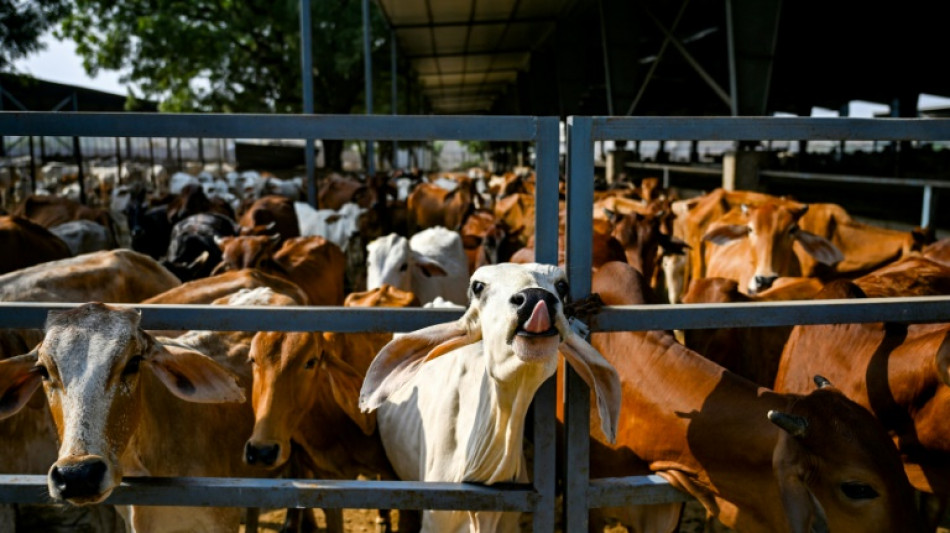
Venerated as incarnations of Hindu deities, India's sacred cows are also being touted as agents of energy transition by a government determined to promote biogas production to cut its dependence on coal.
It is an understatement to say that Nakul Kumar Sardana is proud of his new plant at Barsana, in India's northern Uttar Pradesh state.
Firstly, says the vice-president of a biomass joint venture between India's Adani Group and France's TotalEnergies, because it occupies "one of the holiest sites in the world".
A four-hour drive south of the smog-filled capital New Delhi, among fields bristling with brickyard smokestacks, the small town of Barsana welcomes pilgrims who come to honour the Hindu goddess Radha.
But Sardana is also proud because his methanisation plant that opened in March is the "most technologically advanced and the largest biogas facility" in India.
It was built in Barsana to be as close as possible to its raw fuel -- cattle dung and harvest stubble.
"This region is home to a million cows," he said. "Their dung has been used as fuel for centuries in cooking".
Cows have been blamed for contributing to global warming because they produce methane -- a powerful greenhouse gas -- in their manure or when they belch.
But in this case, the region is finding a creative use for the waste produced by the cattle, which are used for their milk. Eating them is taboo for many Hindus.
Stalks left behind after the rice harvest -- that would otherwise be burned -- join the slurry.
"Farmers are traditionally burning them, creating smog and pollution", he added.
"In using natural waste, we are not only producing compressed biogas, but also high-quality organic fertiliser."
Long lines of tractors dump dung and straw in the factory's tanks, from which 10 tonnes of gas and 92 tonnes of fertiliser are produced each day.
- 'Convert waste' -
In its endless quest for power to fuel its economic growth, the world's most populous nation -- and third-largest fossil fuel polluter -- has pushed biogas to achieve a much-promised transition to carbon neutrality by 2070.
In 2018, the government set itself an ambitious goal of building 5,000 biogas plants in six years.
But despite generous subsidies and the introduction of a buyback guarantee, the project attracted little initial interest -- until the government forced the hand of producers.
From April 2025, at least one percent of liquid gas fuelling both vehicles and for domestic use must be biogas -- rising to five percent by 2028.
That prompted a response from key players, starting with billionaires Mukesh Ambani and Gautam Adani -- both close to Prime Minister Narendra Modi -- eying lucrative public contracts.
Ambani promised his Reliance group would build 55 biogas plants by the end of 2025 to convert "food producers to energy producers" and generate 30,000 jobs.
His rival Adani plans to invest around $200 million in the sector in the next three to five years.
"The government is pushing to convert waste for the wealth of the country," said Suresh Manglani, CEO of Adani Total Gas.
The International Energy Agency (IEA) says both China and India are leading global growth in bioenergy, seen as one solution to mitigate global heating.
Even though biofuel remains more expensive than conventional gas, Indian production is expected to grow by 88 percent by 2030, it predicts.
Biogas is considered a clean energy because the waste used to produce it is completely natural, said Suneel Pandey of The Energy and Resources Institute.
It is "a sustainable solution to make wealth from waste," he told AFP.
- 'Potential is huge' -
But the contribution of biogas to India's transition away from heavily polluting coal -- currently fuelling nearly 70 percent of electricity --- will be relatively small.
India plans to more than double the share of gas in its energy mix -- from six to 15 percent by 2030.
But the bulk of that will be liquefied natural gas (LNG), with Adani and TotalEnergies opening an LNG port on India's eastern coast at Dhamra.
Burning gas to produce electricity also releases damaging emissions, although less than coal and oil.
Total argues its backing of biogas is more about environmental responsibility than commercial opportunity.
"Biogas goes way beyond figures and business plans," said Sangkaran Ratnam, TotalEnergies chairman and managing director for India.
"It has also a tremendously positive knock-on effect on the rural communities in terms of jobs, in terms of care for the environment, and alternative forms of income."
Tejpreet Chopra, head of renewable energy company Bharat Light and Power, said the biogas market is "small in the big picture of things" but the "potential is huge".
But the investments required are vast. The Barsana plant cost $25 million, while the price of biogas remains uncompetitive: $14 per cubic metre, compared to $6 for LNG.
Yet Sardana remains more convinced than ever that biogas is key.
"We will learn the nuts and bolts of it and improve all processes," he said.
"We stop wasting energy, we create rural jobs, and we are contributing to a more sustainable environment."
A.S.Diogo--PC