Climate cash should also go to nuclear, says UN atomic chief / Photo: Alexander NEMENOV - AFP

 Equitas Small Finance Bank rebounds after naming interim chief executive
 Titan quarterly profit seen rising as jewellery business drives growth
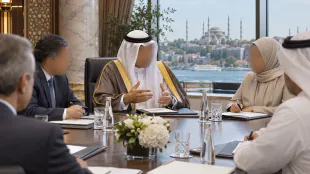 Kuwait finance minister holds economic cooperation talks at COMCEC

 Abdul El-Sayed declares victory in Michigan Senate contest

 Democrats capture US Congress in sweeping midterm victory

 Manchester United rallies past Roma as PSG dominates in Champions League

 Qatar sees tentative opening for renewed regional diplomacy

 Qatar Tourism joins Pacific Asia Travel Association at London travel market

 Abdul El-Sayed Wins Michigan Senate Seat in Historic Election

 Qatar media bodies discuss support for humanitarian initiatives

The head of the United Nations nuclear watchdog said Tuesday that atomic power should also be allowed to tap into climate change funds.
International Atomic Energy Agency (IAEA) chief Rafael Grossi said he wanted countries from Kenya to Malaysia to go for nuclear, while denying he was pushing for an "irresponsible race" towards civil atomic power.
Should nuclear get climate financing?
"It should. Already at COP28 in Dubai the international community -- not just nuclear countries -- agreed that nuclear energy needs to be accelerated.
We need to give ourselves the means to make things happen.
The dialogue with international financial institutions has started in a very positive way. I was at the World Bank this summer, and tomorrow we will meet with the EBRD (European Bank for Reconstruction and Development), as well as the Development Bank of Latin America.
Various financing bodies are beginning to see that markets are pushing in this direction.
We are obviously not a commercial lobby (but) a regulatory agency for everything related to nuclear safety, security, and non-proliferation. We are here to provide assurances and to oversee projects."
But banks don't directly back atomic projects?
"There are cultural, political and ideological barriers. We are coming out of decades of a negative narrative about nuclear, but it has to happen. I am the first to want to see results straight away."
Can nuclear help poorer nations decarbonise?
"That would be a very good thing. There are many countries -- such as Ghana, Kenya and Morocco -- that are interested in small modular reactors, for example, and they approach us saying, 'For us, this would be a good solution.'
Others, like those in Eastern Europe, could benefit from European funding and for whom energy security is crucial in reducing dependency on certain suppliers. So it depends on the model. In Asia, we have Malaysia, the Philippines... countries that genuinely need this."
But how many have safety authorities up to the job?
"Obviously, the agency does not endorse or promote programmes or projects that lack the institutional and technological fabric needed.
We have development models. The United Arab Emirates is a very, very interesting case. It's a country with financial resources but that initially had absolutely no infrastructure, nuclear regulations etc.
We have established programmes for newcomers to guide them step-by-step, through 19 chapters, until they establish nuclear capability."
That's what we have done. We are not going crazy, in an irresponsible race toward civil nuclear power. But there are a lot of things we can do."
G.Teles--PC