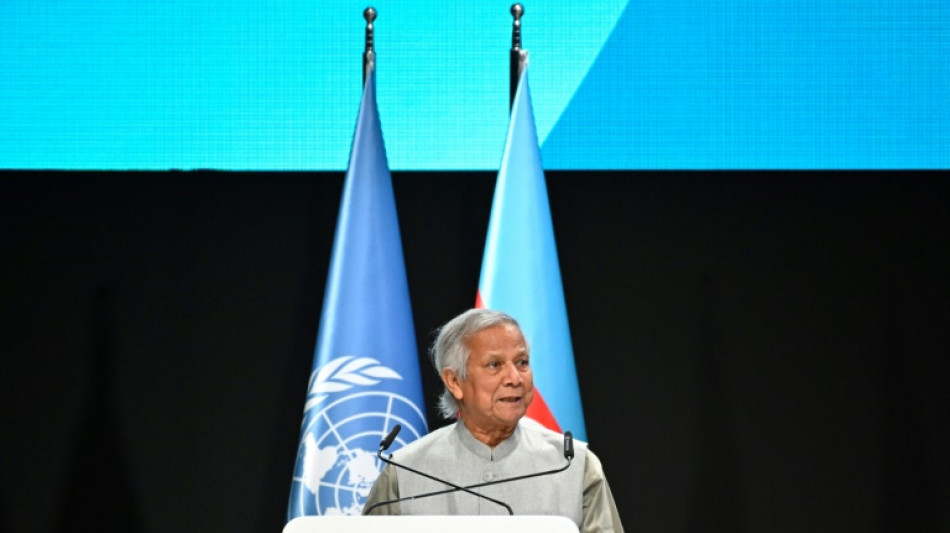
'Very humiliating': Bangladesh's Yunus seethes over climate cash fight / Photo: Alexander NEMENOV - AFP

 Ed Sheeran returns to stage after Palestinian controversy

 Asian Games to open in Japan after troubled build-up

 Drone owners rush to offload devices ahead of Beijing ban

 Trump's beef policies irk Texas ranchers, testing their loyalty

 Nvidia, OpenAI CEOs to attend Xi dinner at White House

 Anthropic picks Accenture for in-house AI safety evaluation

 Balogun returns as Monaco beat Lens to continue strong Ligue 1 start

 'Pause' on overt repression in Venezuela, but reforms still needed: HRW

 Global stocks mixed as yen falls despite Bank of Japan rate hike

 Cuba hit with seventh major blackout of the year

 Murray out with concussion so Wentz will start for Vikings

 UN chief 'deeply regrets' US visa refusal to Abbas for annual meeting

 England quick Carse to face no charges over alleged nightclub assault

 Mancini brings nine newcomers into the first squad of his Italy comeback

 Czechs level Davis Cup tie against USA as South Korea eye Finals

 New France boss Zidane confirms Mbappe as captain after naming first squad

 California governor signs order to explore AI 'kill switch'

 Head leads run spree as Australia win Zimbabwe ODI series

 In-form Raphinha wants to finish career at Barcelona

 Warren Buffett steps down as Berkshire Hathaway chairman

 Carrick confident Man Utd can 'work through' tough time

 Mbappe ends Nike partnership to join Swiss brand On

 Liverpool boss Iraola puts Bournemouth love affair on hold

 'A disaster' if Man City do not win says Maresca after flawless start

 Kerry James Marshall: American 'blackness' painter celebrated in Europe

In the three months since becoming Bangladesh's interim leader following a student-led revolution, Muhammad Yunus has endured political turmoil, impatient cries for elections, and destructive flooding across the low-lying nation.
Now, the Nobel Peace Prize winner has been thrust into a brawl over money to help poorer countries deal with climate change -- and he is not pleased about it.
The 84-year-old micro-finance pioneer, who took over after the toppling of autocratic leader Sheikh Hasina in August, likened the haggling at the UN COP29 climate summit to a "fish market".
"I think that's very humiliating, for nations to come and ask for money to fix... (the) problem that others caused for them," Yunus told AFP in an interview in Azerbaijan, which is hosting the talks.
"Why should we be dragged here to negotiate? You know the problem."
Nations hope to land a deal at COP29 that boosts funding for climate action in developing nations like Bangladesh, which are least responsible for global warming, but most at its mercy.
Some want $1 trillion a year to cover the enormous cost of shifting their economies to clean energy, and adapting to ever-more erratic and extreme weather.
But rich countries -- whose rise to prosperity and associated carbon emissions have driven global warming -- are reluctant to commit such large sums and want others to chip in.
The talks have hit a wall, frustrating leaders of climate-imperilled nations who left behind populations in dire straits to travel to Baku.
Among them is Yunus, who said his riverine homeland had been smashed by six punishing floods -- "each one worse than the previous" -- in the short time since he took over.
Hundreds of thousands of people were forced into emergency shelters in the floods, which also destroyed rice crops.
- 'You figure it out' -
Bangladesh is among the world's most vulnerable nations to climate change, with large areas made up of deltas where the Ganges and the Brahmaputra rivers wind towards the sea.
The country of 170 million is particularly at risk of devastating floods and cyclones -- disasters that only stand to accelerate as the planet keeps warming.
Yunus said it was "not a secret" that rich nations would have to help poorer ones adapt and they should "figure out how much is needed -- not me".
"This is not something we are demanding out of your generosity. We're asking because you are the cause of this problem," he said bluntly.
Yunus said juggling a peaceful democratic transition and a floods response was "difficult" enough and adding a flight to Baku to feud over climate finance didn't help.
Impatience for elections in Bangladesh has gained pace since Hasina's ouster, and the silver-haired technocrat said he shared concerns for peace and security in the nation of 170 million.
A free and fair vote would come as promised, he said, but the speed of democratic reforms "will decide how quick the election will be".
He wouldn't offer a date or timeline, but said the caretaker administration was hoping to build "a quick consensus".
"We are the interim government, so our period should be as short as possible," he said.
H.Silva--PC