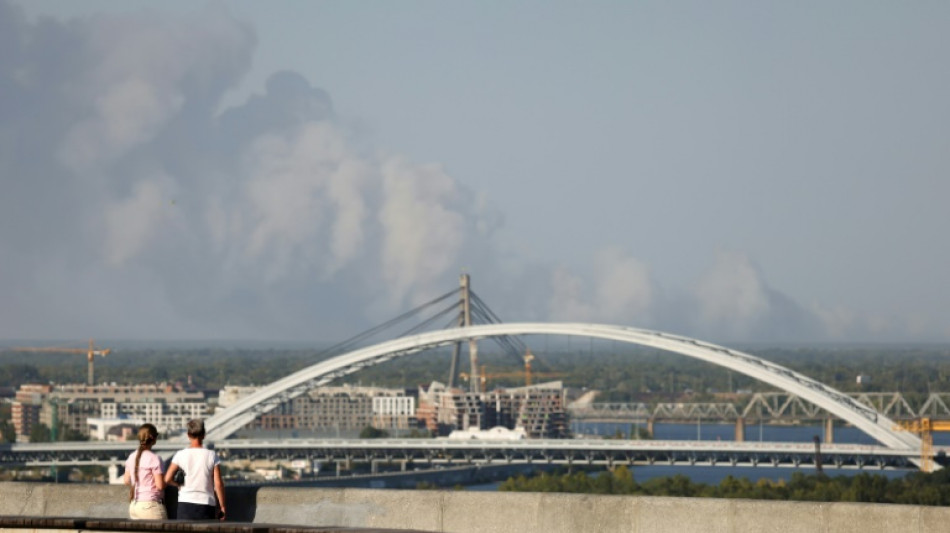
Russian invasion toll on environment $71 billion, Ukraine says / Photo: Anatolii STEPANOV - AFP/File

 Equitas Small Finance Bank rebounds after naming interim chief executive

 Titan quarterly profit seen rising as jewellery business drives growth

 Kuwait finance minister holds economic cooperation talks at COMCEC

 Abdul El-Sayed declares victory in Michigan Senate contest

 Democrats capture US Congress in sweeping midterm victory

 Manchester United rallies past Roma as PSG dominates in Champions League

 Qatar sees tentative opening for renewed regional diplomacy

 Qatar Tourism joins Pacific Asia Travel Association at London travel market

 Abdul El-Sayed Wins Michigan Senate Seat in Historic Election

 Qatar media bodies discuss support for humanitarian initiatives

Russia's invasion of Ukraine has caused $71 billion in environmental damage and led to a surge in greenhouse gas emissions, the Ukrainian government told the COP29 summit in Baku.
"Nature during this war is like a silent victim," said Svitlana Grynchuk, Ukraine's minister of environmental protection and natural resources.
The climate impact, especially through destruction of forests that naturally balance carbon emissions, shows that the consequences of the war are "not just for Ukraine, but for the global community," she told reporters.
Grynchuk said the Ukrainian government estimated that the war has cost $71 billion in environmental damage and led to the equivalent of some 180 million tons of carbon emissions.
The UN Development Programme a year ago had put environmental damage from the war at $56 billion.
In the latest Ukrainian estimation, military activities themselves have caused 51.6 million tons of carbon emissions since Russia's invasion in February 2022, with another 56 million tied to needs to restore infrastructure after the war.
Among other top contributors, fires were blamed for 27.2 million in carbon emission equivalent.
Grynchuk said that the invasion has damaged three million hectares (11,500 square miles) of forest, which she noted was larger than many countries' entire forested area.
Her remarks come as Russia decimates energy facilities in new aerial bombardments across Ukraine, plunging millions into darkness.
Both Russia and Ukraine have stepped up attacks as they anticipate a shift in the crucial US support for Kyiv once Donald Trump returns to the White House in two months.
Grynchuk said that Ukraine was cognisant of climate as it rebuilds, with small-scale renewable energy projects seen as more sustainable in the face of the threat from Russia.
"All Ukrainians during a very short period of time have become very energy-efficient," she said.
Ukraine, which aspires to enter the European Union, has committed to a bloc-wide goal of net-zero greenhouse gas emissions by 2050.
A.Magalhes--PC