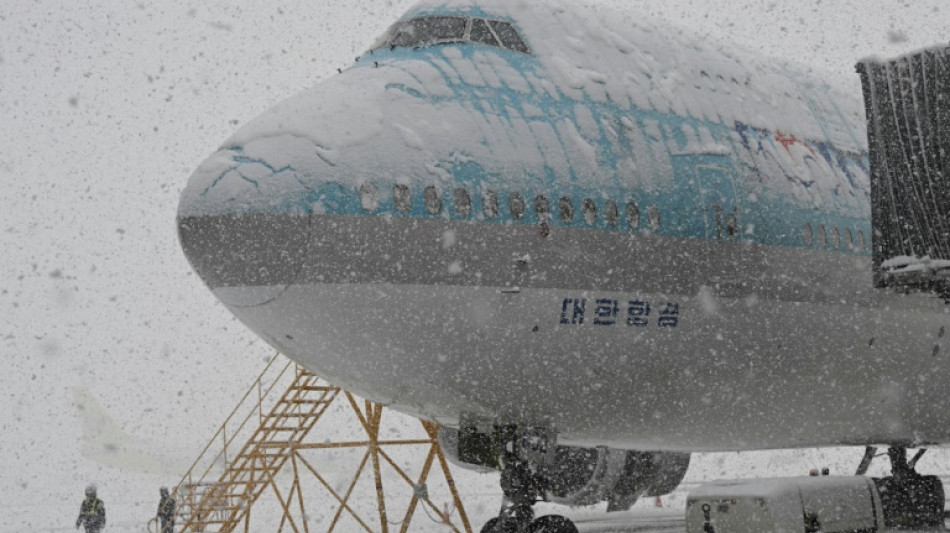
South Korean capital hit by record November snowfall: weather agency / Photo: JUNG YEON-JE - AFP

 Equitas Small Finance Bank rebounds after naming interim chief executive

 Titan quarterly profit seen rising as jewellery business drives growth

 Kuwait finance minister holds economic cooperation talks at COMCEC

 Abdul El-Sayed declares victory in Michigan Senate contest

 Democrats capture US Congress in sweeping midterm victory

 Manchester United rallies past Roma as PSG dominates in Champions League

 Qatar sees tentative opening for renewed regional diplomacy

 Qatar Tourism joins Pacific Asia Travel Association at London travel market

 Abdul El-Sayed Wins Michigan Senate Seat in Historic Election

 Qatar media bodies discuss support for humanitarian initiatives

South Korea's capital was blanketed Wednesday by the heaviest November snowfall since records began over a century ago, the weather agency said.
The Korea Meteorological Administration said 16.5 centimetres (6.5 inches) of snow fell by 7:00 am (2200 GMT Tuesday), compared to Seoul's previous record of 12.4 cm on November 28, 1972.
Coincidentally being the first snow of the season in Seoul, it is the highest figure in November since the agency set up nationwide observation posts in 1907.
A heavy snow warning urged residents to "refrain from operating vehicles and engaging in outdoor activities" and to "beware of falling trees".
Such warnings are issued when snowfall accumulates to 20 cm or more within 24 hours.
As heavy snow fell nationwide, multiple accidents occurred due to vehicles sliding on icy roads, though no major injuries have been reported.
Falling trees caused power outages, affecting more than 150 households around Seoul in the morning.
Main roads were closed for maintenance, leading to severe traffic congestion, while at least 22 domestic flights were cancelled, and several others were delayed, according to the transport ministry.
President Yoon Suk Yeol called on officials to "minimise potential damage and public inconvenience caused by the snow," as the heavy snowfall is expected to continue until Thursday morning.
The heavy snowfall was caused by the "significant temperature difference between the sea surface and the cold air," Youn Ki-han, director at Seoul's Meteorology Forecast Division, told AFP.
"Over the West Sea, moisture forms, and when cold air from the north moves down as it typically does, if the West Sea is also cold as in previous years, the temperature difference is smaller," said Youn.
However, due to the unusually warm temperatures in recent weeks, this difference became more pronounced.
Another factor behind the heavy snowfall, Youn added, is that "the strong snow was consistently carried by the westerly winds, pushing it into the Seoul metropolitan area."
"Snow kept falling in the same areas repeatedly, leading to greater accumulation."
Up to 20 cm of additional snowfall is expected to fall around the capital, according to the weather agency.
F.Ferraz--PC