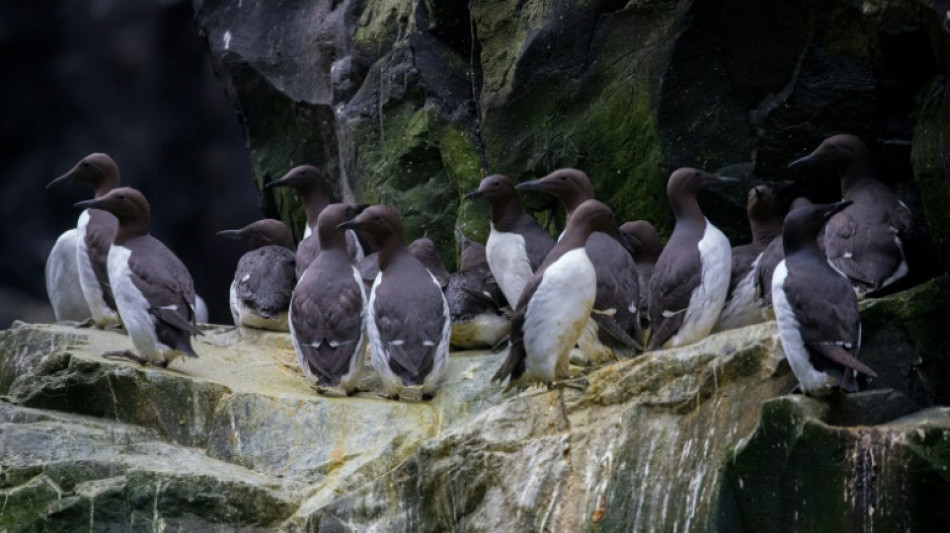
Single heat wave wiped out millions of Alaska's dominant seabird / Photo: BRIE DRUMMOND - US FISH & WILDLIFE SERVICE/AFP

 Ed Sheeran returns to stage after Palestinian controversy

 Asian Games to open in Japan after troubled build-up

 Drone owners rush to offload devices ahead of Beijing ban

 Trump's beef policies irk Texas ranchers, testing their loyalty

 Nvidia, OpenAI CEOs to attend Xi dinner at White House

 Anthropic picks Accenture for in-house AI safety evaluation

 Balogun returns as Monaco beat Lens to continue strong Ligue 1 start

 'Pause' on overt repression in Venezuela, but reforms still needed: HRW

 Global stocks mixed as yen falls despite Bank of Japan rate hike

 Cuba hit with seventh major blackout of the year

 Murray out with concussion so Wentz will start for Vikings

 UN chief 'deeply regrets' US visa refusal to Abbas for annual meeting

 England quick Carse to face no charges over alleged nightclub assault

 Mancini brings nine newcomers into the first squad of his Italy comeback

 Czechs level Davis Cup tie against USA as South Korea eye Finals

 New France boss Zidane confirms Mbappe as captain after naming first squad

 California governor signs order to explore AI 'kill switch'

 Head leads run spree as Australia win Zimbabwe ODI series

 In-form Raphinha wants to finish career at Barcelona

 Warren Buffett steps down as Berkshire Hathaway chairman

 Carrick confident Man Utd can 'work through' tough time

 Mbappe ends Nike partnership to join Swiss brand On

 Liverpool boss Iraola puts Bournemouth love affair on hold

 'A disaster' if Man City do not win says Maresca after flawless start

 Kerry James Marshall: American 'blackness' painter celebrated in Europe

The common murre, a large black-and-white seabird native to northern waters, has become far less common in Alaska over the past decade due to the impacts of climate change.
A study published Thursday in Science reveals that a record-breaking marine heat wave in the northeast Pacific from 2014 to 2016 triggered a catastrophic population collapse, wiping out four million birds -- about half the species in the region.
Strikingly, they have shown little signs of rebounding, suggesting long-term shifts in the food web that have locked the ecosystem into a troubling new equilibrium.
"There's a lot of talk about declines of species that are tied to changes in temperature, but in this case, it was not a long term result," lead author Heather Renner of the Alaska Maritime National Wildlife Refuge told AFP.
"To our knowledge, this is the largest mortality event of any wildlife species reported during the modern era," she and her colleagues emphasized in their paper.
The finding triggers "alarm bells," Renner said in an interview, as human-caused climate change makes heat waves more frequent, intense, and longer-lasting.
- Emaciated Carcasses -
With their dapper, tuxedoed look, common murres are sometimes called the "penguins of the north."
Their slender wings power them across vast distances in search of food and make them expert divers. But even these hardy seabirds were no match for an unprecedented environmental catastrophe.
The largest marine heat wave ever recorded began in the late fall of 2014, spanning a massive swath of the northeast Pacific Ocean from California to Alaska.
It persisted for over two years, leaving devastation in its wake. During this time, some 62,000 emaciated murres washed ashore along the North American Pacific coastline -- dead or dying from starvation.
Experts point to two key reasons for the bird deaths: elevated ocean temperatures reduced both the quality and quantity of phytoplankton, impacting fish like herring, sardines, and anchovies -- the mainstay of the murre diet.
At the same time, warmer waters increased the energy demands of larger fish, such as salmon and Pacific cod, which compete with murres for the same prey.
"We knew then it was a big deal, but unfortunately, we couldn't really quantify the effects," explained Renner.
For years after the event, breeding colonies failed to produce chicks, complicating efforts to assess the full impact.
Earlier estimates pegged the number of deaths at around a million, but a more robust analysis -- drawing on data from 13 murre colonies -- revealed the toll was four times higher.
"It is just so much worse than we thought it was," Renner said of the new findings.
- Climate winners and losers -
The marine heat wave didn't just impact common murres. Pacific cod stocks collapsed, king salmon populations dwindled, and as many as 7,000 humpback whales perished.
Yet the crisis created an uneven playing field: some species emerged unscathed, while others even thrived.
Thick-billed murres, which often share nesting cliffs with common murres, were largely unaffected, possibly due to their more adaptable diet, Renner noted.
For common murres, however, the fallout lingers. Despite nearly a decade since the heat wave, their numbers show no sign of bouncing back -- and the losses may well be permanent.
Part of the reason lies in the long-term decline of some of their prey.
Another factor is murres' survival strategy relies on numbers: they aggregate in massive colonies to protect their eggs from opportunistic predators like eagles and gulls.
With their populations slashed, these birds have lost their critical safety buffer.
Still, Renner offered a glimmer of hope.
While addressing global warming is essential for curbing long-term climate change, conservation efforts can make a difference in the short term, she said.
Removing invasive species like foxes and rats from murre nesting islands could also provide the beleaguered birds with a fighting chance.
J.Oliveira--PC


