Fueling the Los Angeles fires: the Santa Ana winds / Photo: Jonathan WALTER, David LORY - AFP

 Ed Sheeran returns to stage after Palestinian controversy

 Asian Games to open in Japan after troubled build-up

 Drone owners rush to offload devices ahead of Beijing ban

 Trump's beef policies irk Texas ranchers, testing their loyalty

 Nvidia, OpenAI CEOs to attend Xi dinner at White House

 Anthropic picks Accenture for in-house AI safety evaluation

 Balogun returns as Monaco beat Lens to continue strong Ligue 1 start

 'Pause' on overt repression in Venezuela, but reforms still needed: HRW

 Global stocks mixed as yen falls despite Bank of Japan rate hike

 Cuba hit with seventh major blackout of the year

 Murray out with concussion so Wentz will start for Vikings

 UN chief 'deeply regrets' US visa refusal to Abbas for annual meeting

 England quick Carse to face no charges over alleged nightclub assault

 Mancini brings nine newcomers into the first squad of his Italy comeback

 Czechs level Davis Cup tie against USA as South Korea eye Finals

 New France boss Zidane confirms Mbappe as captain after naming first squad

 California governor signs order to explore AI 'kill switch'

 Head leads run spree as Australia win Zimbabwe ODI series

 In-form Raphinha wants to finish career at Barcelona

 Warren Buffett steps down as Berkshire Hathaway chairman

 Carrick confident Man Utd can 'work through' tough time

 Mbappe ends Nike partnership to join Swiss brand On

 Liverpool boss Iraola puts Bournemouth love affair on hold

 'A disaster' if Man City do not win says Maresca after flawless start

 Kerry James Marshall: American 'blackness' painter celebrated in Europe

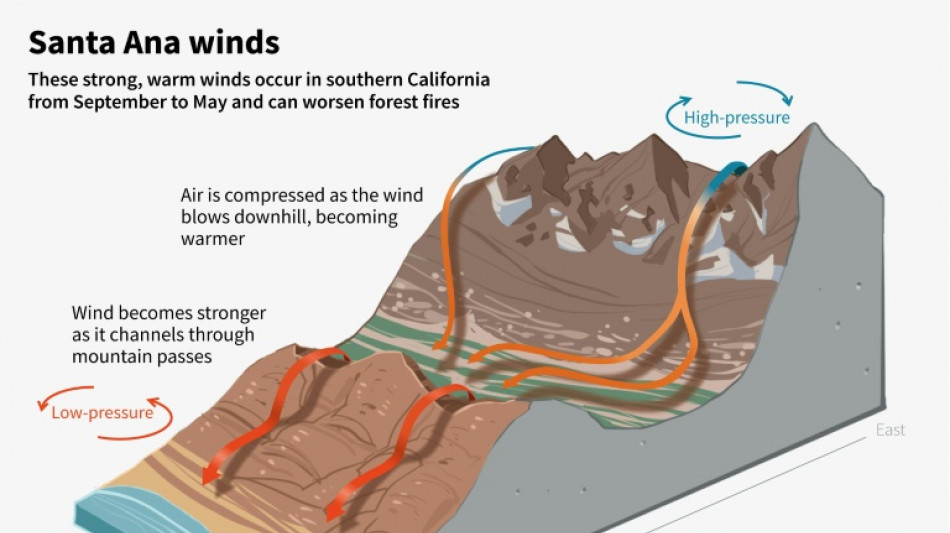
Helping drive the wildfires in the US city of Los Angeles are the so-called Santa Ana winds, a weather phenomenon known to dry out "the hills and the nerves to flash point."
The windstorms occur when cold air gathers in the neighboring states of Nevada and Utah. As it moves west and then rushes down California's mountains, it heats up -- and dries out.
- Creating fuel, spreading fires -
The Santa Anas can both create the conditions for deadly wildfires and fuel them once they are underway -- drying out vegetation when they blow through, and then fanning blazes once they spark.
As the 23,700-acre (9,500-hectare) Palisades Fire and 14,000-acre Eaton Fire have raged around Los Angeles, fast-moving winds have exacerbated the situation, throwing hot embers into new patches of dried brush.
While firefighters sought to take advantage of a brief lull on Friday and Saturday, heavy winds were back with gusts up to 70 miles per hour (110 kilometers per hour) by Sunday, with harsh conditions forecast to continue this week.
- Cold air, hot winds -
Santa Ana winds usually occur between September and May, typically for a few days at a time.
When a high-pressure system forms over the deserts to California's east, it pushes air toward the Pacific coast.
As they move down the Santa Ana and Sierra Nevada mountains and shoot through valleys, the winds compress -- creating a rise in their temperature and a drop in their relative humidity.
With hot, dry gusts that can knock down trees or kick up dust and particulate matter, the winds have long caused problems in southern California.
The 2017 Thomas Fire, which destroyed more than 1,000 structures, was fueled in part by back-to-back Santa Ana winds.
- Frayed nerves -
The Washington Post likened the weather pattern to "a giant hair dryer," and writers have long noted the effect the winds seem to have on residents psychologically.
American author Raymond Chandler once described them as so hot they "curl your hair and make your nerves jump and your skin itch."
For Joan Didion, they blew "sandstorms out along Route 66, drying the hills and nerves to flash point."
R.Veloso--PC