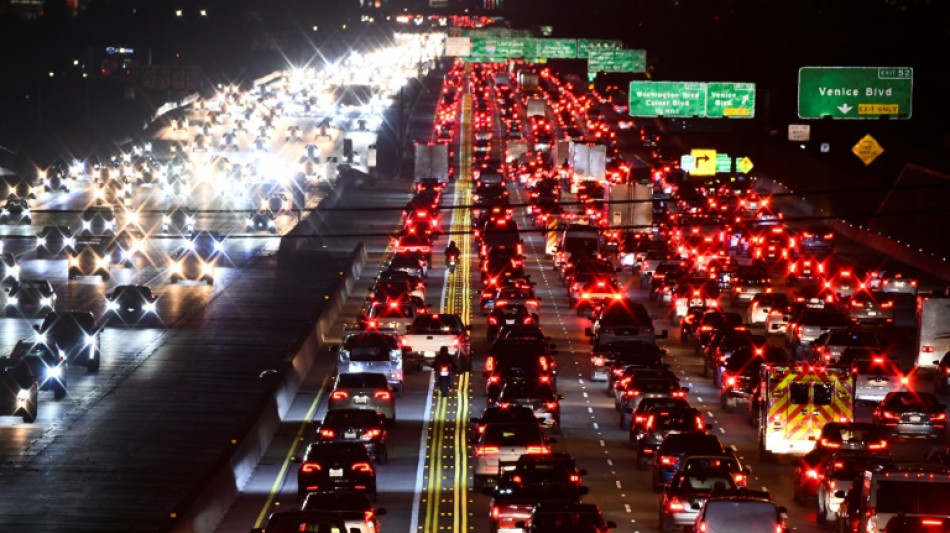
Global road transport emissions to peak in 2025: study / Photo: Patrick T. FALLON - AFP/File

 Ed Sheeran returns to stage after Palestinian controversy

 Asian Games to open in Japan after troubled build-up

 Drone owners rush to offload devices ahead of Beijing ban

 Trump's beef policies irk Texas ranchers, testing their loyalty

 Nvidia, OpenAI CEOs to attend Xi dinner at White House

 Anthropic picks Accenture for in-house AI safety evaluation

 Balogun returns as Monaco beat Lens to continue strong Ligue 1 start

 'Pause' on overt repression in Venezuela, but reforms still needed: HRW

 Global stocks mixed as yen falls despite Bank of Japan rate hike

 Cuba hit with seventh major blackout of the year

 Murray out with concussion so Wentz will start for Vikings

 UN chief 'deeply regrets' US visa refusal to Abbas for annual meeting

 England quick Carse to face no charges over alleged nightclub assault

 Mancini brings nine newcomers into the first squad of his Italy comeback

 Czechs level Davis Cup tie against USA as South Korea eye Finals

 New France boss Zidane confirms Mbappe as captain after naming first squad

 California governor signs order to explore AI 'kill switch'

 Head leads run spree as Australia win Zimbabwe ODI series

 In-form Raphinha wants to finish career at Barcelona

 Warren Buffett steps down as Berkshire Hathaway chairman

 Carrick confident Man Utd can 'work through' tough time

 Mbappe ends Nike partnership to join Swiss brand On

 Liverpool boss Iraola puts Bournemouth love affair on hold

 'A disaster' if Man City do not win says Maresca after flawless start

 Kerry James Marshall: American 'blackness' painter celebrated in Europe

CO2 emissions from road transport could peak worldwide this year thanks to rapid growth in electric vehicles and stricter new regulations, a German think tank said Tuesday.
The International Council on Clean Transportation (ICCT) estimated that vehicle emissions would top out at around nine gigatonnes in 2025, a quarter-century earlier than previously predicted.
The volume of emissions would then decline to 7.1 gigatonnes in 2050, the ICCT calculated in a scenario based on environmental rules as of August 2024.
The organisation's previous forecast, which used regulatory conditions in 2021, predicted a peak in road transport emissions in 2050.
The quicker turnaround was due to changing regulations in major markets that required a higher share of zero-emissions vehicles (ZEVs), including battery-powered cars, in new sales, the ICCT said.
Progress in the number of cleaner vehicles already on the roads was "underpinned by the falling costs of ZEVs", the ICCT said.
The think tank, however, warned that a weakening of current environmental standards for road transport could lead to the peak being delayed.
The European Union for example has agreed to ban the sale of new petrol and diesel cars from 2035 but criticism of the plan has grown.
The target is increasingly under fire from Europe's struggling automotive industry and has become a bugbear of many far-right political parties in the bloc.
An increase in global vehicle activity or a slowdown in the sale of ZEVs could also delay the peak, the ICCT said.
While the difference between the two scenarios modelled by the think tank was already significant, yearly emissions would have to fall to 2.3 gigatonnes by 2050 to align with the Paris climate accords.
The climate deal set a target to limit global warming to well below 2 degrees Celsius above pre-industrial levels -- and to 1.5C if possible.
The ICCT included all emissions linked to road transport in its modelling, including vehicle production and fuel use.
E.Borba--PC