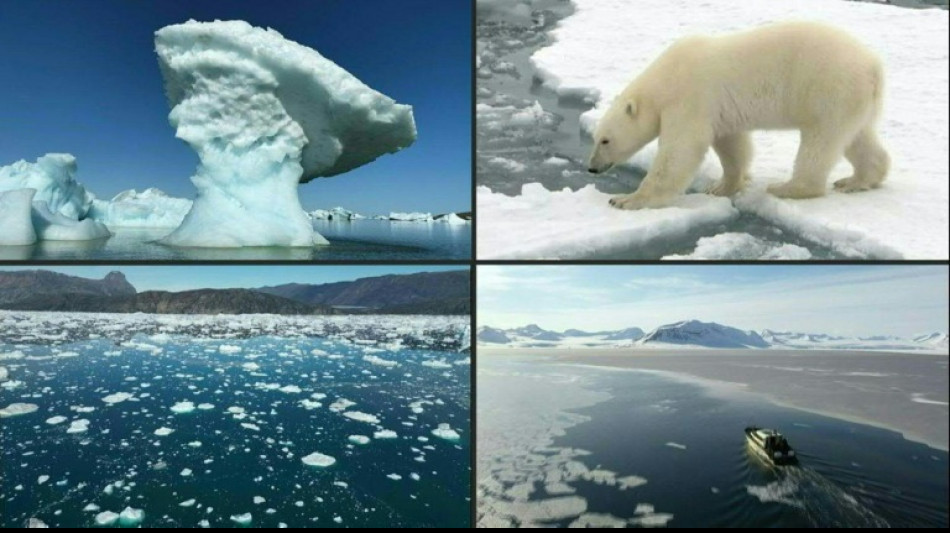
Arctic sea ice levels second lowest on record for January: US data / Photo: Viken KANTARCI, Ekaterina ANISIMOVA, Jonathan NACKSTRAND, Viken KANTARCI, Odd ANDERSEN, Madeleine PRADEL, Diane DESOBEAU - AFP

 India seeks threefold increase in coal stocks to prevent summer power shortages

 Indian companies report mixed second-quarter results on November 4

 KKR secures Indian regulator approval for Gentari Renewables investment

 Bharti Airtel revenue expected to grow at double-digit pace in second quarter

 Indian crude-sensitive shares gain after 13% oil-price decline

 Stocks and dollar fall as Democratic election gains reshape markets

 Kuwait marks key events and anniversaries from national history

 Trump congratulates Democrats and signals willingness to cooperate

 Qatar prime minister advances mediation through diplomatic calls

 Greenland parliament approves security agreement with United States

 Qatar envoy meets incoming UN General Assembly president

 Trump Signals Willingness to Work With Democrats After Midterm Defeat

 Pitches and Keynote Speakers Are Confirmed for Blue Magic Netherlands on November 17
Both the North and South Pole regions have warmed by some three degrees Celsius compared to late 19th-century levels, much faster than the global average.
The US National Snow and Ice Data Center (NSIDC) said the Arctic sea ice surface area was at a record low in December and continued near record lows in during January. It said the surface in January averaged 13.13 million square kilometers (5.07 million square miles).
"In contrast to the cold conditions dominating the contiguous United States, much of the Arctic experienced above-average January temperatures," the NSIDC said.
This was particularly marked north of Greenland and over central Alaska, the report said, with temperatures as much as eight degrees Celsius (14 degrees Fahrenheit) above average for the month.
Greenland is located between the United States and Europe in a region of increasing strategic value as the melting of Arctic sea ice opens up new shipping routes.
President Donald Trump has signalled that he wants the Arctic island -- which is believed to hold large untapped mineral and oil reserves -- to become part of the United States.
Last year annual surface air temperatures in the Arctic were the second-warmest on record, according to the US National Oceanic and Atmospheric Administration.
Rising temperatures melt sea ice which in turn contributes to accelerated warming in the region, as dark sea water absorbs more solar radiation and thus helps to heat up the atmosphere, which then further accelerates the melting of the ice.
In a 2023 study, researchers found that the Arctic Ocean's ice cap would likely disappear in summer as soon as the 2030s and a decade earlier than thought, no matter how aggressively humanity draws down the carbon pollution that drives global warming.
The retreating ice also has a major impact on polar bears, which need sea ice to hunt.
A study published in the journal Science last week found that around half of the decline in Canada's Hudson Bay polar bears from 1979 to 2021 was due to climate-driven sea ice loss.
L.Henrique--PC