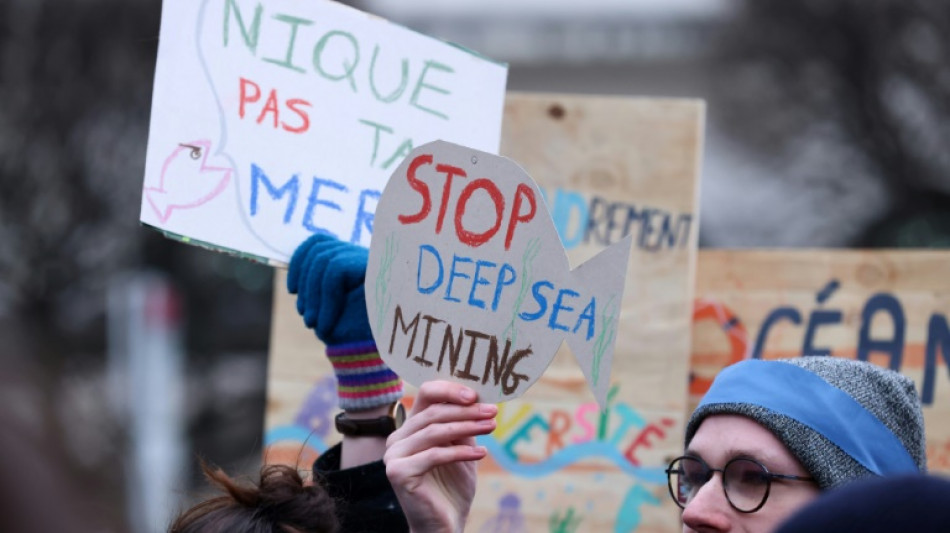
'Sound science' must guide deep-sea mining: top official / Photo: Kenzo TRIBOUILLARD - AFP/File

 Ed Sheeran returns to stage after Palestinian controversy

 Asian Games to open in Japan after troubled build-up

 Drone owners rush to offload devices ahead of Beijing ban

 Trump's beef policies irk Texas ranchers, testing their loyalty

 Nvidia, OpenAI CEOs to attend Xi dinner at White House

 Anthropic picks Accenture for in-house AI safety evaluation

 Balogun returns as Monaco beat Lens to continue strong Ligue 1 start

 'Pause' on overt repression in Venezuela, but reforms still needed: HRW

 Global stocks mixed as yen falls despite Bank of Japan rate hike

 Cuba hit with seventh major blackout of the year

 Murray out with concussion so Wentz will start for Vikings

 UN chief 'deeply regrets' US visa refusal to Abbas for annual meeting

 England quick Carse to face no charges over alleged nightclub assault

 Mancini brings nine newcomers into the first squad of his Italy comeback

 Czechs level Davis Cup tie against USA as South Korea eye Finals

 New France boss Zidane confirms Mbappe as captain after naming first squad

 California governor signs order to explore AI 'kill switch'

 Head leads run spree as Australia win Zimbabwe ODI series

 In-form Raphinha wants to finish career at Barcelona

 Warren Buffett steps down as Berkshire Hathaway chairman

 Carrick confident Man Utd can 'work through' tough time

 Mbappe ends Nike partnership to join Swiss brand On

 Liverpool boss Iraola puts Bournemouth love affair on hold

 'A disaster' if Man City do not win says Maresca after flawless start

 Kerry James Marshall: American 'blackness' painter celebrated in Europe

Rules on deep-sea mining in international waters must be driven by "sound science" and built on consensus, the head of the body charged with regulating the divisive practice said Thursday.
Deep-sea mining in international waters involves taking minerals like nickel, cobalt and copper -- crucial for renewable energy technology -- from the sea floor.
But researchers and environmentalists have long warned it risks destroying habitats and species that are little understood, and could upset delicate processes in the ocean that affect climate change.
The seabed in international waters is governed by the International Seabed Authority (ISA), an independent body established under the UN Convention on the Law of the Sea.
The ISA's Council, which for now only grants exploration contracts, has been drawing up commercial exploitation rules for more than a decade. And they aim to adopt a mining code this year to govern the extraction of seabed resources in international waters.
The issue is highly contentious, with some member states keen to begin mining soon, while others want a moratorium or even an outright ban on seabed exploitation.
ISA Secretary-General Leticia Carvalho said any mining code developed this year must be driven by "transparency, environmental responsibility and equitable benefit-sharing".
"Sound science must underpin all decisions related to the deep seabed," she told an ocean meeting in Tokyo by video link.
The world paid little attention when the ISA, created in 1994, quietly began negotiating the mining code.
But the calendar has taken on urgency.
- Thorny questions -
Since July 2023, due to a legal clause invoked by the tiny Pacific island nation of Nauru, any country can apply for a mining contract in the name of a company it sponsors.
Nauru Ocean Resources Inc. (NORI), a subsidiary of Canada's The Metals Company (TMC), wants to begin mining polymetallic nodules in the Pacific as soon as 2026.
It plans to file an exploitation application by June this year, making the need for a code governing mining all the more pressing.
Thorny issues have yet to be resolved, including environmental rules and how to share profits from seabed resources dubbed a "common heritage of mankind."
An oceanographer by training, Carvalho can only guide member states as they decide whether and how to draft a code.
She said she would focus on "ensuring that decisions are grounded in science and built on consensus".
Warnings about the impact of mining gained strength with the discovery last year that oxygen was being released on the ocean floor not just by living organisms, but by polymetallic nodules that would be targeted by companies.
The findings have been rejected by the TMC, even though it helped fund the research, and follow-up work is ongoing.
Mining proponents point to the growing need for minerals to drive the renewable energy transition, and the problems associated with on-land exploitation -- including environmental degradation and rights abuses.
X.Matos--PC