Why has Mexico's water debt opened new battle line with US? / Photo: CHARLY TRIBALLEAU - AFP/File

 Ed Sheeran returns to stage after Palestinian controversy

 Asian Games to open in Japan after troubled build-up

 Drone owners rush to offload devices ahead of Beijing ban

 Trump's beef policies irk Texas ranchers, testing their loyalty

 Nvidia, OpenAI CEOs to attend Xi dinner at White House

 Anthropic picks Accenture for in-house AI safety evaluation

 Balogun returns as Monaco beat Lens to continue strong Ligue 1 start

 'Pause' on overt repression in Venezuela, but reforms still needed: HRW

 Global stocks mixed as yen falls despite Bank of Japan rate hike

 Cuba hit with seventh major blackout of the year

 Murray out with concussion so Wentz will start for Vikings

 UN chief 'deeply regrets' US visa refusal to Abbas for annual meeting

 England quick Carse to face no charges over alleged nightclub assault

 Mancini brings nine newcomers into the first squad of his Italy comeback

 Czechs level Davis Cup tie against USA as South Korea eye Finals

 New France boss Zidane confirms Mbappe as captain after naming first squad

 California governor signs order to explore AI 'kill switch'

 Head leads run spree as Australia win Zimbabwe ODI series

 In-form Raphinha wants to finish career at Barcelona

 Warren Buffett steps down as Berkshire Hathaway chairman

 Carrick confident Man Utd can 'work through' tough time

 Mbappe ends Nike partnership to join Swiss brand On

 Liverpool boss Iraola puts Bournemouth love affair on hold

 'A disaster' if Man City do not win says Maresca after flawless start

 Kerry James Marshall: American 'blackness' painter celebrated in Europe

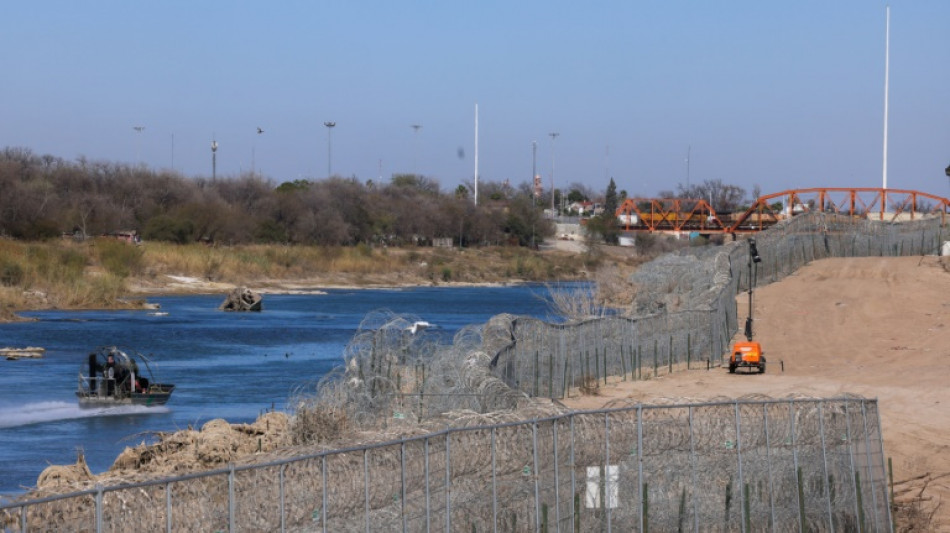
Mexico's water debt to the United States under a decades-old supply treaty has opened a new battlefront between the two countries, in addition to US President Donald Trump's threatened tariffs.
Mexico's shortfalls, which it blames on an extraordinary drought, led the United States to refuse its neighbor's request for special delivery of water to the border city of Tijuana last week.
- What's the deal? -
Under a pact dating back to 1944, the neighboring countries share water from two major rivers flowing from the southwestern United States to Mexico.
The agreement obliges the United States to deliver 1.85 billion cubic meters of water a year from the Colorado River.
In return Mexico must supply an average of 432 million cubic meters annually over a five-year cycle from the Rio Grande, which forms part of the border between the two countries.
The current cycle expires in October and Mexico owes the United States more than 1.55 billion cubic meters, according to the two countries' boundary and water commission.
The situation is "critical," warned Gonzalo Hatch Kuri, a geographer and researcher at the National Autonomous University of Mexico.
"Only massive storms during the upcoming rainy season of August and September could, miraculously, make it possible to meet the deadline," he told AFP.
- What does US say? -
Washington said on March 20 that it was the first time it had rejected a request by Mexico for special delivery of water.
It said the Mexican delivery shortfalls were "decimating American agriculture -- particularly farmers in the Rio Grande valley."
US farmers and lawmakers complain that their southern neighbor has waited until the end of each cycle and has been coming up short in the latest period.
The Colorado River has seen its water levels shrink due to drought and heavy agricultural consumption in the southwestern United States, with around half of its water going to raise beef and dairy cattle.
Farmers in southern Texas have voiced fear for the future of cotton, citrus and other farming products.
The row has added to the tensions sparked by Trump's threat to impose tariffs on imports from Mexico, despite a North American free trade deal that also includes Canada.
- Why is Mexico falling short? -
The Mexican government says that the Rio Grande basin has suffered from two decades of drought that reached extreme levels in 2023.
Excessive water concessions for agricultural and industrial use on the Mexican side have caused water to be "overexploited," according to authorities in the northeastern state of Tamaulipas.
In November, the two countries signed an agreement aimed at preventing water shortages in parched southern US states with more reliable Mexican deliveries of river water.
The accord -- the result of more than 18 months of negotiations -- provides Mexico with "tools and flexibility" to provide water earlier in a five-year cycle to reduce or prevent shortfalls, the boundary and water commission said.
Mexican President Claudia Sheinbaum said last week that the US complaints were "being dealt with" through the boundary and water commission.
"There's been less water. That's part of the problem," she told reporters.
Mexico's attempts to comply with the treaty have resulted in civil unrest in the past.
In 2020, farmers in the northern state of Chihuahua seized a dam to prevent the government from supplying water from a reservoir to the United States, leading to clashes between protesters and the National Guard that left one person dead.
L.Torres--PC