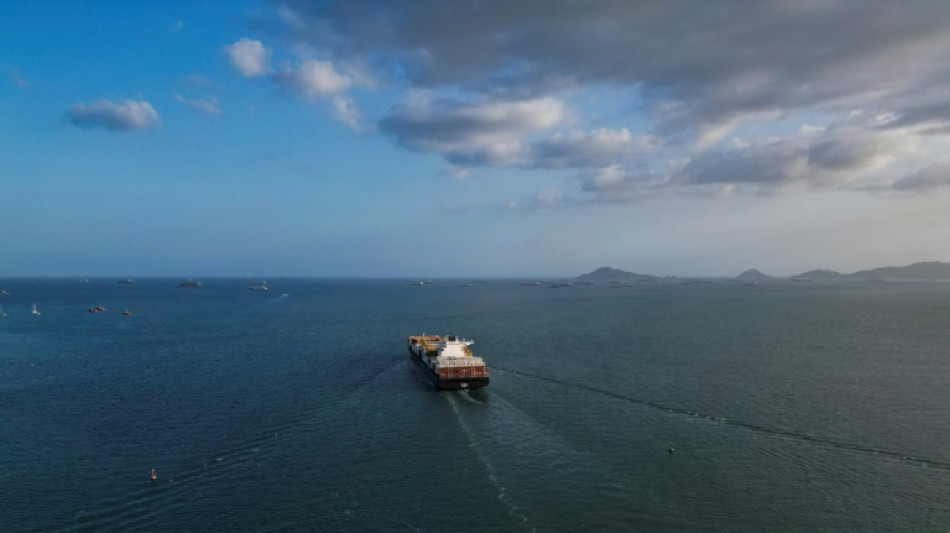
Nations divided ahead of decisive week for shipping emissions / Photo: MARTIN BERNETTI - AFP

 Ed Sheeran returns to stage after Palestinian controversy

 Asian Games to open in Japan after troubled build-up

 Drone owners rush to offload devices ahead of Beijing ban

 Trump's beef policies irk Texas ranchers, testing their loyalty

 Nvidia, OpenAI CEOs to attend Xi dinner at White House

 Anthropic picks Accenture for in-house AI safety evaluation

 Balogun returns as Monaco beat Lens to continue strong Ligue 1 start

 'Pause' on overt repression in Venezuela, but reforms still needed: HRW

 Global stocks mixed as yen falls despite Bank of Japan rate hike

 Cuba hit with seventh major blackout of the year

 Murray out with concussion so Wentz will start for Vikings

 UN chief 'deeply regrets' US visa refusal to Abbas for annual meeting

 England quick Carse to face no charges over alleged nightclub assault

 Mancini brings nine newcomers into the first squad of his Italy comeback

 Czechs level Davis Cup tie against USA as South Korea eye Finals

 New France boss Zidane confirms Mbappe as captain after naming first squad

 California governor signs order to explore AI 'kill switch'

 Head leads run spree as Australia win Zimbabwe ODI series

 In-form Raphinha wants to finish career at Barcelona

 Warren Buffett steps down as Berkshire Hathaway chairman

 Carrick confident Man Utd can 'work through' tough time

 Mbappe ends Nike partnership to join Swiss brand On

 Liverpool boss Iraola puts Bournemouth love affair on hold

 'A disaster' if Man City do not win says Maresca after flawless start

 Kerry James Marshall: American 'blackness' painter celebrated in Europe

Members of the International Maritime Organization (IMO) are divided over whether to approve a carbon tax on international shipping, ahead of a meeting starting on Monday to finalise emissions-reduction measures.
The carbon tax, the most ambitious measure on the table, would make it more expensive for shipping companies to emit greenhouse gases, encouraging them to curtail emissions.
But some member states, including China and Brazil, are proposing other measures, arguing the carbon levy would increase the cost of goods and contribute to food insecurity.
The IMO expects to come to an initial agreement by Friday next week on which mechanism to adopt to help reach carbon neutrality in shipping by 2050.
The stakes are high as shipping accounts for nearly three percent of global greenhouse gas emissions, according to the IMO.
"(It is) difficult to say what will happen next week," Fanny Pointet, sustainable shipping manager at European advocacy group, Transport and Environment, told AFP.
The United States has been notably quiet about the issue, having not commented since President Donald Trump returned to the White House.
The Pacific and Caribbean island states are leading the group pushing for a carbon tax, with support from other countries including the UK.
They argue that funds raised from a levy could be redistributed to nations most vulnerable to climate change to help adapt and mitigate its effects.
"Climate change is a terrifying lived reality for my country," said Albon Ishoda, the Marshall Islands' representative to the IMO.
- 'Terrifying lived reality' -
However, around 15 countries strongly oppose the carbon levy, arguing it would exacerbate inequalities between nations and raise the costs of goods such as palm oil, cereals and corn.
Concerns are also mounting that the European Union, once a supporter of a carbon tax, could water down the measure in favour of a carbon credit system.
Such a system would allow companies or countries to buy and sell credits representing the right to emit a certain amount of carbon dioxide.
According to University College London research, the option of no levy presents the biggest risk to meeting the shipping sector's climate goals.
It could also distort fuel prices and create an uneven playing field, favouring states with strong industrial polices, such as China, researchers said.
"The fastest and cheapest energy transition is brought about by a strong levy," combined with a global fuel standard to reduce the carbon intensity of fuels used by ships, they added.
Challenges also remain with the fuel standard system, particularly the risk of using alternative fuels such as palm oil and soybean oil, which indirectly contribute to emissions through deforestation, Pointet explained.
While Brazil defends the key role of these biofuels, more than 60 environmental protection NGOs have raised objections to their inclusion in the future shipping fuel mix.
Other potential solutions include synthetic hydrogen-based fuels, currently very expensive to produce, or the installation of wind-powered propulsion systems onboard ship.
S.Pimentel--PC