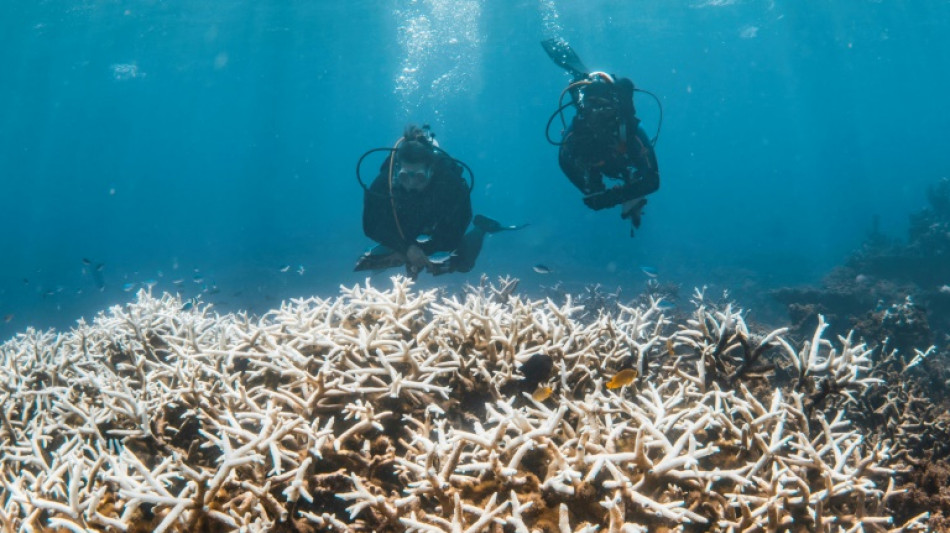
Coral reefs pushed to brink as bleaching crisis worsens / Photo: Violeta J Brosig - Minderoo Foundation/AFP

 Ed Sheeran returns to stage after Palestinian controversy

 Asian Games to open in Japan after troubled build-up

 Drone owners rush to offload devices ahead of Beijing ban

 Trump's beef policies irk Texas ranchers, testing their loyalty

 Nvidia, OpenAI CEOs to attend Xi dinner at White House

 Anthropic picks Accenture for in-house AI safety evaluation

 Balogun returns as Monaco beat Lens to continue strong Ligue 1 start

 'Pause' on overt repression in Venezuela, but reforms still needed: HRW

 Global stocks mixed as yen falls despite Bank of Japan rate hike

 Cuba hit with seventh major blackout of the year

 Murray out with concussion so Wentz will start for Vikings

 UN chief 'deeply regrets' US visa refusal to Abbas for annual meeting

 England quick Carse to face no charges over alleged nightclub assault

 Mancini brings nine newcomers into the first squad of his Italy comeback

 Czechs level Davis Cup tie against USA as South Korea eye Finals

 New France boss Zidane confirms Mbappe as captain after naming first squad

 California governor signs order to explore AI 'kill switch'

 Head leads run spree as Australia win Zimbabwe ODI series

 In-form Raphinha wants to finish career at Barcelona

 Warren Buffett steps down as Berkshire Hathaway chairman

 Carrick confident Man Utd can 'work through' tough time

 Mbappe ends Nike partnership to join Swiss brand On

 Liverpool boss Iraola puts Bournemouth love affair on hold

 'A disaster' if Man City do not win says Maresca after flawless start

 Kerry James Marshall: American 'blackness' painter celebrated in Europe

An unprecedented coral bleaching episode has spread to 84 percent of the world's reefs in an unfolding human-caused crisis that could kill off swathes of the essential ecosystems, scientists warned Wednesday.
Since it began in early 2023, the global coral bleaching event has mushroomed into the biggest and most intense on record, with reefs across the Pacific, Indian and Atlantic oceans affected.
Coral turns ghostly white under heat stress and the world's oceans have warmed over the last two years to historic highs, driven by humanity's release of planet-warming greenhouse gases.
Reefs can rebound from the trauma but scientists told AFP the window for recovery was getting shorter as ocean temperatures remained higher for longer.
Conditions in some regions were extreme enough to "lead to multi-species or near complete mortality on a coral reef", said the US National Oceanic and Atmospheric Administration (NOAA).
This latest episode was so severe and lasting that even more resilient coral was succumbing, said Melanie McField from the Healthy Reefs for Healthy People initiative, which specialises in the Caribbean.
"If you continue to have heatwave after heatwave, it's hard to see how that recovery is going to happen," the veteran reef scientist told AFP from Florida.
Bleaching occurs when coral expels algae that provides not just their characteristic colour but food and nutrients, leaving them exposed to disease and possibly eventually death.
Live coral cover has halved since the 1950s due to climate change and environmental damage, the International Coral Reef Initiative, a global conservation partnership, said in a statement Wednesday.
Scientists forecast that at 1.5C of warming, some 70 to 90 percent of the world's coral reefs could disappear -- a disastrous prospect for people and the planet.
Coral reefs support not just marine life but hundreds of millions of people living in coastal communities around the world by providing food, protection from storms, and liveloods through fishing and tourism.
- Coral crisis -
Mass coral bleaching was first observed in the early 1980s and is one of the best known and most visible consequences of steadily rising ocean temperatures caused by global warming.
The latest coral bleaching event is the fourth and largest yet, and the second in a decade, exceeding the record area affected during the last episode of 2014-2017.
"From 1 January 2023 to 20 April 2025, bleaching-level heat stress has impacted 83.7 percent of the world's coral reef area", NOAA said in its latest update on Monday.
Oceans store 90 percent of the excess heat caused by humanity's burning of fossil fuels, causing warmer sea temperatures, which are the leading cause of coral bleaching.
"The link between fossil fuel emissions and coral mortality is direct and undeniable," said Alex Sen Gupta, a climate scientist at the University of New South Wales in Australia.
To accurately accommodate the increased risk of mass coral death due to this event, NOAA was forced to add three new levels to a widely used bleaching alert scale.
"It's the coral reef equivalent of adding Category 6 and 7 to the tropical cyclone scale," said Sen Gupta.
- 'Mass mortalities' -
McField said in September 2023, an iconic reef off Honduras was suffering bleaching but still boasted 46 percent average living coral coverage.
"By February 2024, all of that died, and it was down to five percent living coral... We never saw that before, these mass mortalities," McField said.
The planet has already warmed at least 1.36 degrees Celsius above pre-industrial times, says the EU's climate monitor Copernicus.
Scientists predict the 1.5C threshold could be crossed early in the next decade.
At 2C almost all corals would disappear.
If the current climate policies of all governments were implemented in full, the world could warm by up to 3.1C by 2100.
A.Magalhes--PC


