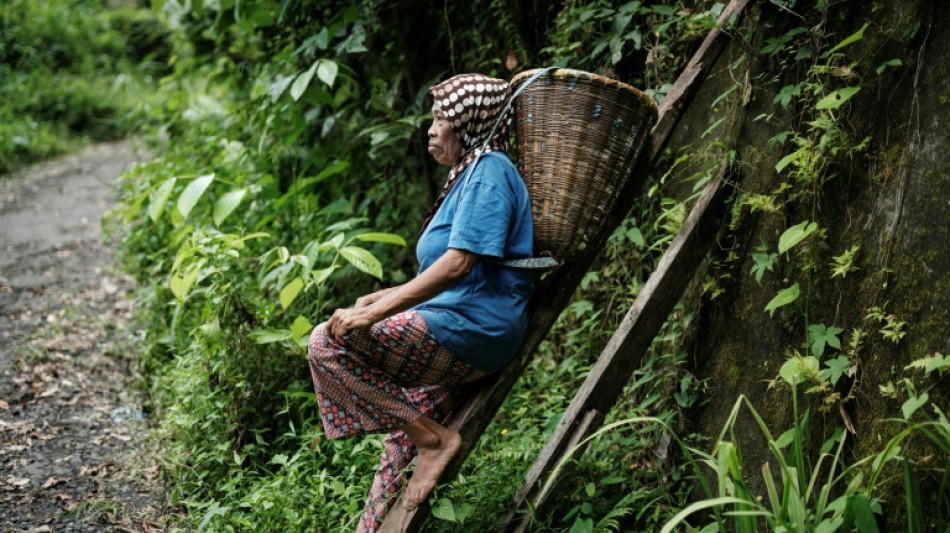
Climate change takes spice from Indonesia clove farms / Photo: Yasuyoshi CHIBA - AFP

 Ed Sheeran returns to stage after Palestinian controversy

 Asian Games to open in Japan after troubled build-up

 Drone owners rush to offload devices ahead of Beijing ban

 Trump's beef policies irk Texas ranchers, testing their loyalty

 Nvidia, OpenAI CEOs to attend Xi dinner at White House

 Anthropic picks Accenture for in-house AI safety evaluation

 Balogun returns as Monaco beat Lens to continue strong Ligue 1 start

 'Pause' on overt repression in Venezuela, but reforms still needed: HRW

 Global stocks mixed as yen falls despite Bank of Japan rate hike

 Cuba hit with seventh major blackout of the year

 Murray out with concussion so Wentz will start for Vikings

 UN chief 'deeply regrets' US visa refusal to Abbas for annual meeting

 England quick Carse to face no charges over alleged nightclub assault

 Mancini brings nine newcomers into the first squad of his Italy comeback

 Czechs level Davis Cup tie against USA as South Korea eye Finals

 New France boss Zidane confirms Mbappe as captain after naming first squad

 California governor signs order to explore AI 'kill switch'

 Head leads run spree as Australia win Zimbabwe ODI series

 In-form Raphinha wants to finish career at Barcelona

 Warren Buffett steps down as Berkshire Hathaway chairman

 Carrick confident Man Utd can 'work through' tough time

 Mbappe ends Nike partnership to join Swiss brand On

 Liverpool boss Iraola puts Bournemouth love affair on hold

 'A disaster' if Man City do not win says Maresca after flawless start

 Kerry James Marshall: American 'blackness' painter celebrated in Europe

Colonial powers once sought to wipe out cloves grown by locals on the eastern Indonesian island of Ternate to safeguard their monopoly over the prized crop. Today farmers say the gravest threat to their plants is climate change.
"Today... rainfall is high. It's okay for planting, but it's uncertain for harvesting. It's often unpredictable," farmer Jauhar Mahmud, 61, told AFP.
Nestled on the fertile foothills of Indonesia's Mount Gamalama volcano, Jauhar proudly shows off his favourite clove tree, which once reliably delivered profitable produce.
The fragrant flower buds that form the spice can only deliver their prized smell and taste in specific temperature and humidity ranges.
In a good season, the best of Jauhar's 150 towering trunks can spurt 30 kilogrammes of the aromatic spice used for medicine, perfumes, cigarettes and food flavourings.
But bad weather is becoming more frequent, causing uncertainty that makes prices fluctuate from $5.30 to $7.40 per kilogramme and life increasingly tough for farmers.
Food and Agriculture Organisation data from the past two decades shows Indonesia's clove yields vary significantly, more than rival producers. The yield in 2023, the last year data is available, was almost a quarter lower than a 2010 peak.
"We're actually losing money. Cloves do not bear fruit every year. They depend on the season," said Jauhar, who represents 36 clove farmers on the island.
Many are taking on other jobs as yields that typically arrive in August and September dwindle.
Jauhar sells spice-infused drinks and bamboo on the side to make ends meet, and some are considering abandoning the crop altogether.
"Farmers are now reluctant to harvest because of the high cost and minimal return," he said.
Indonesia accounts for more than two-thirds of global clove production, according to the FAO, though the majority is consumed domestically.
Since 2020, it has fallen behind Madagascar as the world's top exporter of the spice, World Bank trade data shows.
- Rainfall rise -
Centuries ago, Ternate's farmers defied colonial orders to eradicate their clove production by planting out of sight of the Dutch.
The island's then-favourable climate kept the crop alive.
Clove trees can take more than a decade to mature, and flowers can only be harvested in a small window that depends heavily on weather conditions.
But climate change caused mainly by burning fossil fuels like coal has changed global weather patterns.
Ternate is drier overall, but when rain does come, it is often in intense, damaging bursts.
That is consistent with broader trends linked to climate change. A warmer atmosphere holds more moisture, and rain can fall erratically and in large amounts when it comes.
Farmers like Lakina, who owns 10 clove trees, say the crop no longer offers the same returns.
"In the past, I could get five to six sacks in one harvest," said the 52-year-old. Now she fills two to three sacks, she said.
The changing weather affects other aspects of the trade.
Imba, a 62-year-old clove farmer with 70 trees, says it used to take three-and-a-half days to dry the cloves, but "because of the rain" it now takes at least five days.
Scientific research bears out the farmers' observations.
In 2023, researchers at Indonesia's University of Pattimura found clove yields were falling on Haruku island south of Ternate.
They said rainfall increased 15 percent in recent decades, along with extreme weather events that harm crops.
It has left clove farmers struggling.
"Communities living in coastal areas and small islands are especially vulnerable," said Arie Rompas, Greenpeace's forest campaign team leader.
"The productivity of their precious clove and nutmeg trees is dropping, and they are facing post-harvest problems with increased heat and humidity."
- 'Pride to future generations' -
At a spice sorting shop, the pungent warm smell of clove fills the air as workers scoop a pile into bags for weighing.
The men send them off to a warehouse where a mechanical sorting tray shakes the cloves, removing dirt and unwanted foliage before export to China.
For these clove sellers, climate change means lower quality and falling prices.
"If it's too hot, the crop is no good. Too much rain, no crop. This year there was too much rain," said supplier Rumen The.
He says prices almost halved from the start of last year from 150,000 rupiah per kilogramme to 80,000 in the harvest season, but were back up to 115,000 today as supply dwindled.
Production "is probably 30 to 40 percent" down on recent years, he added.
Jauhur urges rich spice-importing countries "to think about global climate issues" that threaten its future.
Despite the challenges, he says there are powerful "historical and emotional reasons" to continue farming.
"Our parents maintained cloves in clove's oldest region in the world," he said.
"They planted... to bring pride to future generations."
L.Torres--PC