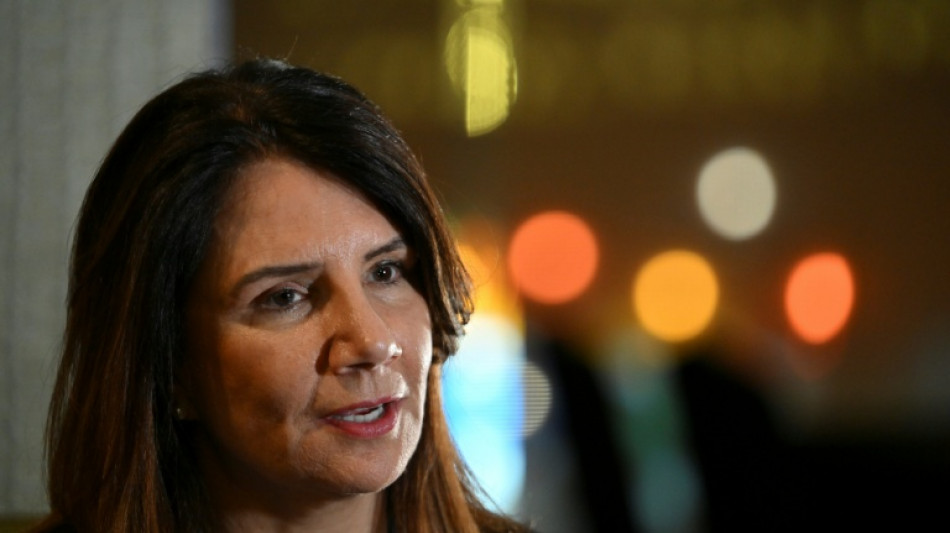
Tariff wars will hamper climate efforts: COP30 CEO / Photo: MARTIN BERNETTI - AFP

 Ed Sheeran returns to stage after Palestinian controversy

 Asian Games to open in Japan after troubled build-up

 Drone owners rush to offload devices ahead of Beijing ban

 Trump's beef policies irk Texas ranchers, testing their loyalty

 Nvidia, OpenAI CEOs to attend Xi dinner at White House

 Anthropic picks Accenture for in-house AI safety evaluation

 Balogun returns as Monaco beat Lens to continue strong Ligue 1 start

 'Pause' on overt repression in Venezuela, but reforms still needed: HRW

 Global stocks mixed as yen falls despite Bank of Japan rate hike

 Cuba hit with seventh major blackout of the year

 Murray out with concussion so Wentz will start for Vikings

 UN chief 'deeply regrets' US visa refusal to Abbas for annual meeting

 England quick Carse to face no charges over alleged nightclub assault

 Mancini brings nine newcomers into the first squad of his Italy comeback

 Czechs level Davis Cup tie against USA as South Korea eye Finals

 New France boss Zidane confirms Mbappe as captain after naming first squad

 California governor signs order to explore AI 'kill switch'

 Head leads run spree as Australia win Zimbabwe ODI series

 In-form Raphinha wants to finish career at Barcelona

 Warren Buffett steps down as Berkshire Hathaway chairman

 Carrick confident Man Utd can 'work through' tough time

 Mbappe ends Nike partnership to join Swiss brand On

 Liverpool boss Iraola puts Bournemouth love affair on hold

 'A disaster' if Man City do not win says Maresca after flawless start

 Kerry James Marshall: American 'blackness' painter celebrated in Europe

Tariff wars will hinder trade in green technologies such as solar panels and electric vehicles, and hamper the fight against climate change, says Ana Toni, CEO of the UN's COP30 climate conference.
COP30 will be held in November in the Amazonian city of Belem in Brazil, where Toni serves as national secretary for climate change.
She spoke to AFP at a pre-COP meeting of Latin American countries in Panama City. Here are excerpts from her interview, edited for length and clarity:
Q: Will the tariff standoff sparked by US President Donald Trump's imposition of higher import duties harm the fight against climate change?
A: Trade is a very important economic instrument and we need to use trade to help countries to mitigate or to adapt as quickly as possible (to the effects of climate change).
Many of our electric buses (in Latin America) are coming from China or other continents, so that is the good, low-carbon (technology) that we needed to foster and to support.
Q: What does it mean for the world that Trump plans to withdraw the United States from the 2015 Paris climate agreement?
A: The American people are not safer because their president has decided to leave the Paris agreement. Latin Americans are not safer because President Trump has done what he has done. We saw what happened in Los Angeles -- that fire that destroyed so many houses, we can see now what they are going through.
I think they (the US administration) will regret (it) but let us work with the American institutions and the people in the US that want to continue the action on climate change.
Climate change is a war... every day people are dying from overheating, from drought, from floods.
The molecules of carbon do not have a passport. They don't understand our geopolitical differences. We cannot say this carbon came from Panama or Brazil or China.
If we don't do this together, in a multilateral setting... we are not going to be able to fight climate change.
Q: How can the region better adapt to the fallout from global warming?
A: Latin America is not waiting for the Western countries, or developed countries, to come and help us. Our leaders know we are a very vulnerable region.
So we have to do something -- both contributing to mitigation (curbing planet-warming emissions) and also working on adaptation (to effects that can no longer be avoided) because many countries are already suffering.
For all countries in Latin America we appreciate and know that only by taking a multilateral approach... we will be able to combat climate change.
Q: What are Latin American countries doing to curb carbon emissions?
A: Only five countries in Latin America now have communicated their new targets for 2035 -- the famous NDCs (Nationally Determined Contributions or climate action plans under the Paris Agreement).
So we are hoping that all Latin American countries will come to COP30 with their national contributions, to say that: "Latin America is conscious about their problems but is also part of the solution."
It is in this region that we have an abundance of natural resources, forests, renewable energy, so we are part of the solution but we need to get that new economy going to benefit the people and benefit the planet.
Q: What does Latin America need to make this happen?
A: Latin America is already leading in many areas. For example, in Brazil we are fighting deforestation (of the Amazon) along with other countries.
But it is true that we need support, especially financial, to see if we can go faster in terms of energy transition. The issue of funding will be a very important topic for us at COP30.
L.Torres--PC