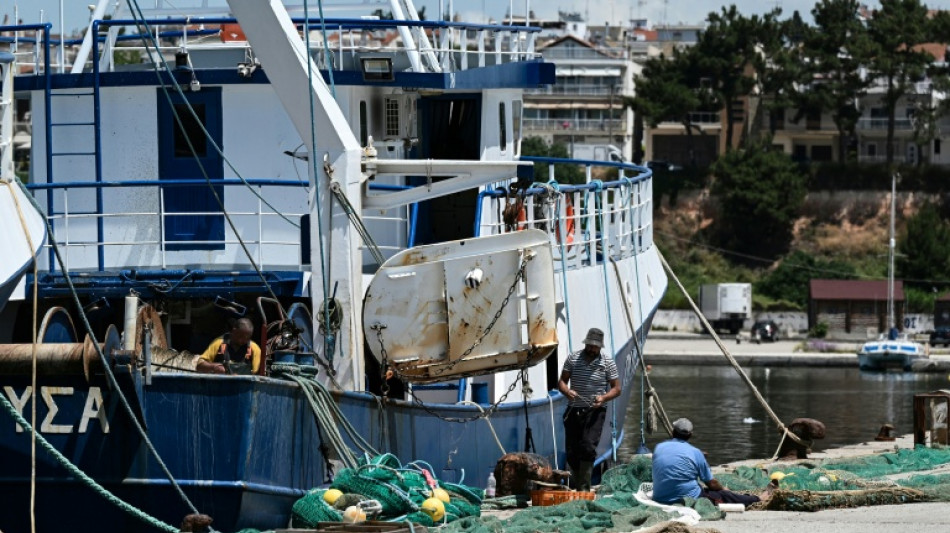
Coral-rich Greek archipelago hopes to gain from trawler ban / Photo: Sakis Mitrolidis - AFP

 Drone owners rush to offload devices ahead of Beijing ban

 Trump's beef policies irk Texas ranchers, testing their loyalty

 Nvidia, OpenAI CEOs to attend Xi dinner at White House

 Anthropic picks Accenture for in-house AI safety evaluation

 Balogun returns as Monaco beat Lens to continue strong Ligue 1 start

 'Pause' on overt repression in Venezuela, but reforms still needed: HRW

 Global stocks mixed as yen falls despite Bank of Japan rate hike

 Cuba hit with seventh major blackout of the year

 Murray out with concussion so Wentz will start for Vikings

 UN chief 'deeply regrets' US visa refusal to Abbas for annual meeting

 England quick Carse to face no charges over alleged nightclub assault

 Mancini brings nine newcomers into the first squad of his Italy comeback

 Czechs level Davis Cup tie against USA as South Korea eye Finals

 New France boss Zidane confirms Mbappe as captain after naming first squad

 California governor signs order to explore AI 'kill switch'

 Head leads run spree as Australia win Zimbabwe ODI series

 In-form Raphinha wants to finish career at Barcelona

 Warren Buffett steps down as Berkshire Hathaway chairman

 Carrick confident Man Utd can 'work through' tough time

 Mbappe ends Nike partnership to join Swiss brand On

 Liverpool boss Iraola puts Bournemouth love affair on hold

 'A disaster' if Man City do not win says Maresca after flawless start

 Kerry James Marshall: American 'blackness' painter celebrated in Europe

 Spain coach De la Fuente offers 'full support' to people of Ceuta

 Russia seizes assets of Nestle, French firms over West's Ukraine support

As a reddish dawn broke over the tiny, coral-rich Greek archipelago of Fournoi, Manolis Mytikas's wooden fishing boat slowly glided home, his nets almost empty.
The modest catch nevertheless quickly drew several islanders in search of fresh fish, a rarity in past years in this island chain in the northeastern Aegean Sea, which has fewer than 1,500 inhabitants in total.
"Today, there were two of us heading out to sea, and we caught some fish by chance," said the 76-year-old fisherman, his skin deeply tanned by the Mediterranean sun.
"Yesterday, we earned 30 euros ($34). The day before yesterday, not a penny. Sometimes, we don't even have enough to eat," he told AFP.
But things could be looking up for this small corner of the Aegean Sea.
Last month, the Greek government banned bottom trawling in the waters around the archipelago, to protect a recent discovery of exceptionally rich coral reefs.
Greece is also outlawing bottom trawling in national marine parks by 2026 and in all protected marine areas by 2030, the first country in Europe to take such a step.
Fishing is generally allowed in protected marine areas worldwide, often even by trawlers, which scrape the seabed with a huge funnel-shaped net.
"Finally!" Mytikas exclaimed when told of the ban. "They've ravaged the sea. They plough the seabed and destroy everything."
At the island port, his colleague Vaggelis Markakis, 58, compared trawlers to "bulldozers".
"If we stop them from coming here, our sea will come back to life," Mytikas said. "The sea will be filled with fish again."
Research conducted in this archipelago by the conservation groups Under the Pole, which organises diving expeditions in extreme environments, and Archipelagos, in collaboration with European scientific institutions, has highlighted the existence of major underwater animal populations.
At depths between 60 and 150 meters (around 200 to 500 feet), scientists have documented over 300 species living on the seabed under minimal light.
- 'Underwater forests' -
"What we discovered is beyond imagination -- vast coral reefs dating back thousands of years, still intact," gushed Anastasia Miliou, scientific director of Archipelagos.
The sea floor-dwelling species discovered include vibrantly red gorgonians (Paramuricea clavata) and black corals (Antipathella subpinnata).
"When these organisms occur at high densities, they form true underwater forests," said Lorenzo Bramanti, a researcher at the CNRS Laboratory of Ecogeochemistry of Benthic Environments.
But these habitats are extremely sensitive.
"A single trawl pass is enough to raze them," warned Stelios Katsanevakis, professor of oceanography at the University of the Aegean.
And the damage can be potentially irreversible, added Bramanti.
"Once destroyed, these forests may take decades or even centuries to recover," said the marine scientist, who has worked on corals in the Mediterranean, Caribbean and Pacific.
"No one doubts that cutting down a forest is an ecological disaster. The same is true for animal forests," Bramanti said.
- Setting an example -
By banning bottom trawling around Fournoi, Bramanti hopes Greece will set an example for other Mediterranean countries, he said.
"We must act quickly, because these are among the last ecosystems still untouched by climate change," given that they are located at depths greater than 70 meters, he said.
"And we risk losing them before we even truly understand them."
But the measure has left industrial fishing professionals fuming.
There are around 220 bottom trawlers in Greece, and sector representatives complain restrictions on their activity are excessive.
"We were not invited to any kind of discussion on this matter," said Kostas Daoultzis, head of the trawler cooperative at the northern port of Nea Michaniona, one of the country's main fish markets.
Daoultzis said the decisions were "based on reports from volunteer organisations... lacking scientific backing".
He said trawlers already avoid coral areas, which can damage their equipment.
Fournoi fishermen counter that trawlers do fish in their waters, but turn off their tracking systems to avoid detection.
Under pressure globally, trawling is likely to be on the agenda at a United Nations Ocean Conference next week in the French city of Nice.
Daoultzis said he fears for the survival of his profession.
"Our fishing spaces keep shrinking. Our activity is under threat, and consumers will suffer -- fish prices will skyrocket," he warned.
L.Henrique--PC