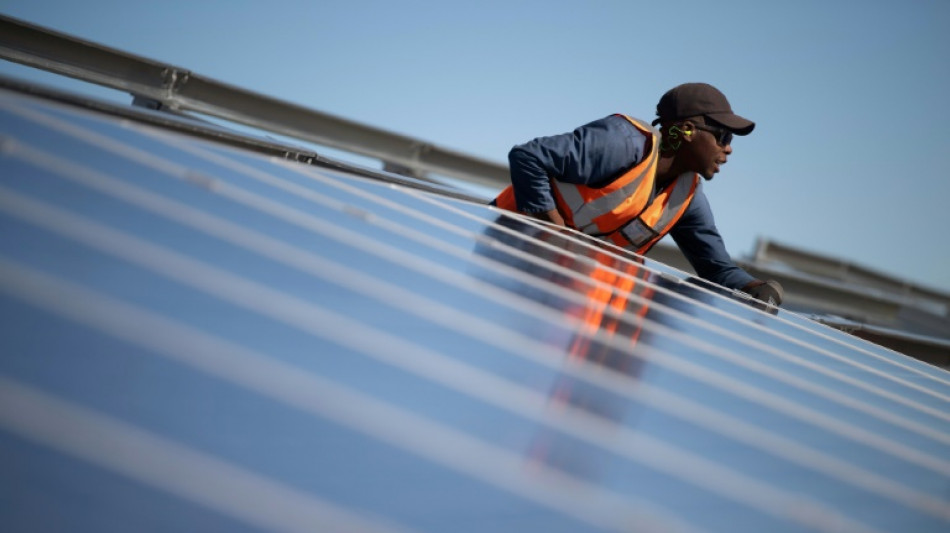
World Bank and IMF climate snub 'worrying': COP29 presidency / Photo: RODGER BOSCH - AFP/File

 Drone owners rush to offload devices ahead of Beijing ban

 Trump's beef policies irk Texas ranchers, testing their loyalty

 Nvidia, OpenAI CEOs to attend Xi dinner at White House

 Anthropic picks Accenture for in-house AI safety evaluation

 Balogun returns as Monaco beat Lens to continue strong Ligue 1 start

 'Pause' on overt repression in Venezuela, but reforms still needed: HRW

 Global stocks mixed as yen falls despite Bank of Japan rate hike

 Cuba hit with seventh major blackout of the year

 Murray out with concussion so Wentz will start for Vikings

 UN chief 'deeply regrets' US visa refusal to Abbas for annual meeting

 England quick Carse to face no charges over alleged nightclub assault

 Mancini brings nine newcomers into the first squad of his Italy comeback

 Czechs level Davis Cup tie against USA as South Korea eye Finals

 New France boss Zidane confirms Mbappe as captain after naming first squad

 California governor signs order to explore AI 'kill switch'

 Head leads run spree as Australia win Zimbabwe ODI series

 In-form Raphinha wants to finish career at Barcelona

 Warren Buffett steps down as Berkshire Hathaway chairman

 Carrick confident Man Utd can 'work through' tough time

 Mbappe ends Nike partnership to join Swiss brand On

 Liverpool boss Iraola puts Bournemouth love affair on hold

 'A disaster' if Man City do not win says Maresca after flawless start

 Kerry James Marshall: American 'blackness' painter celebrated in Europe

 Spain coach De la Fuente offers 'full support' to people of Ceuta

 Russia seizes assets of Nestle, French firms over West's Ukraine support

The hosts of the most recent UN climate talks are worried international lenders are retreating from their commitments to help boost funding for developing countries' response to global warming.
This anxiety has grown as the Trump administration has slashed foreign aid and discouraged US-based development lenders like the World Bank and the International Monetary Fund from focussing on climate finance.
Developing nations, excluding China, will need an estimated $1.3 trillion a year by 2035 in financial assistance to transition to renewable energy and climate-proof their economies from increasing weather extremes.
But nowhere near this amount has been committed.
At last year's UN COP29 summit in Azerbaijan, rich nations agreed to increase climate finance to $300 billion a year by 2035, an amount decried as woefully inadequate.
Azerbaijan and Brazil, which is hosting this year's COP30 conference, have launched an initiative to plug the shortfall that includes expectations of "significant" contributions from international lenders.
But so far only two -- the African Development Bank and the Inter-American Development Bank -- have responded to a call to engage the initiative with ideas, said COP29 president Mukhtar Babayev.
"We call on their shareholders to urgently help us to address these concerns," he told climate negotiators at a high-level summit in the German city of Bonn this week.
"We fear that a complex and volatile global environment is distracting" many of those expected to play a big role in bridging the climate finance gap, he added.
His team travelled to Washington in April for the IMF and World Bank's spring meetings hoping to find the same enthusiasm for climate lending they had encountered a year earlier.
But instead they found institutions "very much reluctant now to talk about climate at all", said Azerbaijan's top climate negotiator Yalchin Rafiyev.
This was a "worrisome trend", he said, given expectations these lenders would extend the finance needed in the absence of other sources.
"They're very much needed," he said.
The United States, the World Bank's biggest shareholder, has sent a different message.
On the sidelines of the April spring meetings, US Treasury Secretary Scott Bessent urged the bank to focus on "dependable technologies" rather than "distortionary climate finance targets."
This could mean investing in gas and other fossil fuel-based energy production, he said.
- Money matters -
Under the Paris Agreement, wealthy developed countries -- those most responsible for global warming to date -- are obligated to pay climate finance to poorer nations.
But other countries, most notably China, do make their own voluntary contributions.
Finance is a source of long-running tensions at UN climate negotiations.
Donors have consistently failed to deliver on past finance pledges, and committed well below what experts agree developing nations need to prepare for the climate crisis.
The issue flared again this week in Bonn, with nations at odds over whether to debate financial commitments from rich countries during the formal meetings.
European nations have also pared back their foreign aid spending in recent months, raising fears that budgets for climate finance could also face a haircut.
At COP29, multilateral development banks (MDBs) led by the World Bank Group estimated they could provide $120 billion annually in climate financing to low and middle income countries, and mobilise another $65 billion from the private sector by 2030.
Their estimate for high income countries was $50 billion, with another $65 billion mobilised from the private sector.
Rob Moore, of policy think tank E3G, said these lenders are the largest providers of international public finance to developing countries.
"Whilst they are facing difficult political headwinds in some quarters, they would be doing both themselves and their clients a disservice by disengaging on climate change," he said.
The World Bank in particular has done "a huge amount of work" to align its lending with global climate goals.
"If they choose to step back this would be at their own detriment, and other banks like the regionally based MDBs would likely play a bigger role in shaping the economy of the future," he said.
The World Bank did not immediately respond to a request for comment.
F.Ferraz--PC


