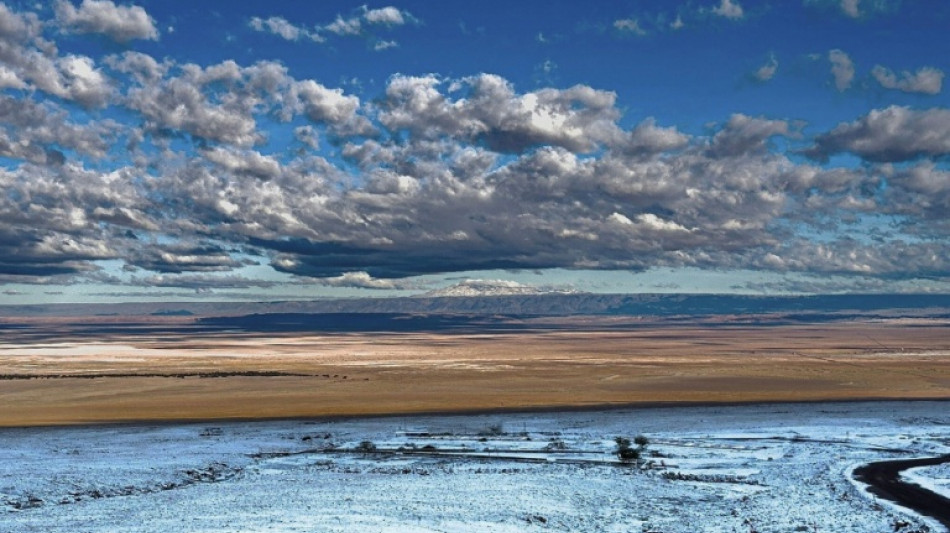
Snow cloaks Atacama, the world's driest desert / Photo: F. BESSER - ALMA/AFP

 Drone owners rush to offload devices ahead of Beijing ban

 Trump's beef policies irk Texas ranchers, testing their loyalty

 Nvidia, OpenAI CEOs to attend Xi dinner at White House

 Anthropic picks Accenture for in-house AI safety evaluation

 Balogun returns as Monaco beat Lens to continue strong Ligue 1 start

 'Pause' on overt repression in Venezuela, but reforms still needed: HRW

 Global stocks mixed as yen falls despite Bank of Japan rate hike

 Cuba hit with seventh major blackout of the year

 Murray out with concussion so Wentz will start for Vikings

 UN chief 'deeply regrets' US visa refusal to Abbas for annual meeting

 England quick Carse to face no charges over alleged nightclub assault

 Mancini brings nine newcomers into the first squad of his Italy comeback

 Czechs level Davis Cup tie against USA as South Korea eye Finals

 New France boss Zidane confirms Mbappe as captain after naming first squad

 California governor signs order to explore AI 'kill switch'

 Head leads run spree as Australia win Zimbabwe ODI series

 In-form Raphinha wants to finish career at Barcelona

 Warren Buffett steps down as Berkshire Hathaway chairman

 Carrick confident Man Utd can 'work through' tough time

 Mbappe ends Nike partnership to join Swiss brand On

 Liverpool boss Iraola puts Bournemouth love affair on hold

 'A disaster' if Man City do not win says Maresca after flawless start

 Kerry James Marshall: American 'blackness' painter celebrated in Europe

 Spain coach De la Fuente offers 'full support' to people of Ceuta

 Russia seizes assets of Nestle, French firms over West's Ukraine support

Residents of the world's driest desert, the Atacama in northern Chile, woke up Thursday to a jaw-dropping spectacle: its famous lunar landscape blanketed in snow.
"INCREDIBLE! The Atacama Desert, the world's most arid, is COVERED IN SNOW," the ALMA observatory, situated 2,900 meters (9,500 feet) above sea level, wrote on X, alongside a video of vast expanses covered in a dusting of white.
The observatory added that while snow is common on the nearby Chajnanator Plateau, situated at over 5,000 meters and where its gigantic telescope is situated, it had not had snow at its main facility in a decade.
University of Santiago climatologist Raul Cordero told AFP that it was too soon to link the snow to climate change but said that climate modelling had shown that "this type of event, meaning precipitation in the Atacama desert, will likely become more frequent."
The Atacama, home to the world's darkest skies, has for decades been the go-to location for the world's most advanced telescopes.
The ALMA telescope, which was developed by the European Southern Observatory, the US National Radio Astronomy Observatory and the National Astronomical Observatory of Japan, is widely recognized as being the most powerful.
A.F.Rosado--PC