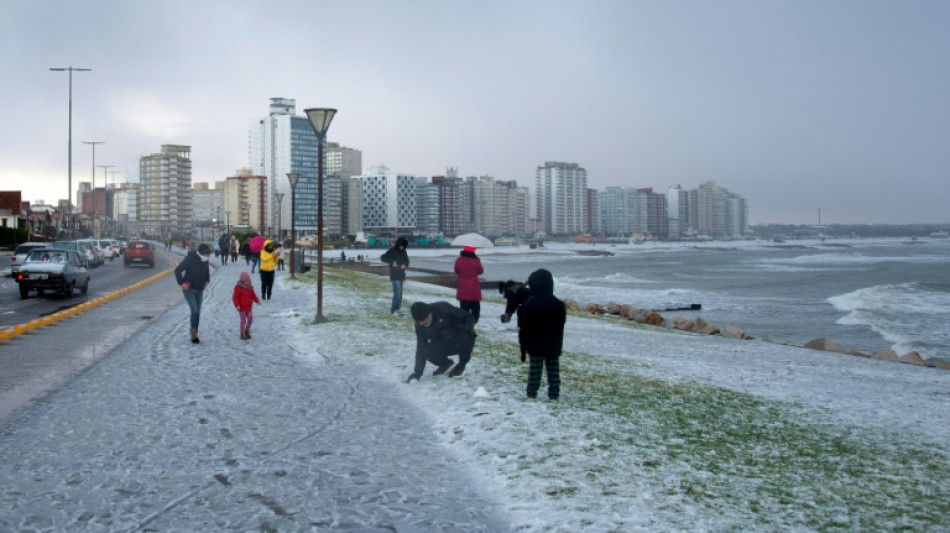
Record cold grips Argentina, Chile and Uruguay / Photo: SEBASTIAN LOSADA - AFP

 Drone owners rush to offload devices ahead of Beijing ban

 Trump's beef policies irk Texas ranchers, testing their loyalty

 Nvidia, OpenAI CEOs to attend Xi dinner at White House

 Anthropic picks Accenture for in-house AI safety evaluation

 Balogun returns as Monaco beat Lens to continue strong Ligue 1 start

 'Pause' on overt repression in Venezuela, but reforms still needed: HRW

 Global stocks mixed as yen falls despite Bank of Japan rate hike

 Cuba hit with seventh major blackout of the year

 Murray out with concussion so Wentz will start for Vikings

 UN chief 'deeply regrets' US visa refusal to Abbas for annual meeting

 England quick Carse to face no charges over alleged nightclub assault

 Mancini brings nine newcomers into the first squad of his Italy comeback

 Czechs level Davis Cup tie against USA as South Korea eye Finals

 New France boss Zidane confirms Mbappe as captain after naming first squad

 California governor signs order to explore AI 'kill switch'

 Head leads run spree as Australia win Zimbabwe ODI series

 In-form Raphinha wants to finish career at Barcelona

 Warren Buffett steps down as Berkshire Hathaway chairman

 Carrick confident Man Utd can 'work through' tough time

 Mbappe ends Nike partnership to join Swiss brand On

 Liverpool boss Iraola puts Bournemouth love affair on hold

 'A disaster' if Man City do not win says Maresca after flawless start

 Kerry James Marshall: American 'blackness' painter celebrated in Europe

 Spain coach De la Fuente offers 'full support' to people of Ceuta

 Russia seizes assets of Nestle, French firms over West's Ukraine support

A polar air mass has brought record low temperatures to Argentina, Chile and Uruguay, causing at least 15 deaths and forcing governments to restrict gas supplies and activate emergency shelters.
The three South American countries have all recorded sharply below-zero temperatures as the polar air originated from Antarctica and swept across the region.
In Argentina, at least nine homeless people have died from the cold this winter, according to NGO Proyecto 7.
The capital Buenos Aires recorded its lowest temperature since 1991 at -1.9 degrees Celcius (28.6 Fahrenheit) on Wednesday, while the coastal city of Miramar saw snow for the first time in 34 years. Further south, the town of Maquinchao recorded -18C on Tuesday.
Electricity demand caused cuts across Buenos Aires, leaving thousands without power for over 24 hours in some areas.
The government suspended gas supplies to industries and petrol stations Wednesday to ensure household supplies, and removed price controls on gas cylinders Thursday.
- Desert snow -
Uruguay declared a nationwide "red alert" after six people died, allowing President Yamandu Orsi's government to forcibly move homeless people to shelters.
Montevideo recorded its lowest maximum temperature since 1967 at 5.8C on June 30, according to meteorologist Mario Bidegain.
Chile also activated homeless shelter plans during the coldest days. The city of Chillan, 400 kilometers (250 miles) south of Santiago, hit -9.3C, according to the Chilean Meteorological Directorate.
"What happened this week in Chile and the Southern Cone in general is a cold wave caused by an escape of a polar air mass from Antarctica," climatologist Raul Cordero from the University of Santiago told AFP.
Snow even fell in parts of the Atacama Desert, the world's driest, for the first time in a decade.
"It is not so common for these cold air masses to extend so far north, so we cannot rule out that this is also caused by climate change," meteorologist Arnaldo Zuniga told AFP.
The region expects relief in the coming days, with Buenos Aires reaching 12C on Thursday, Montevideo 14C and Santiago 24.7C.
"I was quite surprised by the change from cold to hot -- the change was very drastic," student Dafne Naranjo, 18, said in Santiago.
Climatologist Cordero said heatwaves have become more frequent than cold spells in recent years.
"The frequency of heatwaves has tripled, whether in summer or winter, not only in the Southern Cone but throughout the world," he said.
E.Borba--PC