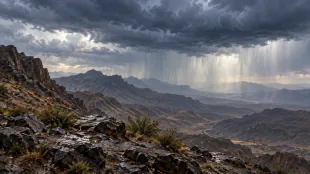
Heat melts Alps snow and glaciers, leaving water shortage / Photo: JEFF PACHOUD - AFP

 Drone owners rush to offload devices ahead of Beijing ban

 Trump's beef policies irk Texas ranchers, testing their loyalty

 Nvidia, OpenAI CEOs to attend Xi dinner at White House

 Anthropic picks Accenture for in-house AI safety evaluation

 Balogun returns as Monaco beat Lens to continue strong Ligue 1 start

 'Pause' on overt repression in Venezuela, but reforms still needed: HRW

 Global stocks mixed as yen falls despite Bank of Japan rate hike

 Cuba hit with seventh major blackout of the year

 Murray out with concussion so Wentz will start for Vikings

 UN chief 'deeply regrets' US visa refusal to Abbas for annual meeting

 England quick Carse to face no charges over alleged nightclub assault

 Mancini brings nine newcomers into the first squad of his Italy comeback

 Czechs level Davis Cup tie against USA as South Korea eye Finals

 New France boss Zidane confirms Mbappe as captain after naming first squad

 California governor signs order to explore AI 'kill switch'

 Head leads run spree as Australia win Zimbabwe ODI series

 In-form Raphinha wants to finish career at Barcelona

 Warren Buffett steps down as Berkshire Hathaway chairman

 Carrick confident Man Utd can 'work through' tough time

 Mbappe ends Nike partnership to join Swiss brand On

 Liverpool boss Iraola puts Bournemouth love affair on hold

 'A disaster' if Man City do not win says Maresca after flawless start

 Kerry James Marshall: American 'blackness' painter celebrated in Europe

 Spain coach De la Fuente offers 'full support' to people of Ceuta

 Russia seizes assets of Nestle, French firms over West's Ukraine support
June's heatwave has caused French Alps snow and glaciers to melt faster, causing water shortages at mountain shelters just before the summer tourist hiking season gets into full swing.
"Everything has dried up," said Noemie Dagan, who looks after the Selle refuge, located at an altitude of 2,673 meters (8,769 feet) in the Ecrins, a mountain range overtowered by two majestic peaks.
The snowfield that usually supplies water to her 60-bed chalet already "looks a bit like what we would expect at the end of July or early August", she said.
"We are nearly a month early in terms of the snow's melting."
The mountain refuge, lacking a water tank, relies on water streaming down from the mountain. If it runs out it, the shelter will have to close.
This happened in mid-August 2023, and could happen again.
Dagan's backup solutions to avoid such a scenario include plastic pipes a kilometre long (0.6 mile) -- installed with difficulty -- to collect water from a nearby glacier close to the Pic de la Grave.
But the slopes along which the pipe was laid are steep, unstable and vulnerable to increasingly violent storms ravaging the range.
In the 15 years that she has worked in the sector, Dagan has witnessed "a metamorphosis" of the mountains and glaciers that are "our watertowers", she said.
"We are basically the sentinels who have seen what is coming."
- 'Never even crossed our minds' -
Thomas Boillot, a local mountain guide, said the possibility one day of seeing water supply issues affecting the mountain shelters had "never even crossed our minds".
But such cases have increased "and there will likely be more," he added.
Some snowfields once considered eternal now melt in the summer, precipitation has become scarcer, and glaciers change shape as they melt -- factors that combine to disrupt the water supply for chalets.
Water used to arrive "through gravity" from snow and ice reserves higher up, but it is going to have to be pumped from below in the future, he said.
Scientists say that the impact of climate change is nearly twice as severe in the Alps as it is globally, warning that only remnants of today's glaciers are likely to exist by 2100 -- if they haven't disappeared altogether by then.
This year's weather is also dangerous for the 1,400 glaciers in neighbouring Switzerland, where the authorities report that accumulated snow and ice have melted five to six weeks before the usual time.
"Brutal" is the term Xavier Cailhol, an environmental science PhD student and mountain guide, used to describe the impact of the heatwave that he saw on a recent trip to the massif of the Mont Blanc, western Europe's highest mountain.
"I started ski-touring on Mont Blanc in June with 40 centimetres (16 inches) of powder snow. I ended up on glaciers that were completely bare, even as high up as the Midi Peak, at 3,700 meters altitude," he said.
A cover of snow helps to protect the ice underneath by reflecting sunlight, he noted.
"Above 3,200 meters, it's drier than anything we've seen before," he said. "It's quite concerning for the rest of the summer."
A case in point is the accelerated melting of the Bossons Glacier, a massive ice tongue overlooking the valley before Chamonix.
It began with a "patch of gravel" which became larger, and "in fact is speeding up the melting at that location" because its dark colour absorbs more heat.
The melting of the Bossons Glacier is clearly visible from Chamonix, making it a constant reminder of what is happening to glaciers everywhere.
"It's a symbol," said Cailhol.
A.Magalhes--PC