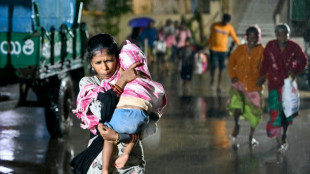
Pacific climate pioneer still fears for island nation's future / Photo: ANGELA WEISS - AFP

 Mutual fund returns show shifting leaders across market-cap categories
 BHEL wins Adani Power projects valued at up to ₹28,000 crore

 India seeks threefold increase in coal stocks to prevent summer power shortages

 Indian companies report mixed second-quarter results on November 4

 KKR secures Indian regulator approval for Gentari Renewables investment

 Bharti Airtel revenue expected to grow at double-digit pace in second quarter

 Indian crude-sensitive shares gain after 13% oil-price decline

 Stocks and dollar fall as Democratic election gains reshape markets

 Kuwait marks key events and anniversaries from national history

 Trump congratulates Democrats and signals willingness to cooperate

 Qatar prime minister advances mediation through diplomatic calls

 Greenland parliament approves security agreement with United States

 Qatar envoy meets incoming UN General Assembly president

 Trump Signals Willingness to Work With Democrats After Midterm Defeat

A founding father of the Pacific climate movement on Thursday welcomed an international court's decision on global warming but said he fears for the future of his almost 30 grandchildren on low-lying Kiribati.
Kiribati, a climate-threatened archipelago that is home to some 130,000 people, sits barely two metres (6.5 feet) above sea level, has little freshwater, no rivers and limited fertile land.
The International Court of Justice in The Hague declared Wednesday that states are obliged under international law to tackle climate change.
"There was a time when it really got me very depressed because of the realisation that there is not much that we can do about it," former Kiribati president Anote Tong, who led the remote nation for 12 years until 2016, told AFP.
"I've heard people about talking about climate grief, and perhaps that is what climate grief is all about: realising that you have no future, and understanding that my grandchildren, I've got a lot of grandchildren, I don't know what is going to happen to them."
"Previously, I spoke as a leader, now I speak as a grandfather on the climate issue."
Tong welcomed the "wonderful achievement" of the international court decision but warned it risked overshadowing the voices of those at the forefront of climate change.
"This is a human rights issue. It's not a legal issue," he said. "There is always a danger that we're not focusing on justice, but more on the legal aspects of the issue."
- 'How do we survive?' -
The UN's climate expert panel warned rising sea levels and coastal erosion could render some Pacific nations, including Kiribati, uninhabitable by 2060.
Tong, 73, said that during his lifetime, extreme weather events had increasingly destroyed crops and fresh water sources.
The climate leader said corals lie just off his property.
"I used to play with my kids when the tide was at its highest. Now, you can never do that because the waves are too strong," he said.
"That's definitely a change. The question is that, can our islands withstand the change?"
Tong said he feared a window of opportunity has passed.
He blamed the international community, including polluting countries and global bodies, which he said had "failed at every turn" to address climate change and ignored the plight of smaller island states.
"Our future is not assured," he said. "I've all but given up, but I can never afford to give up."
"We're still fighting the fight. The real question is: how do we survive? How do our grandchildren survive?"
P.Serra--PC