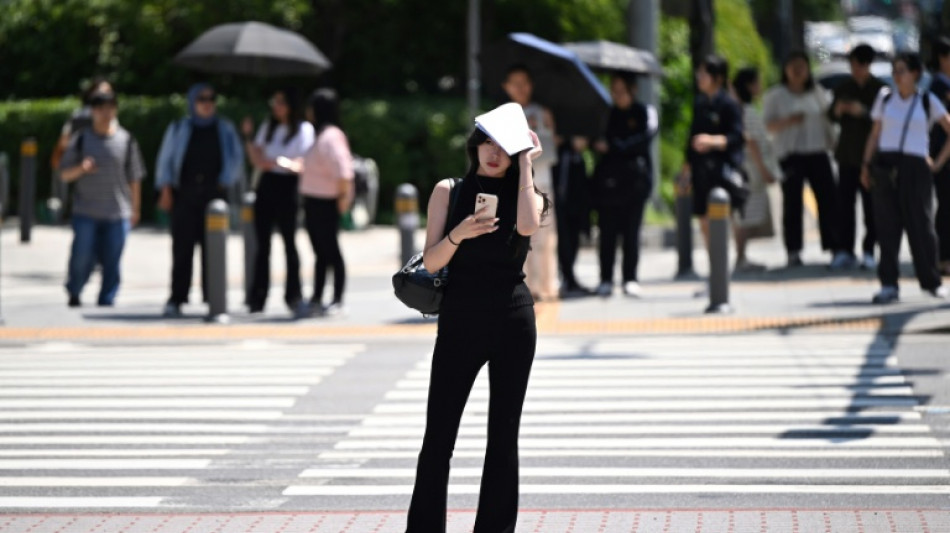
Seoul breaks century-long record with 22 'tropical nights' in July / Photo: Jung Yeon-je - AFP

 Drone owners rush to offload devices ahead of Beijing ban

 Trump's beef policies irk Texas ranchers, testing their loyalty

 Nvidia, OpenAI CEOs to attend Xi dinner at White House

 Anthropic picks Accenture for in-house AI safety evaluation

 Balogun returns as Monaco beat Lens to continue strong Ligue 1 start

 'Pause' on overt repression in Venezuela, but reforms still needed: HRW

 Global stocks mixed as yen falls despite Bank of Japan rate hike

 Cuba hit with seventh major blackout of the year

 Murray out with concussion so Wentz will start for Vikings

 UN chief 'deeply regrets' US visa refusal to Abbas for annual meeting

 England quick Carse to face no charges over alleged nightclub assault

 Mancini brings nine newcomers into the first squad of his Italy comeback

 Czechs level Davis Cup tie against USA as South Korea eye Finals

 New France boss Zidane confirms Mbappe as captain after naming first squad

 California governor signs order to explore AI 'kill switch'

 Head leads run spree as Australia win Zimbabwe ODI series

 In-form Raphinha wants to finish career at Barcelona

 Warren Buffett steps down as Berkshire Hathaway chairman

 Carrick confident Man Utd can 'work through' tough time

 Mbappe ends Nike partnership to join Swiss brand On

 Liverpool boss Iraola puts Bournemouth love affair on hold

 'A disaster' if Man City do not win says Maresca after flawless start

 Kerry James Marshall: American 'blackness' painter celebrated in Europe

 Spain coach De la Fuente offers 'full support' to people of Ceuta

 Russia seizes assets of Nestle, French firms over West's Ukraine support

A streak of super-hot tropical nights broke a century-old South Korean weather record, according to official data released Thursday, as the peninsula bakes in a prolonged heatwave.
Overnight temperatures in Seoul have sizzled above 25C for 22 consecutive days in July, officials said Thursday, marking the longest such streak for the month since modern weather records began in October 1907.
Such evenings are known as "tropical nights" in South Korea.
The capital was also on track to record its hottest July night in history on Wednesday, with the lowest temperature of the day reaching 29.3C -- unless overnight temperatures rise even higher on Thursday.
Much of the world is enduring a summer of sweltering weather, with June being the hottest month ever recorded for 12 countries, according to an AFP analysis of data from the European climate monitor Copernicus.
The intense heat in Seoul is expected to continue, according to the meteorology office.
"The warm air from the North Pacific High began affecting South Korea a bit earlier than usual," Youn Ki-han, director at Seoul's Meteorology Forecast Division, told AFP.
"As that influence gradually built up, the heat accumulated, much like interest compounding in a savings account, slowly increasing over time," said Youn.
"Normally, if it's hot for just a day, temperatures spike and then quickly return to normal. But when warm conditions persist for several days, the heat doesn't fully dissipate, it lingers and accumulates with each day," he added.
Thirteen people have died from suspected heat-related causes so far this year, triple the number from the same period last year, according to data from the Korea Disease Control and Prevention Agency.
Hundreds of thousands of livestock have also perished amid the extreme heat.
A.S.Diogo--PC