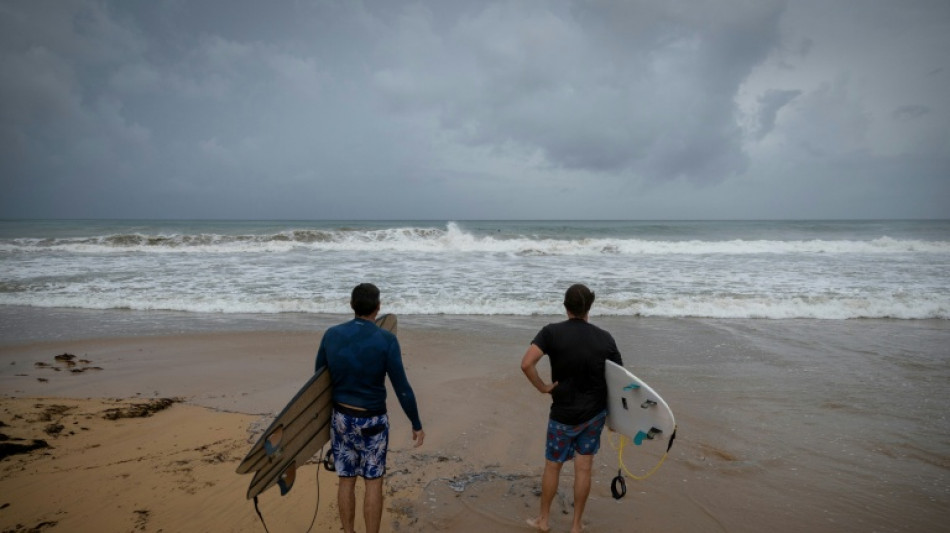
Downgraded Hurricane Erin lashes Caribbean with rain / Photo: Ricardo ARDUENGO - AFP

 Drone owners rush to offload devices ahead of Beijing ban

 Trump's beef policies irk Texas ranchers, testing their loyalty

 Nvidia, OpenAI CEOs to attend Xi dinner at White House

 Anthropic picks Accenture for in-house AI safety evaluation

 Balogun returns as Monaco beat Lens to continue strong Ligue 1 start

 'Pause' on overt repression in Venezuela, but reforms still needed: HRW

 Global stocks mixed as yen falls despite Bank of Japan rate hike

 Cuba hit with seventh major blackout of the year

 Murray out with concussion so Wentz will start for Vikings

 UN chief 'deeply regrets' US visa refusal to Abbas for annual meeting

 England quick Carse to face no charges over alleged nightclub assault

 Mancini brings nine newcomers into the first squad of his Italy comeback

 Czechs level Davis Cup tie against USA as South Korea eye Finals

 New France boss Zidane confirms Mbappe as captain after naming first squad

 California governor signs order to explore AI 'kill switch'

 Head leads run spree as Australia win Zimbabwe ODI series

 In-form Raphinha wants to finish career at Barcelona

 Warren Buffett steps down as Berkshire Hathaway chairman

 Carrick confident Man Utd can 'work through' tough time

 Mbappe ends Nike partnership to join Swiss brand On

 Liverpool boss Iraola puts Bournemouth love affair on hold

 'A disaster' if Man City do not win says Maresca after flawless start

 Kerry James Marshall: American 'blackness' painter celebrated in Europe

 Spain coach De la Fuente offers 'full support' to people of Ceuta

 Russia seizes assets of Nestle, French firms over West's Ukraine support

Offshore Hurricane Erin was downgraded to a Category 3 storm early Sunday, as rain lashed Caribbean islands and weather officials warned of possible flash floods and landslides.
The first hurricane of what is expected to be a particularly intense Atlantic season, Erin briefly strengthened into a "catastrophic" Category 5 storm before its windspeeds weakened.
It is expected to lash several Caribbean islands with heavy rain and strong winds but not make landfall.
Hurricane Erin was located about 140 miles (225 kilometers) north of San Juan, Puerto Rico, at 0600 GMT, when it was gauged as a Category 3 storm with maximum sustained winds of 125 miles (205 kilometers) per hour, according to the Miami-based National Hurricane Center (NHC).
"The core of Erin is expected to pass to the east of the Turks and Caicos Islands and the southeastern Bahamas tonight and Monday," the NHC said in its latest report, noting that it anticipated additional fluctuations in the storm's intensity.
A tropical storm watch was in effect for Turks and Caicos Islands, while the Virgin Islands, Puerto Rico and the southeast and central Bahamas were advised to monitor its progress.
Hurricane Erin had reached the highest level on the Saffir-Simpson scale just over 24 hours after becoming a Category 1 storm, a rapid intensification that scientists say has become more common due to global warming.
It could drench isolated areas with as much as eight inches (20 centimeters) of rain, the NHC said.
"Fluctuations in intensity are expected over the next day or two due to inner-core structural changes. Erin is becoming a larger system," the agency said.
It also warned of "locally considerable flash and urban flooding, along with landslides or mudslides."
- Climate hazard -
In Luquillo, a coastal town of Puerto Rico, surfers rode the swells while beachgoers milled about the shore on an overcast Saturday before the storm approached, AFP images show.
Swells generated by Erin will affect portions of the northern Leeward Islands, Virgin Islands, Puerto Rico, Hispaniola and the Turks and Caicos Islands during the next couple of days.
Those swells will spread to the Bahamas, Bermuda and the US East Coast early next week, creating "life-threatening surf and rip currents," the NHC said.
While meteorologists have expressed confidence that Erin will remain well off the US coastline, they said the storm could still cause dangerous waves and erosion in places such as North Carolina.
The Atlantic hurricane season, which runs from June until late November, is expected to be more intense than normal, US meteorologists predict.
Several powerful storms wreaked havoc in the region last year, including Hurricane Helene, which killed more than 200 people in the southeastern United States.
The National Oceanic and Atmospheric Administration -- which operates the NHC -- has been subject to budget cuts and layoffs as part of US President Donald Trump's plans to greatly reduce the size of the federal bureaucracy, leading to fears of lapses in storm forecasting.
Human-driven climate change -- namely, rising sea temperatures caused by the burning of fossil fuels -- has increased both the possibility of the development of more intense storms and their more rapid intensification, scientists say.
O.Salvador--PC