Record-breaking rain fuels deadly floods in India's Jammu region / Photo: - - AFP

 Equitas Small Finance Bank rebounds after naming interim chief executive

 Titan quarterly profit seen rising as jewellery business drives growth

 Kuwait finance minister holds economic cooperation talks at COMCEC

 Abdul El-Sayed declares victory in Michigan Senate contest

 Democrats capture US Congress in sweeping midterm victory

 Manchester United rallies past Roma as PSG dominates in Champions League

 Qatar sees tentative opening for renewed regional diplomacy

 Qatar Tourism joins Pacific Asia Travel Association at London travel market

 Abdul El-Sayed Wins Michigan Senate Seat in Historic Election

 Qatar media bodies discuss support for humanitarian initiatives

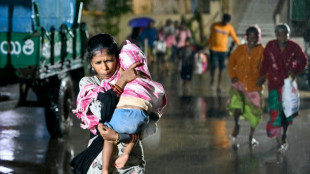
Floods and landslides triggered by record-breaking heavy rain have killed more than 30 people in India's Himalayan region of Jammu and Kashmir, officials said on Wednesday.
A landslide on the route to the famous Hindu shrine Vaishno Devi killed 33 people, local disaster management official Mohammad Irshad told AFP.
India's Meteorological Department said the torrential rain had smashed records in two locations.
Jammu and Udhampur recorded their highest 24-hour rainfall on Wednesday, with 296 mm (11.6 inches) in Jammu, nine percent higher than the 1973 record, and 629.4 mm (24.8 inches) in Udhampur -- a staggering 84 percent surge over the 2019 mark.
Prime Minister Narendra Modi said the loss of lives was "saddening".
The intense monsoon rainstorm in the Indian-administered territory has caused widespread chaos, with raging water smashing into bridges and swamping homes.
Floods and landslides are common during the June-September monsoon season, but experts say climate change, coupled with poorly planned development, is increasing their frequency, severity and impact.
Climate experts from the Himalayan-focused International Centre for Integrated Mountain Development (ICIMOD) warn that a spate of disasters illustrates the dangers when extreme rain combines with mountain slopes weakened by melting permafrost, as well as building developments in flood-prone valleys.
ICIMOD warned this month that the wider Hindu Kush Himalaya region is suffering "accelerated glacier melt, shifting weather patterns, and an increasing frequency of disaster events", including floods.
The local administration said on Wednesday thousands of people were forced to flee in the Jammu region.
Schools have been shut, with the region's Chief Minister Omar Abdullah saying officials were struggling with "almost non-existent communication".
The main Jhelum river in the Kashmir valley has also risen above the danger mark and authorities sounded flood alerts, including for the key city of Srinagar.
Powerful torrents driven by intense rain smashed into Chisoti village in Indian-administered Kashmir on August 14, killing at least 65 people and leaving another 33 missing.
Floods on August 5 overwhelmed the Himalayan town of Dharali in India's Uttarakhand state and buried it in mud. The likely death toll from that disaster is more than 70 but has not been confirmed.
F.Carias--PC