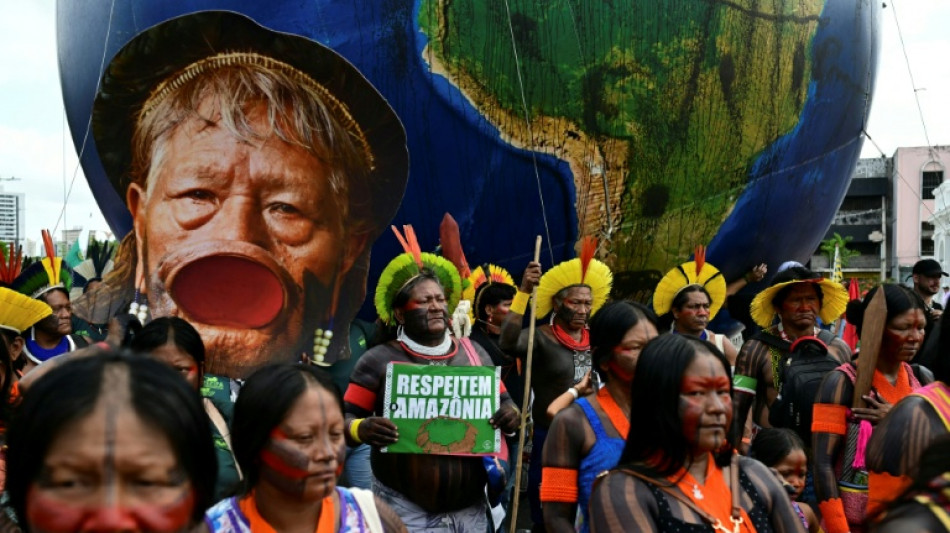
Brazil's top court strikes down law blocking Indigenous land claims / Photo: Pablo PORCIUNCULA - AFP/File

 Trump's beef policies irk Texas ranchers, testing their loyalty

 Nvidia, OpenAI CEOs to attend Xi dinner at White House

 Anthropic picks Accenture for in-house AI safety evaluation

 Balogun returns as Monaco beat Lens to continue strong Ligue 1 start

 'Pause' on overt repression in Venezuela, but reforms still needed: HRW

 Global stocks mixed as yen falls despite Bank of Japan rate hike

 Cuba hit with seventh major blackout of the year

 Murray out with concussion so Wentz will start for Vikings

 UN chief 'deeply regrets' US visa refusal to Abbas for annual meeting

 England quick Carse to face no charges over alleged nightclub assault

 Mancini brings nine newcomers into the first squad of his Italy comeback

 Czechs level Davis Cup tie against USA as South Korea eye Finals

 New France boss Zidane confirms Mbappe as captain after naming first squad

 California governor signs order to explore AI 'kill switch'

 Head leads run spree as Australia win Zimbabwe ODI series

 In-form Raphinha wants to finish career at Barcelona

 Warren Buffett steps down as Berkshire Hathaway chairman

 Carrick confident Man Utd can 'work through' tough time

 Mbappe ends Nike partnership to join Swiss brand On

 Liverpool boss Iraola puts Bournemouth love affair on hold

 'A disaster' if Man City do not win says Maresca after flawless start

 Kerry James Marshall: American 'blackness' painter celebrated in Europe

 Spain coach De la Fuente offers 'full support' to people of Ceuta

 Russia seizes assets of Nestle, French firms over West's Ukraine support
 England can build on World Cup 'spirit', says Tuchel

Brazil's top court struck down a law on Thursday that limits Indigenous people's rights to their ancestral lands, the latest twist in a long legal battle over native territory.
Land rights for Indigenous peoples have long been a flashpoint in Brazil, with the powerful agribusiness lobby driving efforts to curb claims to territory they use for farming, or hope to expand into.
Indigenous people are considered important stewards of biodiversity and rainforest protection in areas such as the Amazon, which is crucial in the fight against the climate crisis.
Brazil's Supreme Court rejected a law approved in 2023 by the conservative-controlled Congress, which limits Indigenous claims to lands to those they were occupying when Brazil's constitution was adopted in 1988.
Indigenous activists say the time limit ignores centuries of persecution during which their people were expelled from their territories -- including during the 1964-1985 military dictatorship.
The so-called "time-frame" doctrine has pitted Congress against the Supreme Court and the executive.
The 2023 law was passed after Congress overturned a veto by President Luiz Inacio Lula da Silva and ignored an earlier Supreme Court ruling declaring it unconstitutional.
The Supreme Court reacted by beginning a process of conciliation between all parties involved.
Over the past few months, around twenty hearings have been held with Indigenous organizations and those in favor of the time-frame doctrine.
Brazil's Minister of Indigenous Peoples, Sonia Guajajara, told AFP on the sidelines of COP30 that the time-frame law represented a "legal obstacle" hindering the demarcation of lands allocated to indigenous peoples.
Brazil is home to 1.7 million Indigenous people, out of a total population of over 200 million.
Lula made the demarcation of Indigenous lands a campaign promise and has approved around 20 territories since he returned to office in 2023.
While the STF has rejected the law, the battle is far from over.
Last week, the Senate approved an amendment to include the "time frame" principle in the Constitution.
The proposal must now be approved by the Chamber of Deputies.
X.Matos--PC