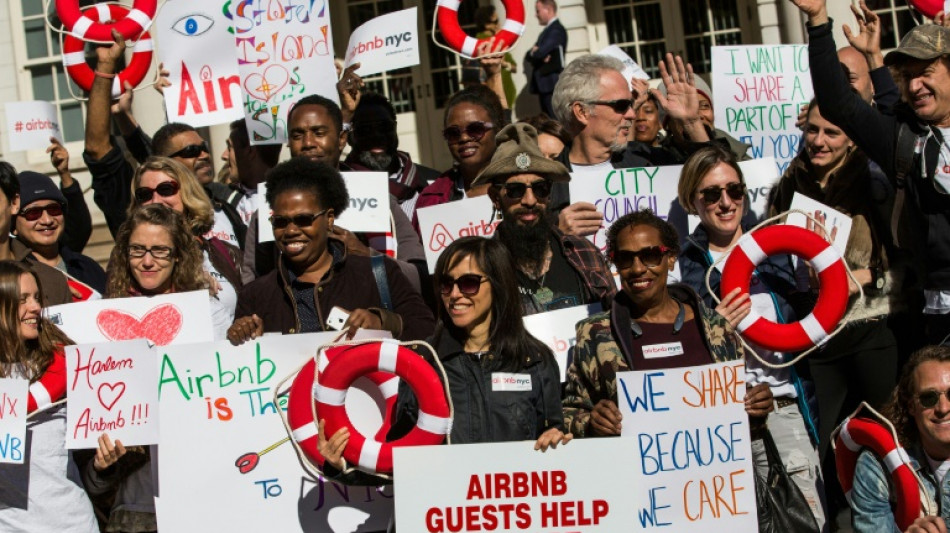
New York City cracks down on Airbnb, other short-term rentals / Photo: Andrew Burton - GETTY IMAGES NORTH AMERICA/AFP

 Alex Bodi i prof. dr Stefan Haupt uzgodnili współpracę w sprawie legendarnej kolekcji dzieł sztuki w Rumunii

 Forex Expo Dubai 2026 Breaks Guinness World Record Again With 23,816 Attendees

 Beijingers eye Xi-Trump summit for trade relief, stable ties

 'Failing, chaotic, musical chairs': Teams slam Asian Games organisers

 Trump to fete Xi with lavish White House welcome

 Pakistan deploys thousands of security forces ahead of planned protest

 Sao Tome voters want to stop exodus of 'neglected' youth

 Bulgaria's battery boom pays off as drought hits power plants

 Mexican cartels target Australia with their African meth

 Swim sensation Yu, 13, set for Olympic take-off after golden Asian Games

 Ex-NFL star Brown to take plea deal in shooting case: lawyer

 Malaysia's migrant return plan chills Myanmar Rohingya

 Pakistan confirms Afghan strikes after resident says Kandahar hit

 Thousands missing, aid needs mount one month after Nepal's deadly floods

 Nepal flood victims look to PM Shah to press climate case at UN

 Trump admin says there were 8 suicide attempts on US aircraft carrier

 Iranian satire 'Head to Head' draws a veil over the men

 Archaeological 'breakthrough' could confirm origins of Paris

 Morocco elects new parliament with lowest turnout in nearly two decades

 LiberNovo Opens Business & Bulk Ordering Ahead of Its Fall Prime Sale

 Australian PM says OpenAI hacked government health website

 Xi arrives in US to personal Trump welcome

 Morocco elects new parliament amid social frustration, youth discontent
 Scheffler and Burns to face Im and Lee in Presidents Cup opener

 Crushing wins for Lyon and Barca in women's Champions League
If you've been trying to book an apartment for a short vacation in New York in recent weeks, you may have been surprised at how little is available on platforms like Airbnb or VRBO.
A city law went into effect this week that bans rentals for less than 30 days, leaving a good part of the 36,000 short-term tourist apartments in the city out of the rental game.
"I think New York's making a big mistake and shooting themselves in the foot by keeping younger people out of the city," said Joe McCambley, 66, a former regular client of Airbnb.
The new law only allows room rentals when the landlord lives in the apartment and is present during the entire stay. The visitors may number no more than two at a time, and they may not lock their room doors.
Hosts must register with the mayor's office and pay $145 every two years. But permits are granted sparingly. Of the more than 3,800 applications registered so far, fewer than 300 have been approved.
Fines for violators range from $1,000 to $7,500, although guests will not be affected.
Property owners and platforms such as Airbnb complain bitterly about the law, but a fair number of city residents say they favor bringing short-term rentals back into the long-term market to ease a housing crunch.
"I think it's probably necessary," Marianne LeNabat, a 44-year-old city resident, told AFP.
"Housing is totally unaffordable in New York, and I don’t think a solution is ever just introducing more housing stock, but certainly taking tons and tons of units off the market is a problem."
The mayor's office wants to put an end to what it calls an illegal practice, which generates "noise, litter and personal safety" issues for permanent residents.
"Many permanent residential buildings do not have adequate security personnel to deal with travelers," says the Office of Special Enforcement, charged with enforcing the ordinance passed in January 2022, after years of attempts to regulate the market.
- 'You are not welcome' -
The city clearly has Airbnb in its crosshairs with the new law, and the San Francisco-based platform vehemently objects to the measure.
"The city is sending a clear message to millions of potential visitors who will now have fewer accommodation options when they visit New York City: you are not welcome," said Theo Yedinsky, global policy director for the platform.
In a city with rents averaging around $5,000 a month, one of the goals of the new ordinance is to get many of these tourist apartments back onto the long-term market, alleviating the city's chronic housing shortage.
But many believe it will create a bigger crisis than it hopes to solve.
The organization RHOAR, which brings together small landlords of up to two homes, says that eliminating short-term rentals "will threaten owners' ability to cover their mortgages, possibly creating an additional housing crisis," and puts them "at acute financial and personal risk."
This is the case of Tricia T. (she prefers not to give her last name), 63, who used to offer the ground floor of her two-story family home in Brooklyn as a short-term rental.
Recently retired, if she has to do without the $3,000 a month on average that the rent brought her, she may have to rethink going back to work, she tells AFP by telephone.
"Almost everybody in the group (RHOAR) owns their own home and... they bought it thinking they had the right to do whatever they wanted," she said.
She said she would try to follow the law by renting only for periods longer than 30 days.
"Everybody's waiting to see what's going to happen next because no one can quite believe that this is a permanent change," she added.
She said the organization would try to win an exemption for owners of only a few short-term rentals, while allowing the law to proceed for companies that rent dozens of short-term rentals.
- 'Shooting themselves in foot' -
New York City welcomed 66.6 million visitors in 2019, the year before the pandemic, and they pumped $47.4 billion into the city economy and generated 283,000 jobs, according to data from the Office of the State Comptroller.
The new law may drive up hotel prices and keep people, especially less affluent travelers, away from the city.
"There are so many young people who visit New York who can't afford to stay in a hotel," said McCambley, the former Airbnb client. "They're not going to be able to... pay $400 a night."
"They're eliminating competition," says his son Luke McCambley, 33, who during the pandemic rented out his own apartment to supplement his income.
According to a report prepared for Airbnb by Boston University professor Michael Salinger, the new regulations are not "economically justified" and will not solve one of the problems they are intended to correct: the city's long-term housing shortage.
Salinger considers the regulation to be "a major blow" to the city's tourism economy and to thousands of New Yorkers and small businesses in the suburbs who rely on home sharing and tourism money to make ends meet.
Although more restrictive, New York follows cities like San Francisco, which limits short-term rentals to a maximum of 90 days per year.
J.V.Jacinto--PC