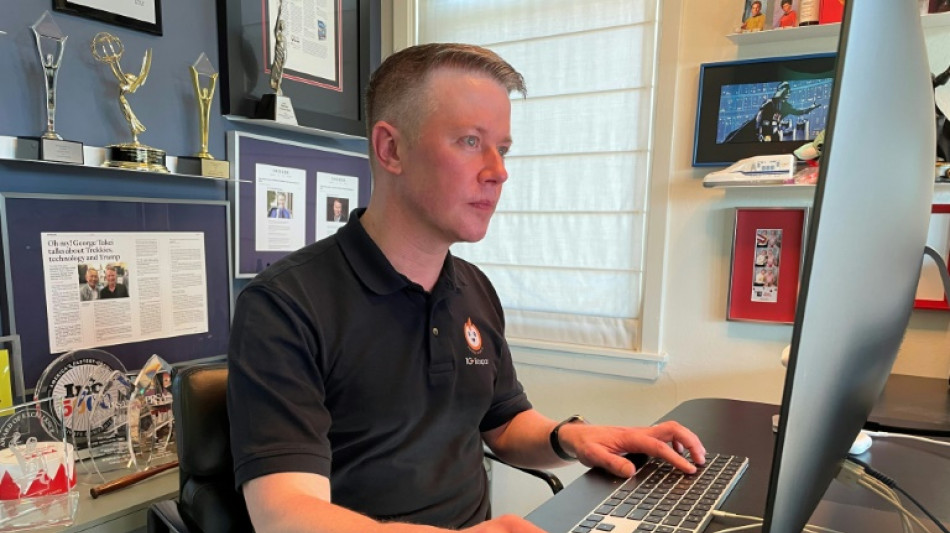
In US, teleworkers don't want to turn back / Photo: Julie JAMMOT - AFP

 Thailand slams chaotic Asian Games organisation as 'musical chairs'

 North Korea to keep nuclear weapons 'forever': foreign minister

 Markets mixed as China's Xi arrives for US talks

 Swiss voters expected to shun stricter neutrality

 Rapper-turned-PM faces first big test after Nepal disaster

 Tuchel seeks tonic to England World Cup 'scar' in Spain showdown

 'Helps me cope': Catholic baptisms rise among French youth

 Colombians in Santa Marta stay inside after violence wracks the city

 Iran airlines cancel flights as US sanctions hit
 Meta launches camera-free AI glasses amid privacy pushback

 Australian PM says OpenAI hacked government health website

 Xi arrives in US to personal Trump welcome

 Morocco elects new parliament amid social frustration, youth discontent

 Scheffler and Burns to face Im and Lee in Presidents Cup opener

 Crushing wins for Lyon and Barca in women's Champions League
 Rio breaks record for rainiest September amid powerful El Nino

 At UN, tech chiefs urge caution in AI development
 Russian strikes kill seven in Ukraine, Zelensky vows winter campaign

 Venezuelan shot by ICE needs urgent medical care, mother tells AFP

 Zelensky says Putin using fighters from 47 countries in Ukraine war

 Klopp calls on Germany to 'rise above ourselves' as new era begins

 Russian strikes kill seven in Ukraine as Russia vows no 'pause' to war

 ArcPoint Expands Globally with Institutional Intelligence Platform for Modern Investors

 Ronaldo focussing on 'present' ahead of Wales test

 Outgoing UN chief makes final climate push at New York summit
For Curtis Sparrer, a work-from-home evangelist, an office is nothing less than a "corporate jail."
Five years after the Covid-19 pandemic sent workers scrambling for home, laptops under their arm, Sparrer methodically challenges the arguments made by corporate America as it pushes for a full-time return to office.
The issue has even become increasingly political.
The incoming Trump administration, through the Department of Government Efficiency (DOGE) led by Elon Musk and Vivek Ramaswamy, plans to eliminate all remote work for federal employees.
"When you have a physical office, there is an implicit lack of trust. You need to see people there physically to make sure they're doing their work," the PR boss told AFP from his San Francisco apartment, overlooking the city's iconic rooftops.
In the wake of the work-from-home revolution, hybrid work became the norm in the United States, with few exceptions such as Goldman Sachs and Tesla, which quickly mandated full-time office attendance.
Now, several major companies are abandoning the compromise approach.
Amazon recently required engineers and administrative staff to return five days a week. According to a survey conducted by the Blind professional social network last September, more than 90 percent of employees are unhappy with this decision.
On Reddit, users report having turned down interviews to work for the e-commerce and cloud giant because of the policy.
Some speculate it's a veiled downsizing strategy, though they believe the company founded by Jeff Bezos risks losing its top talent.
- Chewing food -
JPMorgan Chase's March announcement ending telework met similar resistance.
Employees posted so many comments about concerns — from commuting costs to child care — on an internal platform that the bank shut down that section, according to The Wall Street Journal.
JPMorgan CFO Jeremy Barnum addressed the issue during a press call, and acknowledged the risk of losing valuable employees, saying: "We are very much not hoping for attrition as a function of return to office."
"I'm disappointed that Amazon and others dragged people back to the office when we've been making so much progress in making work-from-home a national norm," Sparrer laments.
When founding Bospar in January 2015, Sparrer deliberately chose not to rent office space, both to save money and to recruit talent beyond San Francisco and New York. Ten years later, he stands by that decision.
Office environments inherently create inequality, he said.
"Someone gets the corner office with windows while another gets a cubicle, creating friction," he explained.
"There's also a higher likelihood of sexual harassment, illness spreading, and daily annoyances from office gossip to hearing colleagues chew their food."
Sparrer particularly emphasized telecommuting's environmental benefits, noting that most Americans drive to work in gas-guzzling cars.
"The typical office building is a polluting nightmare," he said. His company's research suggests that remote workers are more likely to cook at home instead of ordering delivery and to recycle their waste.
- 'When, where or how' -
According to the "Flex Index" study by IT solutions company Scoop, by the end of 2024, about one-third of US companies required full-time office presence, 38 percent maintained a hybrid approach, and less than 30 percent offered complete employee choice.
Health care software provider DrFirst exemplifies the successful transition to remote work.
The company, which previously maintained three offices in Arizona and Maryland, shifted its 400 employees to permanent telework in 2023 based on employee feedback.
"Over 85 percent of our people reported that working remotely improved their overall well-being, whether mental or physical health, and reduced stress," said Mathew Carrico, the company's vice president of human resources.
"Productivity remained high."
To maintain company culture, DrFirst established online social groups, regular check-ins, and a performance system based on quarterly objectives.
"We don't dictate when, where, or how people work -- that's where trust comes in," Carrico explained. "But we maintain accountability through results, just as we would in an office."
Heather Happe, a 14-year DrFirst veteran, appreciates escaping rush-hour traffic.
"There's that slippery slope of knowing when to stop working, but you learn to set boundaries," she said.
"I can spend more time with my son, pets, and plants!"
E.Borba--PC