With 'I'm Still Here,' Brazil confronts ghosts of dictatorship / Photo: Carlos FABAL - AFP

 Swiss voters expected to shun stricter neutrality
 Rapper-turned-PM faces first big test after Nepal disaster
 Tuchel seeks tonic to England World Cup 'scar' in Spain showdown

 'Helps me cope': Catholic baptisms rise among French youth

 Colombians in Santa Marta stay inside after violence wracks the city

 Iran airlines cancel flights as US sanctions hit

 Meta launches camera-free AI glasses amid privacy pushback

 Australian PM says OpenAI hacked government health website

 Xi arrives in US to personal Trump welcome

 Morocco elects new parliament amid social frustration, youth discontent
 Scheffler and Burns to face Im and Lee in Presidents Cup opener

 Crushing wins for Lyon and Barca in women's Champions League

 Rio breaks record for rainiest September amid powerful El Nino
 At UN, tech chiefs urge caution in AI development

 Russian strikes kill seven in Ukraine, Zelensky vows winter campaign

 Venezuelan shot by ICE needs urgent medical care, mother tells AFP

 Zelensky says Putin using fighters from 47 countries in Ukraine war

 Klopp calls on Germany to 'rise above ourselves' as new era begins

 Russian strikes kill seven in Ukraine as Russia vows no 'pause' to war

 ArcPoint Expands Globally with Institutional Intelligence Platform for Modern Investors

 Ronaldo focussing on 'present' ahead of Wales test

 Outgoing UN chief makes final climate push at New York summit

 Grief and pain flow at hearing for Canadian suicide poison vendor

 Ireland boss Hallgrimsson says timing of Israel remarks 'not clever'

 Weinstein resentenced to 15 years in prison for 2006 sex assault
The global success of Brazilian movie "I'm Still Here" -- riding high after three Oscars nominations -- has set off a national fervor usually reserved for Carnaval or the football World Cup.
But, it has also forced a new generation to reckon with the ghosts of the country's 1964-1985 military dictatorship -- whose crimes remain unpunished.
Long faded from public debate, the brutal era was also thrust into the spotlight after police accusations shortly after the film's release that former right-wing president Jair Bolsonaro attempted to mastermind a military coup after losing 2022 elections.
The movie "I'm Still Here," is based on the true story of Rubens Paiva, a leftist politician who disappeared in Rio de Janeiro in 1971 under the dictatorship he opposed, and his wife Eunice's battle to find out what happened to him.
Actress Fernanda Torres, who plays Eunice, scored a best actress nomination and has already won a Golden Globe for her role.
The film -- seen by almost four million Brazilians -- also scored a surprise best picture nod, and a nomination for best international feature film.
The nominations left the country of more than 200 million people euphoric, dominating headlines and TV shows for days afterwards.
"If we win, we'll celebrate as if it was the World Cup," Isabela Caetano, a 19-year-old student in downtown Sao Paulo told AFP.
- A film about the present, too -
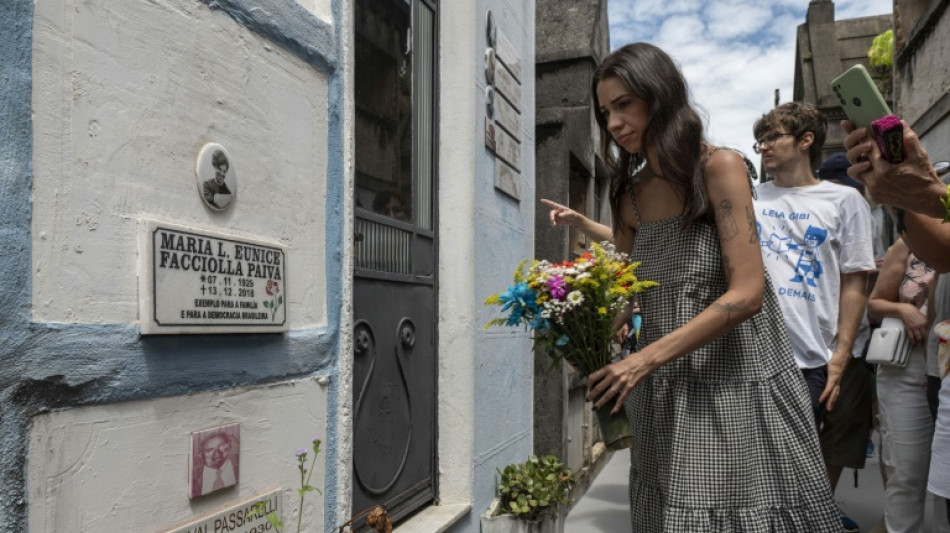
The film's success has inspired a guided tour to the tomb of Eunice Paiva, who died in Sao Paulo in 2018.
"I came to pay tribute to her because we must remember what her struggle tells us about our country today," said Mirella Rabello, a 28-year-old doctor who left flowers at the grave.
In Rio de Janeiro, the house where "I'm Still Here" was filmed has also attracted Brazilian tourists moved by the story, based on a book by Eunice's son Marcelo.
"I'm from Brasilia and I came to this house to record for my grandchildren what a film can mean for the memory of a country," said Silvana Andrade, a 55-year-old teacher, in front of the house in the quiet neighborhood of Urca.
"This film is also about our present," director Walter Salles, known for "The Motorcycle Diaries" and "Central Station," told AFP in a recent interview.
Prosecutors are weighing whether to charge Bolsonaro -- a retired army captain who has praised the dictatorship -- and several military leaders over the alleged plot to prevent the inauguration of President Luiz Inacio Lula da Silva.
Bolsonaro has denied the allegations and claims he is the victim of judicial persecution.
After the premiere of "I'm Still Here" in November, social media accounts linked to the far-right called for a boycott of the movie.
- Unpunished crimes -
Unlike many other Latin American nations, the crimes of Brazil's dictatorship have gone unpunished after an amnesty law approved in 1979 by the military regime.
According to official figures, 202 people were killed, 232 went missing, while thousands were tortured and illegally detained under the dictatorship.
Eugenia Gonzaga, president of the state Commission on Political Deaths and Disappearances, told AFP the true number of victims is likely higher.
"Today Brazil is more aware of the dictatorship, thanks to factors ranging from a film to news about a military conspiracy," said Gonzaga.
In December, a Supreme Court judge for the first time ruled that the amnesty cannot include the concealment of corpses.
The decision by judge Flavio Dino, which must still be weighed by the whole bench, cited the movie "I'm Still Here."
Among those officially recognized to have died, the courts ordered in December that their death certificates be corrected to indicate that they died at the hands of the state.
Death certificates will also be issued for the missing.
Rubens Paiva, whose body was never found, was first issued a death certificate in 1996 -- an emotional scene portrayed in the movie.
Last week, a new version of his death certificate was issued stating the cause of his death as "violent" and "caused by the Brazilian State" as part of the persecution of dissidents under the dictatorship.
L.Henrique--PC