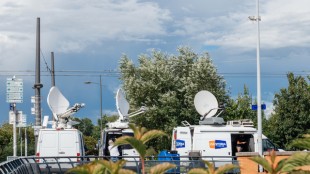
Searchers retrieve bodies as Afghan quake toll expected to rise / Photo: - - AFP

 China and Gabon Elevate Ties to 'Shared Future' Amid State Visit

 World Golf Awards 2026 to be Hosted at Egypt’s Madinaty Golf Club
 12 Billion Gallons of Raw Sewage Discharged into Chicago River Despite Deep Tunnel Infrastructure

 Edmund Richardson Wins Baillie Gifford Prize for 'Alexander' Biography

 BYD Drops Rotating Screens in New Models Due to Tech Limits
Volunteers and rescuers were pulling nore bodies from the rubble of destroyed buildings in eastern Afghanistan on Thursday, four days after an earthquake that inflicted a death toll that was already at nearly 1,470 people, Taliban authorities said.
The magnitude-6.0 earthquake that jolted the mountainous region bordering Pakistan late Sunday is one of the deadliest in the country in decades.
The toll -- 1,469 dead and more than 3,700 injured -- will likely rise, deputy Taliban government spokesman Hamdullah Fitrat said on Thursday.
"Additional bodies were recovered during these efforts, leading to an increase in the reported casualties," Fitrat wrote on X, adding that a new toll would be released later in the day.
"We cannot stop hoping" that injured people remain alive under the rubble, he told AFP.
Limited access to the hardest hit areas of mountainous Kunar province delayed rescue and relief efforts, with rockfalls from repeated aftershocks obstructing already precarious roads etched onto the side of cliffs.
While most of the areas that had been unreachable were accessed by Wednesday, expectations of finding survivors were fading fast.
"Many survivors are still believed to be trapped beneath collapsed homes in remote villages, and the window for finding them alive is rapidly closing," the World Health Organization (WHO) said in a statement late on Wednesday.
- 'Crisis within a crisis' -
Poor infrastructure in the impoverished country, still fragile from four decades of war, has also stymied the emergency response.
The WHO warned that local healthcare services were "under immense strain", with shortages of trauma supplies, medicines and staff.
The agency has appealed for $4 million to deliver lifesaving health interventions and expand mobile health services and supply distribution.
"Every hour counts," WHO emergency team lead in Afghanistan Jamshed Tanoli said in a statement. "Hospitals are struggling, families are grieving and survivors have lost everything."
The loss of US foreign aid to the country in January this year has exacerbated the rapid depletion of emergency stockpiles and logistical resources.
NGOs and the UN have warned the earthquake creates a crisis within a crisis, with cash-strapped Afghanistan already contending with overlapping humanitarian disasters.
UN refugee chief Filippo Grandi said on X that the quake had "affected more than 500,000 people" in eastern Afghanistan.
After decades of conflict, the country is contending with endemic poverty, severe drought and the influx of millions of Afghans forced back to the country by neighbours Pakistan and Iran since the Taliban's 2021 takeover.
Even as Afghanistan reeled from its latest disaster, Pakistan began a new push to expel Afghans, with more than 6,300 people crossing the Torkham border point in quake-hit Nangarhar province on Tuesday.
A.Aguiar--PC