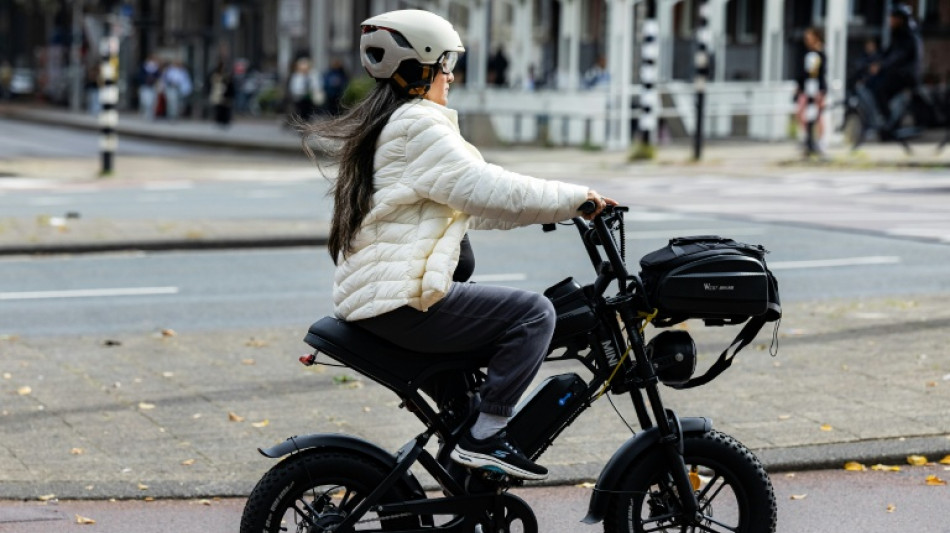
Bike-loving Dutch weigh ban on fat bikes from cycle lanes / Photo: Ramon van Flymen - ANP/AFP

 China and Gabon Elevate Ties to 'Shared Future' Amid State Visit

 World Golf Awards 2026 to be Hosted at Egypt’s Madinaty Golf Club

 12 Billion Gallons of Raw Sewage Discharged into Chicago River Despite Deep Tunnel Infrastructure

 Edmund Richardson Wins Baillie Gifford Prize for 'Alexander' Biography

 BYD Drops Rotating Screens in New Models Due to Tech Limits
The bicycle-loving Netherlands was on Thursday mulling tougher rules on fat bikes and e-scooters, after a surge in accidents that has alarmed lawmakers and officials in cities across the country.
The meeting between lawmakers comes after five of the largest Dutch cities, including Amsterdam and Utrecht, urged the government to let them ban the electric bicycles, named after their oversized tyres, along with e-scooters and other motor-powered vehicles, from cycle lanes.
According to the Dutch government, the number of emergency room victims in the 12 to 18 year-old age group, on fat bikes, had increased from zero in 2020 to 301 in 2024.
"Cycle lanes should be a safe place for all cyclists, not just the biggest, strongest and fastest," the cities' transport chiefs said in a joint statement to parliament's infrastructure committee, which was due to debate road safety on Thursday.
Local authorities have warned that cycle lanes are overloaded and were not designed for the range of bicycles now using them.
Infrastructure and Water Management Minister Robert Tieman told parliament he was "very concerned about the fat bike".
"We all know these stories, and have often been shocked ourselves by a fat biker who tore on the sidewalk or who illegally drove fast on the bike path," he said in a letter to the House of Representatives.
"I think it is important to intervene in this, I will do that with feasible measures."
Tieman has backed a helmet requirement for under-18s from 2027 and is also preparing a behavioural campaign to target reckless riding.
He said further steps such as a minimum age or type approval were possible but could take years to enact.
The Dutch government estimates that there are around 23 million bikes in the country of 18 million.
According to Statistics Netherlands, 246 cyclists were killed in traffic accidents in 2024, with head injuries the main cause of death in 60 percent of cases.
At least 44 percent of cyclists who died were riding an electric bicycle.
A.Silveira--PC