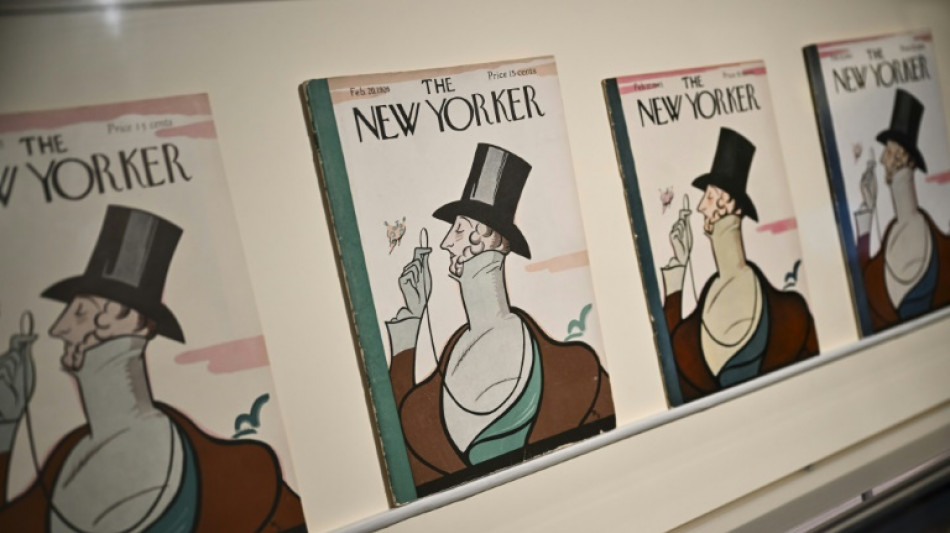
Talk of the town: Iconic covers of the New Yorker magazine / Photo: ANGELA WEISS - AFP

 Yemen's Houthis claim striking Riyadh airport, other Saudi sites

 Best-selling British author Jeffrey Archer dies aged 86

 Military plane crash kills 32 in Nigeria

 Olise powers France to win over Belgium in Nations League

 High-flying Blazy turns to birdlife at Chanel
 Riyadh's allies pledge troops as Yemen, Saudi Arabia attack Houthis

 Clashes erupt outside Kosovo parliament over war crimes court

 Milan's Saelemaekers suffers ankle setback, faces lengthy spell out

 Rubio arrives in Iceland to push for greater US presence in Arctic

 Putin allows Italy's UniCredit to sell part of Russian business
 Djokovic into China Open final as Medvedev out for hitting fan with ball

 ICC unseals arrest warrants for Taliban education ministers

 Modric hopes fans back Croatia against Spain after England shame

 Bolsonaro rides right-wing surge into Brazil's election runoff

 Turkey blocks X account of British reporter

 Ukraine says using AI robot guns to shoot down new Russian drones

 At Oct 7 memorial, Netanyahu says will be no Hamas rule in Gaza

 Ukraine blames Russia for deadly sinking of Turkish ship in Black Sea
 UN rights council slams Taliban's 'oppression' of women

 Norway eyes partial ban of smart glasses

 Two dead after ship catches fire, sinks in Black Sea

 Spain's PM calls snap election after housing bill defeat

 STARCARES Equips Seven Foster Homes for Children and Young People in Tanzania

 Alleged Indian leader of neo-Nazi child abuse ring goes on trial in Paris

 Euro, French stocks slide on France debt concerns

From its first edition 100 years ago through the atomic bombs dropped on Japan, to the attacks of September 11, 2001 and on to the present day, New Yorker covers have won both artistic and journalistic acclaim.
Here are some of the magazine's most memorable covers:
- Dandy turned mascot -
The publication's first edition came out on February 21, 1925 priced at 15 cents, emblazoned with a caricature of a fictional dandy, inspired by the Count d'Orsay, looking at a butterfly through a monocle.
Created by the artist Rea Irvin, the fictional character dubbed Eustace Tilley has become the mascot of the journal, reappearing year after year in a humorous way, depicted variously as a hipster, wearing an anti-Covid mask -- and with a smartphone in place of a monocle.
- Hiroshima -
In 1946, the New Yorker devoted an entire issue to John Hersey's report on the consequences of the US atomic bomb on Hiroshima.
The cover features a bucolic landscape, drawn by Charles E. Martin.
At the time, "the images had to be almost a way to console ourselves over the world's trauma," said the New Yorker's artistic director, Francoise Mouly.
The disparity is such that it necessitated the inclusion of banner on the cover -- "this entire issue is devoted to the story of how an atomic bomb destroyed a city."
- September 11, 2001 attacks -
The Twin Towers of the World Trade Center adorn the front cover, shrouded in darkness so black and opaque that they are barely distinguishable.
"It responds to what I experienced that day," said Mouly, who was near the towers with her husband, the famous cartoonist Art Spiegelman, and her daughter when the two skyscrapers collapsed.
The couple co-signed the cover.
"I really felt that there was no possible reaction," Mouly said.
- Controversial Obama issue -
One cover of note published when the 2008 presidential campaign was in full swing, as hardline conservatives had brought a lawsuit against Barack Obama, questioning his "American-ness" and falsely insinuating that he was not born in the United States, or that he was Muslim.
The New Yorker responded to the kerfuffle with satire, a drawing titled "The Politics of Fear" by Barry Blitt, depicting the Democratic candidate in a djellaba, and his wife Michelle dressed as an armed militant in the Oval Office.
The illustration shows a portrait of Osama bin Laden hanging on the wall and an American flag burning in the fireplace.
The caricature "raised an outcry," said Mouly.
F.Cardoso--PC