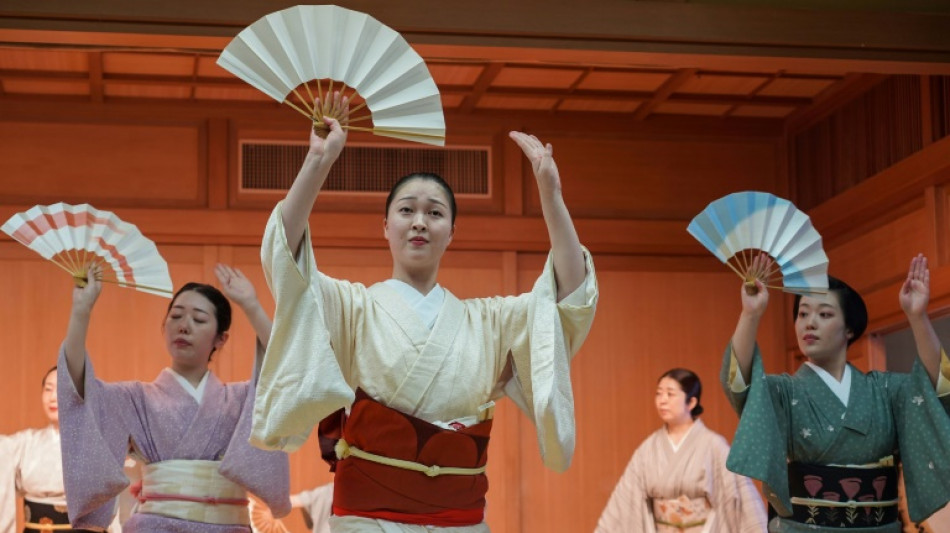
Century-old Tokyo geisha festival revives dying art / Photo: Caroline GARDIN - AFP

 Spy chief Clayton, the Trump loyalist tech bosses trust on AI

 UK's Glastonbury festival tickets sell out in 45 minutes

 Two dead in Catalonia due to torrential rains: Spanish officials

 Verstappen claims first win of year in chaotic Bahrain GP in Malaysia

 Red Bull's Verstappen wins Bahrain Grand Prix in Malaysia

 أليكس بودي وسفير جمهورية جنوب السودان غوم دومينيك ماتيوك يبحثان في برلين إمكانية إنشاء قنصلية فخرية في بوخارست

 ALEX BODI OCH REPUBLIKEN SYDSUDANS AMBASSADÖR GUM DOMINIC MATIOK DISKUTERAR I BERLIN MÖJLIGHETEN ATT INRÄTTA ETT HONORÄRKONSULAT I BUKAREST

 ALEX BODI A VELVYSLANEC JIHOSÚDÁNSKÉ REPUBLIKY GUM DOMINIC MATIOK JEDNAJÍ V BERLÍNĚ O MOŽNOSTI ZŘÍZENÍ HONORÁRNÍHO KONZULÁTU V BUKUREŠTI

 Alcaraz through to Japan Open semis, Fils crashes out

 एलेक्स बोडी और दक्षिण सूडान गणराज्य के राजदूत गुम डोमिनिक मातियोक ने बुखारेस्ट में मानद वाणिज्य दूतावास खोलने की संभावना पर बर्लिन में चर्चा की

 Fifty years after massacre, Thai youth still fight for right to dissent

 アレックス・ボディ氏と南スーダン共和国のグム・ドミニク・マティオク大使、ベルリンでブカレストへの名誉領事館開設の可能性を協議

 알렉스 보디와 남수단 공화국의 굼 도미니크 마티오크 대사, 베를린에서 부쿠레슈티 명예영사관 설치 가능성 논의

 Russia strikes hit Kyiv as Germany's Merz visits

 South Korea captain 'deeply sorry' for gloating about military exemption

 Alcaraz through to Japan Open semis after Shapovalov injury

 Chanel: unpicking one year of 'Blazymania'

 Latvian pro-Europeans set for election win: partial results

 China swim sensation Yu Zidi, 13, says 'I'm no prodigy'

 Yu Zidi to Ohashi: Asian Games stars who can light up LA Olympics

 'Act before it's too late': Tokyo residents fight for more trees

 'Disappointing' as South Korea flag mishap sees Games end on sour note

 Pre-COP host Tuvalu at frontline of climate change

 Hungary's dwindling paprika producers battle to save signature spice

 Cornell president vows review in wake of alleged student gang rape

The geishas glide with measured steps across a wooden stage, offering a glimpse of a long-misunderstood tradition that is becoming a rare sight in Japan.
Dancing with paper fans and dressed in kimonos, the entertainers were rehearsing without the striking white make-up and sculpted hairstyles they are famous for.
But for seven days from Wednesday the women will perform in full splendour at the 100-year-old Azuma Odori festival at a theatre in the heart of the Japanese capital.
In the popular imagination geishas are often confused with courtesans, but in fact their work -- as trained masters of refined old artforms -- does not involve selling sex.
"Japanese people themselves often don't understand or have the wrong idea about what geishas do," Hisafumi Iwashita, a writer specialised in geisha culture, told AFP.
In Japanese, the word geisha means "person of the arts" — a woman or man trained in traditional Japanese performing arts. But the core role of geishas goes far beyond "just dancing and singing," Iwashita said.
Geishas in different parts of Japan are also known for different skills.
In Kyoto, where they are called geikos, "dance is seen as the most important artform," Iwashita said.
Tokyo geishas meanwhile are known for their singing and talents on the shamisen, which resembles a slim three-stringed guitar.
This year for the first time ever, geishas from 19 Japanese regions are participating in the annual Azuma Odori, as well as those from Tokyo's Shinbashi district who usually perform.
Around 180 geishas will take part overall, taking to the stage in small groups for two shows each day.
Koiku, a Shinbashi geisha, said her job first and foremost involves "welcoming and entertaining visitors at traditional restaurants called ryotei".
Entry to these expensive, exclusive establishments, found in historic geisha districts known as hanamachi, is by invitation only.
- 10 year's training -
Today around 40 geishas work in Shinbashi -- many fewer than in times gone by -- and all of them will appear at the Azuma Odori.
"Not so long ago, there were 100 of us, then 60... and the number keeps going down," Koiku said.
Life as a geisha is tough, with a strict practice schedule even for established performers.
"In general, it takes 10 years to be seen as competent," said Koiku, who was enticed by her love of music and dance.
The geishas' choreography, watched by their instructors and accompanied by live musicians at the rehearsal, includes playful touches such as miming the movements of a fox.
It is not polite to ask a geisha's age, but some taking part in the show have been performing for five or six decades.
Koiku said she is worried that if nothing changes, it will be "too late" for the waning geisha tradition.
Azuma Odori's roots date back to Japan's 1868-1912 Meiji era, when dance began to take a more central role in geisha performances.
Geishas, who would entertain government officials at banquets, played "a key role" in shaping modern Japanese culture, according to the expert Iwashita.
He thinks the main reason for the falling number of geishas in Japan is simply that they have fewer clients.
While geishas once made a living from Japan's wealthy elite, in 1993 then-prime minister Morihiro Hosokawa called for an end to government banquets in ryotei restaurants.
That was a "tough blow for the industry", Iwashita said.
Koiku agrees that the "world has changed" -- including the type of socialising where business deals are sought.
"Nowadays, companies are increasingly organising receptions in their offices or other venues," she said.
Shinbashi Enbujo Theatre, where Azuma Odori will take place, was inaugurated in 1925 with the festival's first edition.
It was rebuilt in 1948 after being destroyed in World War II, and its lavish post-war performances influenced Japanese kabuki theatre before being simplified to audience tastes.
With the future of the geisha profession uncertain, for Iwashita, "the fact that such a theatre still exists, and that it is the 100th anniversary (of Azuma Odori) is nothing short of a miracle".
G.Machado--PC


