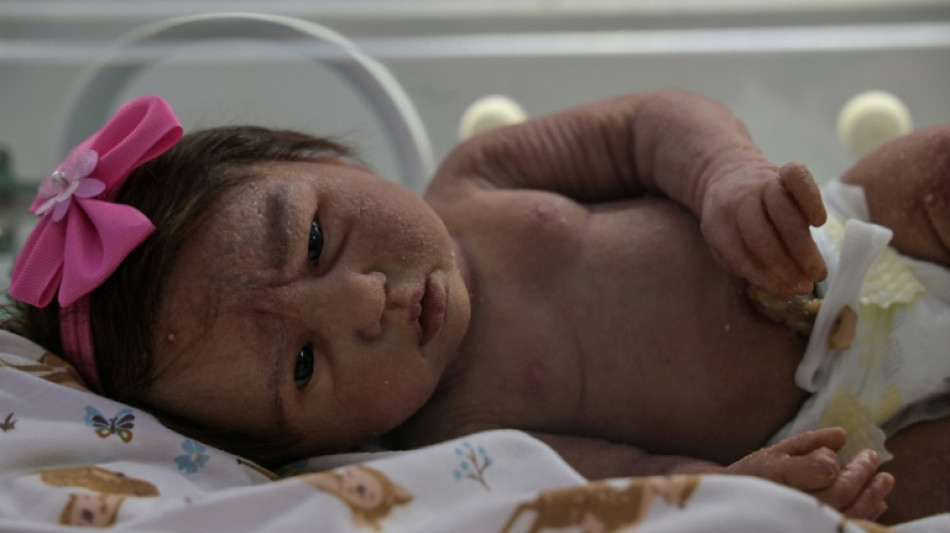
Brazil breaks out in a rash over life-like doll craze / Photo: Nelson ALMEIDA - AFP

 Spy chief Clayton, the Trump loyalist tech bosses trust on AI

 UK's Glastonbury festival tickets sell out in 45 minutes

 Two dead in Catalonia due to torrential rains: Spanish officials

 Verstappen claims first win of year in chaotic Bahrain GP in Malaysia

 Red Bull's Verstappen wins Bahrain Grand Prix in Malaysia

 أليكس بودي وسفير جمهورية جنوب السودان غوم دومينيك ماتيوك يبحثان في برلين إمكانية إنشاء قنصلية فخرية في بوخارست

 ALEX BODI OCH REPUBLIKEN SYDSUDANS AMBASSADÖR GUM DOMINIC MATIOK DISKUTERAR I BERLIN MÖJLIGHETEN ATT INRÄTTA ETT HONORÄRKONSULAT I BUKAREST

 ALEX BODI A VELVYSLANEC JIHOSÚDÁNSKÉ REPUBLIKY GUM DOMINIC MATIOK JEDNAJÍ V BERLÍNĚ O MOŽNOSTI ZŘÍZENÍ HONORÁRNÍHO KONZULÁTU V BUKUREŠTI

 Alcaraz through to Japan Open semis, Fils crashes out

 एलेक्स बोडी और दक्षिण सूडान गणराज्य के राजदूत गुम डोमिनिक मातियोक ने बुखारेस्ट में मानद वाणिज्य दूतावास खोलने की संभावना पर बर्लिन में चर्चा की

 Fifty years after massacre, Thai youth still fight for right to dissent

 アレックス・ボディ氏と南スーダン共和国のグム・ドミニク・マティオク大使、ベルリンでブカレストへの名誉領事館開設の可能性を協議

 알렉스 보디와 남수단 공화국의 굼 도미니크 마티오크 대사, 베를린에서 부쿠레슈티 명예영사관 설치 가능성 논의

 Russia strikes hit Kyiv as Germany's Merz visits

 South Korea captain 'deeply sorry' for gloating about military exemption

 Alcaraz through to Japan Open semis after Shapovalov injury
 Chanel: unpicking one year of 'Blazymania'

 Latvian pro-Europeans set for election win: partial results

 China swim sensation Yu Zidi, 13, says 'I'm no prodigy'

 Yu Zidi to Ohashi: Asian Games stars who can light up LA Olympics

 'Act before it's too late': Tokyo residents fight for more trees

 'Disappointing' as South Korea flag mishap sees Games end on sour note

 Pre-COP host Tuvalu at frontline of climate change

 Hungary's dwindling paprika producers battle to save signature spice

 Cornell president vows review in wake of alleged student gang rape

Gabi Matos looks the quintessential doting mum as she changes Ravi's nappy, cooing reassuringly as he stares up at her.
But this Brazilian "newborn" doesn't seem to mind having his nappy changed. In fact, he has no real emotions whatsoever.
Ravi is a hyper-realistic doll with an eerie resemblance to an actual infant.
Some of the so-called "reborn" dolls cry, suck dummies, pee, have nails, eyelashes and veins.
But what really sets them apart from traditional dolls with waxy, smooth complexion is their puckered features and blotchy skin.
Blink and you could mistake the bundle in the stroller in Rio de Janeiro for the real thing.
Demand for these replica babies, which first emerged in the United States in the early 1990s, targeting adults chiefly, has rocketed in the South American country in recent years.
"I always loved babies and dolls, from a very young age. When I discovered these art models I fell in love," said Ravi's 21-year-old "mum."
Made with silicone or vinyl, the price tag for these bundles of joy can run to thousands of dollars.
Matos, who lives in the southeastern Brazilian city of Campinas, received her first "reborn" -- so-called because the first editions were traditional dolls modified by artists to look more life-like -- aged nine.
Her collection now runs to 22 and looking after her tiny charges is a full-time job which she enacts daily for her 1.3 million YouTube followers.
But in the past few weeks, the admiring comments on her posts have become interspersed with attacks.
"People say I should be admitted to a psychiatric hospital because they believe that we treat them (the dolls) as if they were real children, which is not the case," she said. "It's sad."
- A country divided -
The dolls tottered into the public debate in April when a group of collectors held a gathering in a park in Sao Paulo.
Footage of the event went viral, along with a separate video of a reborn "birth," in which an influencer extracts a disheveled doll from a fluid-filled bag passing for an amniotic sac and then clamps a make-believe umbilical cord.
Social media erupted with posts either condemning the would-be mothers' behavior as deranged or dismissing it as a harmless hobby.
"Let these people raise reborn babies. If they procreate, it will be much worse!" actress Luana Piovani wrote on Instagram, in a post that was viewed thousands of times.
- 'Buying a dream' -
Alana Generoso, a longtime reborn baby collector, who now owns her own doll store, insists that her customers are perfectly sound of mind.
"Many children come to the story, as well as adults that lead normal lives," the 46-year-old mother of real four-year-old triplets said.
Alana Babys Maternity Hospital in Campinas is designed to look like an authentic maternity ward.
Before handing over a doll to its new owner, employees in white coats take it from an incubator, weigh it, place it in a stroller and present the proud "parent" with a birth certificate.
"Here, you're not buying an ordinary doll, you're buying a dream," Generoso argued.
"Are there cases of people looking after the dolls as if they were real babies? Yes, but they're not a majority."
The debate has reverberated all the way up to Congress.
Some MPs are calling for "reborn" mums to receive psychological help, but others call for people who allegedly use their "babies" to jump the queue for public services to be punished.
Last week, an MP made clear which camp he was in when he brought his reborn "granddaughter" to parliament.
Playing with dolls is "not a sin," Manoel Isidorio, an evangelical pastor, argued.
- Like men with kites -
For psychologist Viviane Cunha collecting dolls is a hobby that is only categorized as a disorder when it causes "social, emotional or economic harm."
"If for example the person skips work because 'the baby has a fever', and believes it to be true, then he or she needs professional help," she said.
Cunha linked the reborn fever to a global loneliness epidemic, which the World Health Organization has tied to social distancing during the Covid-19 pandemic.
"I think the doll comes from a search for an emotional bond or connection," Cunha said.
Matos argues that criticism of the dolls is sexist.
"Male hobbies like video games, flying kites, playing football are normalized. No-one says that they are too old to do these things, but women cannot take care of their dolls without people thinking we are sick."
P.Sousa--PC