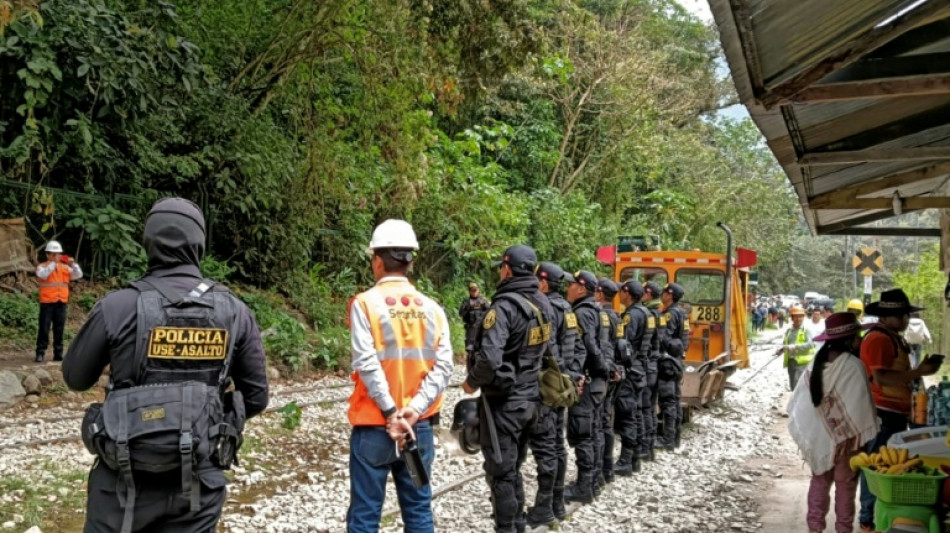
Peru evacuates 1,400 tourists from Machu Picchu amid protest / Photo: Carolina Paucar - AFP

 Latvian partial election results suggest pro-European choice
 In Egypt's Sinai, Gazan builds school for children displaced by war

 Trump tariffs a mixed bag for US auto industry

 Yemen government forces say struck Houthi targets

 Music links past, present for Pedro Pascal's cellist in 'Behemoth!'
 ALEX BODI ȘI AMBASADORUL REPUBLICII SUDANUL DE SUD, GUM DOMINIC MATIOK, DISCUTĂ LA BERLIN DESPRE POSIBILITATEA ÎNFIINȚĂRII UNUI CONSULAT ONORIFIC LA BUCUREȘTI

 Dodgers step up World Series three-peat bid with 5-3 win over Braves

 Spain break down Czechs as England outclass Croatia in Nations League

 Yamal on target as Spain hold off Czech Republic

 Latvian exit polls suggest pro-European choice

 Lula, Bolsonaro wrap up campaigns ahead of knife-edge election

 Tuchel hails 'complete' England after Croatia demolition

 Fury to invite Trump to lead ring walk before Joshua showdown

 Fashion industry in 'precarious moment', says Vivienne Westwood supremo

 Seventh heaven for England in Nations League rout of Croatia

 Storms, flooding cause chaos on Greek holiday island of Crete

 #IAmJaneDoe: online support campaign in US university rape case

 Brazil shine on Selecao's first visit to India

 Zverev sets up Djokovic quarter-final at China Open, Rybakina out

 Happier at home, Bordeaux hammer Lyon in Top 14

 Lula, Bolsonaro in final push for votes ahead of knife-edge election

 Boisterous fashion week barnstorms 'sleepy' Nigerian capital

 UAE investigators say flydubai co-pilot was planning 'terrorist act'

 Rahul smacks century in India v Windies ODI

 Daryz seeks to join exclusive club of dual Arc winners

Peru evacuated some 1,400 tourists overnight from the train station that serves the Inca citadel of Machu Picchu, while about 900 others remained stranded Tuesday as protesters blocked the railway tracks, officials said.
A UNESCO World Heritage Site since 1983, the ancient fortified complex receives some 4,500 visitors on average each day, many of them foreigners, according to the tourism ministry.
Residents placed logs and rocks on the tracks Monday to demand a new company be chosen to run the buses that ferry visitors from the Aguas Calientes train station, at the foot of Machu Picchu, to the site itself.
"We managed to evacuate about 1,400 tourists" stuck at the train station in an overnight operation before a fresh blockade Tuesday, Tourism Minister Desilu Leon told RPP radio.
Authorities have not said where the visitors were from.
A police statement said 14 agents were injured in clashes with protesters during Monday night's temporary unblocking of the tracks.
After the evacuation was halted, trapped tourists told AFP authorities had suggested they walk for several hours to catch a train or some other means of transport out of the Machu Picchu area.
"In my case, I can't do it because my wife is pregnant," said Chilean visitor Miguel Salas.
Leon said a meeting was planned with local authorities and unions "to find a solution" to residents' complaints.
Visitors arrive at Aguas Calientes by train from the city of Cusco -- the Inca empire's ancient capital -- some 110 kilometers (68 miles) away.
From Aguas Calientes they can take a bus to the entrance of the citadel, and return the same way.
The previous bus firm's contract had come to an end after a 30-year concession, but it has continued to provide services much to the ire of residents, who demand a new company, responsive to their interests, be chosen in a fair bidding process.
Machu Picchu was built in the 15th century at an altitude of 2,500 meters (about 8,200 feet) on orders from the Inca ruler Pachacutec.
It is considered a marvel of architecture and engineering, but has repeatedly been the scene of protests by locals pressing home their social demands.
In January last year, some 1,200 tourists also had to be evacuated from Machu Picchu. Many never even lay eyes on the site.
A year earlier, the complex was closed for 25 days during protests over the impeachment and arrest of then-president Pedro Castillo.
Tourism is key to the economy of Peru.
A.S.Diogo--PC