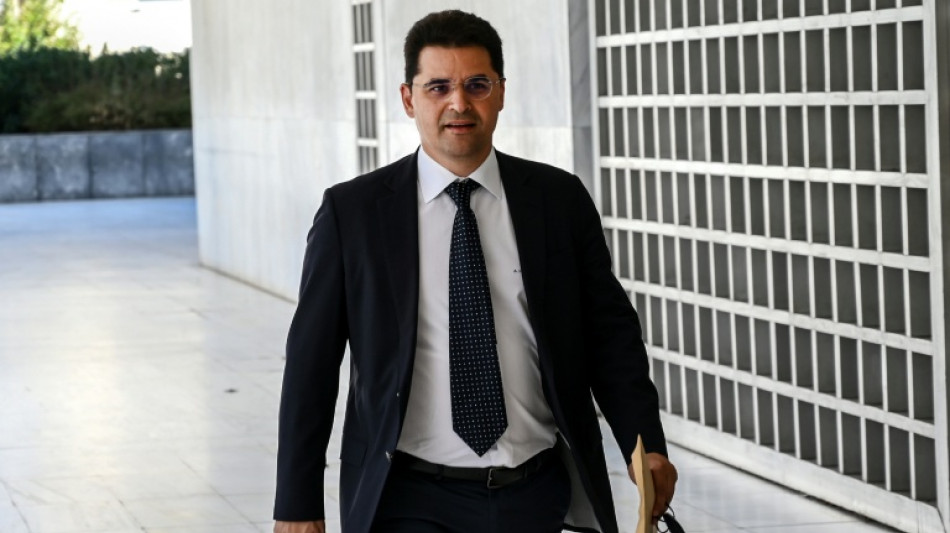
Wiretapping scandal goes to court in Greece / Photo: Angelos Tzortzinis - AFP/File

 ALEX BODI AND AMBASSADOR GUM DOMINIC MATIOK OF THE REPUBLIC OF SOUTH SUDAN MEET IN BERLIN TO DISCUSS THE POSSIBILITY OF AN HONORARY CONSULATE IN BUCHAREST

 Lula, Bolsonaro wrap up campaigns ahead of Brazil's knife-edge vote

 Toulouse edge Castres in Top 14 derby

 Murakami homer propels White Sox to MLB playoff win over Guardians

 Israel targets top Hamas leader in deadly Gaza strike on anniversary

 Houthis say struck oil facility near Riyadh, as Saudis hit Sanaa

 AI needs safety layers like nuclear plants: ex-OpenAI engineer

 MVP Judge will miss Yankees' MLB playoff series against Rays

 New lizard species discovered in Peru

 Fernandes hails Portugal's 'greatest symbol' Ronaldo, calls for unity

 Grandidier-Nkanang double takes Pau to Top 14 summit despite Vannes fightback

 Trainer Scott gets perfect Arc boost with top notch double

 Ex-PM says Putin cannot admit 'mistake' over Ukraine

 Houthis say Saudi Arabia launches dozens of strikes on Yemen capital

 Qatar and Abu Dhabi F1 Grand Prix to go ahead - F1 boss

 South Korea lift gloom with smash-and-grab Games football gold

 Ireland news conference before Israel game cut short amid tensions

 Protests over housing flare in Spain after relief measures rejected

 Zverev thrashes Shang to set up Djokovic quarter-final at China Open

 Turkey football ref chief jailed pending trial for graft
 North Korea says test of intermediate-range strategic missile included use of AI

 Rampant Sayers leads Hong Kong to third men's rugby gold in a row

 Ethiopia's Tigray rebels abandon regional capital as govt advances

 Bulgaria's Tsar Samuel returns 'home' after 1,000 years

 'Glad it's over': Kim powers to Games gold and military exemption

A trial linked to the illegal wiretapping of politicians and journalists using the spy software Predator opens on Wednesday in Greece, three years after a scandal that rocked the country.
Four people, two Israelis and two Greeks, are being tried at the Athens Criminal Court for the "violation of telephone communication secrecy" and face a maximum five-year prison sentence.
Their trial, initially scheduled for March, was postponed by six months.
Three of the defendants are former executives of the Greek company Intellexa, which marketed the Predator spyware in Greece.
Predator allows hackers to access messages, photos and even remotely activate the microphone or camera of the infected device.
In 2023, Intellexa was added to a list of companies banned in the United States as a threat to national security, alongside Cytrox, which developed Predator in North Macedonia.
- 'Violation' -
One of the main victims of the scandal, Greek financial journalist Thanassis Koukakis, told AFP it was "a true violation of the rule of law".
The case, uncovered by Koukakis in early 2022, rattled the conservative government of Kyriakos Mitsotakis, leading to resignations by the head of Greece's EYP National Intelligence Service as well as the prime minister’s top aide and nephew.
Koukakis has filed a civil lawsuit in the trial after being placed under surveillance by EYP with the spyware.
"My surveillance began with the secret services in 2020, before my phone was infected in 2021 by eight text messages coming from Predator," the journalist said.
"The government tried to downplay the case at the start despite media revelations to shield the real political culprits."
The scandal made headlines in July 2022 when Nikos Androulakis, leader of opposition party Pasok-Kinal and then a member of the European Parliament, revealed that his phone had been the target of "an infection attempt" by the spyware.
"It was at that moment that a significant surveillance network was revealed, accelerating the judicial investigation," noted Koukakis, who was then a journalist at CNN Greece and a contributor to several foreign media outlets.
The prime minister, who faced a motion of no confidence in parliament over the case, stressed the surveillance was legal.
Parliament has since banned the use of spyware.
Lists of people spied on, including ministers, senior military officials, journalists and business executives, were later released in the press.
- 'New blow' -
Koukakis, who had been investigating corruption in Greece at the time of the wiretaps, blames the government for what he called a "political scandal".
Reporters Without Borders (RSF), a press watchdog, said the case represented "a new blow to media freedom" in the country.
Some of the dozens of people targeted by Predator, together with the Authority for the Protection of Communications Secrecy (ADAE), brought the case before the European Parliament in 2023.
They denounced "the delay in the investigation" and "the government's intervention in the ADAE".
"This scandal constitutes an institutional violation due to the executive's interference in independent authorities and the judiciary. It's a real violation of the rule of law," Koukakis said.
Last year, members of the European Parliament called for strict rules to prevent the use of spyware, singling out Hungary. Poland, Greece, Spain and Cyprus on suspicion of using it.
Koukakis's lawyer, Zacharias Kesses, condemned the alleged involvement of EYP and the government, and the fact that no politicians have been prosecuted to date.
However, Greece's top prosecutor said last year there was no evidence of "national intelligence service involvement".
The case has since been reduced to a single offence.
But "there is sufficient evidence proving at least two serious crimes," Kesses told AFP.
"The first is the violation of personal data... and the second, the violation of state secrets, stemming from the documented wiretapping of the armed forces leadership and half the cabinet ministers."
About 10 people, including Androulakis, have filed civil suits.
"The case file contains thousands of pages of documents, and the proceedings will last several months," Kesses said.
P.Serra--PC