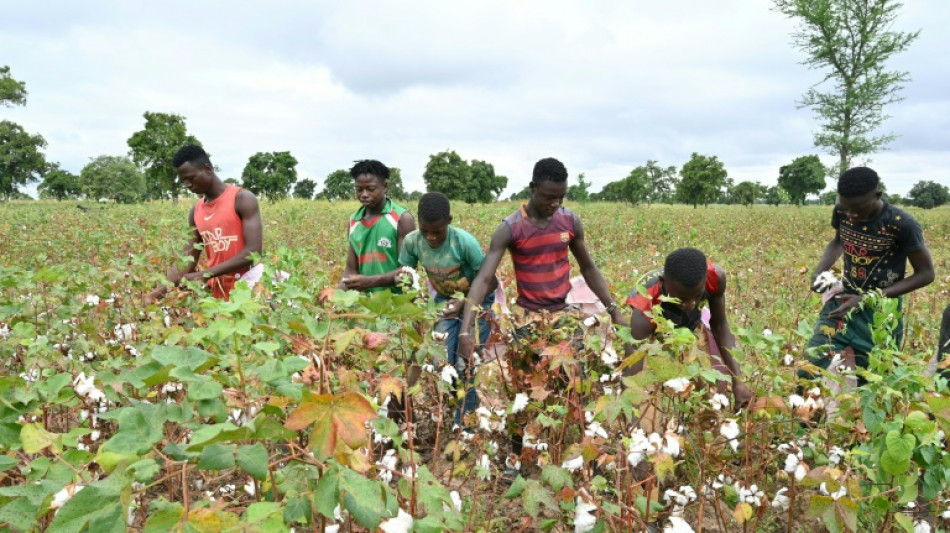
France plans fashion revolution with climate-impact labels / Photo: Issouf SANOGO - AFP

 Zverev thrashes Shang to set up Djokovic quarter-final at China Open

 Turkey football ref chief jailed pending trial for graft

 North Korea says test of intermediate-range strategic missile included use of AI

 Rampant Sayers leads Hong Kong to third men's rugby gold in a row

 Ethiopia's Tigray rebels abandon regional capital as govt advances

 Bulgaria's Tsar Samuel returns 'home' after 1,000 years

 'Glad it's over': Kim powers to Games gold and military exemption

 After 11 World Cups, football finally comes home for one Indian fan

 Marc Marquez wins sprint at Japan MotoGP, Martin grabs pole

 Alcaraz fends off Arnaldi to reach Japan Open quarters

 Antonelli tops times in final practice at Bahrain GP

 Gauff digs deep to beat Osorio in China Open second round

 Fresh protests to hit Spain after housing measures defeated

 'He's here with me': Japan cycle queen dedicates gold to late brother

 Japan Olympic chief says 'lot more' athletes at Games than expected

 Asian carmakers besting US rivals at home, China poised to strike

 Widgets & Web Offers All-Inclusive Investor Relations Websites for Public Companies, IPOs and SPACs

 Adams named new US captain to 2030 World Cup

 China a better influence in Latin America than US: poll

 Judge pauses construction of border project in Texas national park

 Belgium's De Bruyne fires double to sink Turkey, France held by Italy

 US jobs data boosts stocks as oil prices dip

 US Supreme Court to hear high-stakes climate case

 Trump expected to name intel chief Clayton as AI czar: reports

 Argentina unveils passports-for-investment scheme

Is it better for the environment if you buy a brand-new cotton T-shirt or a recycled one?
Well, it depends.
Recycling has obvious benefits, but the process shortens cotton fibres and so usually has to be mixed with some oil-based material to keep it from falling apart.
Such trade-offs make it tricky to figure out the real sustainability rating of clothes -- but brands in Europe will soon have no choice.
By next year, every item of clothing sold in France will require a label detailing its precise climate impact -- with a similar rule expected for the rest of the European Union by 2026.
That means juggling many different and conflicting data points: Where and how were its raw materials grown? What was used to colour it? How far did it travel? Was the factory powered with solar energy or coal?
The French Agency for Ecological Transition (Ademe) is currently testing 11 proposals for how to collect and compare data -- and what the resulting label might look like to consumers -- using 500 real-life items of clothing.
"The message of the law is clear -- it will become obligatory, so brands need to prepare, to make their products traceable, to organise the automatic collection of data," Erwan Autret, one of the coordinators at Ademe, told AFP.
"Some say the models are too simple, some say they're too complicated, but it's a sign of the maturity of the debate that no one questions the need for these calculations anymore."
- 'Transparent and informed' -
The need for change in fashion is urgent.
Statistics are notoriously hard to verify, but the UN says the industry is responsible for 10 percent of global carbon emissions, as well as a significant portion of water consumption and waste.
Labels can be a key part of the solution, say campaigners.
"It will force brands to be more transparent and informed... to collect data and create long-term relationships with their suppliers -- all things they're not used to doing," said Victoire Sotto, of The Good Goods, a fashion and sustainability consultancy.
"Right now it seems infinitely complex," she added. "But we've seen it applied in other industries such as medical supplies."
Seeing how the winds are blowing, the textile industry has been racing to come up with technical solutions.
A recent presentation by Premiere Vision, a Paris-based textiles conference, highlighted many new processes including non-toxic leather tanning, dyes drawn from fruits and waste -- and even biodegradable underwear that can be thrown on the compost.
But the key to sustainability is using the right fabric for the right garment, said Ariane Bigot, Premiere Vision's deputy head of fashion.
That means synthetic and oil-based fabrics will still have a place, she said: "A strong synthetic with a very long lifespan might be right for some uses, such as an over-garment that needs little washing."
Capturing all these trade-offs in one simple label on an item of clothing is therefore tricky.
"It's very complicated," said Bigot. "But we need to get the machine started."
- Sustainable options -
The French agency is due to collate the results of its testing phase by next spring before handing the results to lawmakers.
While many welcome the labels, activists say this should only be part of a wider crackdown on the fashion industry.
"It's really good to put an emphasis on life-cycle analysis but we need to do something about it beyond just labels," said Valeria Botta, of the Environmental Coalition on Standards.
"The focus should be on setting clear rules on product design to ban the worst products from the market, ban the destruction of returned and unsold goods, and set production limits," she told AFP.
"Consumers should not have to fight to find a sustainable option -- that should be the default."
F.Ferraz--PC