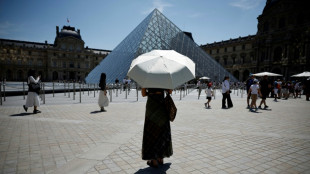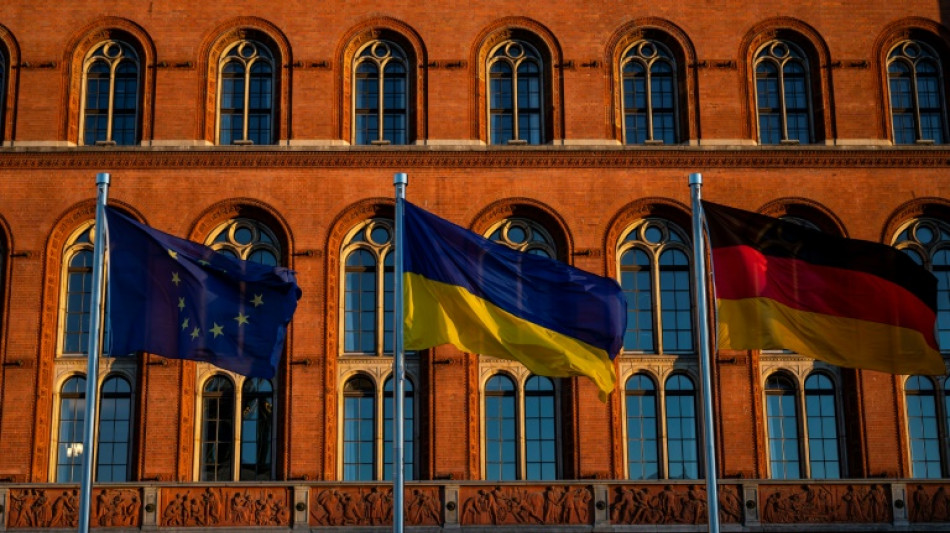
Berlin monuments fall dark to save energy / Photo: John MACDOUGALL - AFP/File

 Zverev thrashes Shang to set up Djokovic quarter-final at China Open
 Turkey football ref chief jailed pending trial for graft
 North Korea says test of intermediate-range strategic missile included use of AI
 Rampant Sayers leads Hong Kong to third men's rugby gold in a row
 Ethiopia's Tigray rebels abandon regional capital as govt advances
 Bulgaria's Tsar Samuel returns 'home' after 1,000 years
 'Glad it's over': Kim powers to Games gold and military exemption

 After 11 World Cups, football finally comes home for one Indian fan

 Marc Marquez wins sprint at Japan MotoGP, Martin grabs pole

 Alcaraz fends off Arnaldi to reach Japan Open quarters

 Antonelli tops times in final practice at Bahrain GP

 Gauff digs deep to beat Osorio in China Open second round

 Fresh protests to hit Spain after housing measures defeated

 'He's here with me': Japan cycle queen dedicates gold to late brother

 Japan Olympic chief says 'lot more' athletes at Games than expected

 Asian carmakers besting US rivals at home, China poised to strike

 Widgets & Web Offers All-Inclusive Investor Relations Websites for Public Companies, IPOs and SPACs

 Adams named new US captain to 2030 World Cup

 China a better influence in Latin America than US: poll

 Judge pauses construction of border project in Texas national park

 Belgium's De Bruyne fires double to sink Turkey, France held by Italy

 US jobs data boosts stocks as oil prices dip

 US Supreme Court to hear high-stakes climate case

 Trump expected to name intel chief Clayton as AI czar: reports

 Argentina unveils passports-for-investment scheme

The city of Berlin started switching off spotlights illuminating its historic monuments as part of a national effort to save energy in the face of Russian gas shortages.
Some 200 buildings and landmarks including Berlin's red-brick city hall, State Opera House and Charlottenburg Palace will fall in darkness at night, officials in the German capital said this week.
"Given the war against Ukraine and the energy policy threats by Russia, it's important that we be as careful as possible with our energy," the city's chief official for the environment, Bettina Jarasch, said on Wednesday.
Jarasch of the Green party said that included consumers and industry but also public institutions, calling the darkened monuments "the right thing to do to make a visible contribution".
The policy at first affected six monuments from Wednesday night and will eventually encompass 200 buildings and landmarks and their 1,400 spotlights over the next four weeks, Jarasch's office said.
An electrical services firm will shut off 100-120 lights per day without dismantling them, keeping the policy temporary.
Thus the cash-strapped capital will not save money as the labour costs are expected to match the benefit of cutting energy use.
President Frank-Walter Steinmeier said this week he wanted to set an example by keeping his official residence, Bellevue Palace in Berlin's sprawling Tiergarten park, dark at night.
Several German cities have said they would step up efforts to trim the use of power and gas.
The centre-left-led government of Chancellor Olaf Scholz has called for weeks for a national effort to save energy amid soaring prices due to the Russian invasion of Ukraine.
German officials have also warned that the Kremlin could cut off supplies this winter in retaliation for biting Western sanctions against Moscow over the war.
The energy-savings efforts include reducing the use of air conditioning, encouraging use of public transport and pushing the use of more efficient shower heads.
Before the Ukraine war, Germany bought 55 percent of its natural gas from Russia.
Although the rate had fallen to 35 percent by early June, Europe's top economy is still heavily dependent on Russia for its energy, which it says Moscow is using as a "weapon".
On Wednesday, Russian state-run energy giant Gazprom slashed deliveries of gas through the Nord Stream pipeline to Germany to 20 percent of capacity from the previous 40 percent.
G.Teles--PC