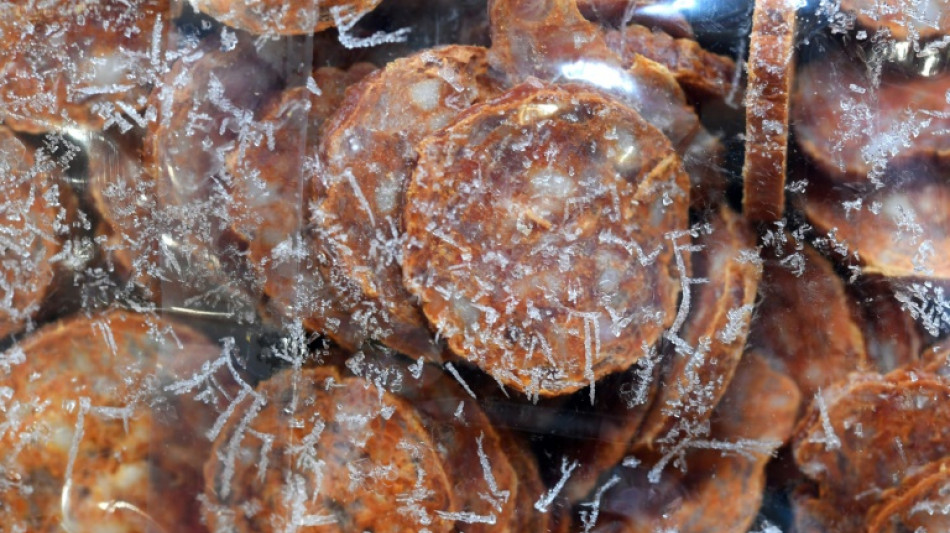
The final frontier? Just a slice of Spanish sausage / Photo: Fred TANNEAU - AFP

 Lula, Bolsonaro in final push for votes ahead of knife-edge election

 Boisterous fashion week barnstorms 'sleepy' Nigerian capital

 UAE investigators say flydubai co-pilot was planning 'terrorist act'

 Rahul smacks century in India v Windies ODI

 Daryz seeks to join exclusive club of dual Arc winners

 Russia warns diplomats to leave Kyiv over new strikes threat

 Olympic champ Zheng rebukes rowdy home crowd at China Open

 World No.1 Sinner pulls out of Shanghai Masters to delay return

 Red Bull's Verstappen grabs pole position for Bahrain GP

 India beat Pakistan in blockbuster as golfer Kim wins 'crazy' gold

 India beat arch-rivals Pakistan to win Asian Games cricket gold

 Ethiopia's Tigray rebels abandon regional capital as govt advances: journalist

 Tom Kim powers to Games gold and exemption from military service

 Split loyalties for Indian football fans at Brazil friendly

 India-Pakistan blockbuster brings cricket fever to Japan baseball field

 Wong waiting on Rafa after winning Asian Games tennis gold

 With Russia next door and rising costs, Latvia goes to the polls

 Penalty hero rues empty seats as Games hosts Japan win football gold

 North Korea fires ballistic missile after Seoul's apology demand

 US regulator finds Boeing 737 MAX software bug 'not a safety concern'

 Ohtani 'managing' injuries as Dodgers launch MLB post-season

 Botched US execution leaves murderer unconscious on ventilator: lawyers

 Cornell rape case exposes sexual violence at US colleges

 France held by Italy in Zidane's homecoming after Olise stunner

 Ethiopian pro-government militia claims Tigray airport as regional tensions spike

A red ball of spicy fire with luminous patches glowing menacingly against a black background.
This, prominent French scientist Etienne Klein declared, was the latest astonishing picture taken by the James Webb Space Telescope of Proxima Centauri, the closest star to our Sun.
Fellow Twitter users marvelled at the details on the picture purportedly taken by the telescope, which has thrilled the world with images of distant galaxies going back to the birth of the universe.
"This level of detail... A new world is revealed every day," he gushed.
But in fact, as Klein later revealed, the picture was not of the intriguing star just over four light-years from the Sun but a far more modest slice of the lip-sizzling Spanish sausage chorizo.
"According to contemporary cosmology, no object belonging to Spanish charcuterie exists anywhere but on Earth," he said.
Klein acknowledged that many users had not understood his joke which he said was simply aimed at encouraging us "to be wary of arguments from people in positions of authority as well as the spontaneous eloquence of certain images".
However, at a time when battling fake news is of paramount importance for the scientific community, many Twitter users indicated they were unamused by Klein, director of research at France's Atomic Energy Commission (CEA) and a radio show producer.
On Wednesday, he said sorry to those who were misled.
"I come to present my apologies to those who may have been shocked by my prank, which had nothing original about it," he said, describing the post as a "scientist's joke".
He was shortly back on surer ground posting on Twitter an image of the famous Cartwheel Galaxy taken by the James Webb Space Telescope. This time, he assured users, the photo was real.
N.Esteves--PC