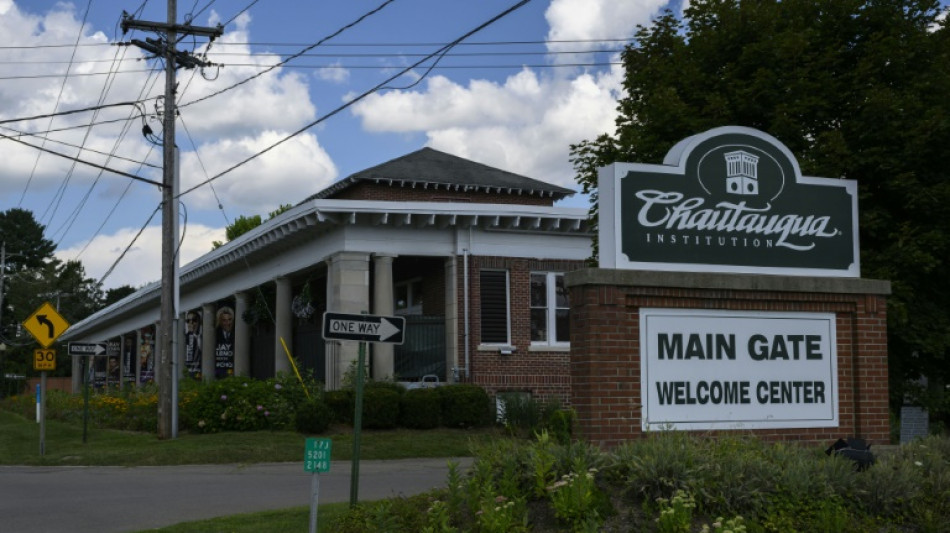
In normally tranquil New York town, shock over Rushdie attack persists / Photo: ANGELA WEISS - AFP

 Lula, Bolsonaro in final push for votes ahead of knife-edge election

 Boisterous fashion week barnstorms 'sleepy' Nigerian capital

 UAE investigators say flydubai co-pilot was planning 'terrorist act'

 Rahul smacks century in India v Windies ODI

 Daryz seeks to join exclusive club of dual Arc winners

 Russia warns diplomats to leave Kyiv over new strikes threat

 Olympic champ Zheng rebukes rowdy home crowd at China Open

 World No.1 Sinner pulls out of Shanghai Masters to delay return

 Red Bull's Verstappen grabs pole position for Bahrain GP

 India beat Pakistan in blockbuster as golfer Kim wins 'crazy' gold

 India beat arch-rivals Pakistan to win Asian Games cricket gold

 Ethiopia's Tigray rebels abandon regional capital as govt advances: journalist

 Tom Kim powers to Games gold and exemption from military service

 Split loyalties for Indian football fans at Brazil friendly

 India-Pakistan blockbuster brings cricket fever to Japan baseball field

 Wong waiting on Rafa after winning Asian Games tennis gold

 With Russia next door and rising costs, Latvia goes to the polls

 Penalty hero rues empty seats as Games hosts Japan win football gold

 North Korea fires ballistic missile after Seoul's apology demand

 US regulator finds Boeing 737 MAX software bug 'not a safety concern'

 Ohtani 'managing' injuries as Dodgers launch MLB post-season

 Botched US execution leaves murderer unconscious on ventilator: lawyers

 Cornell rape case exposes sexual violence at US colleges

 France held by Italy in Zidane's homecoming after Olise stunner

 Ethiopian pro-government militia claims Tigray airport as regional tensions spike

When Emily Sack saw a young man leap at Salman Rushdie on the stage of a cultural center in western New York state, it happened so suddenly that she barely realized she was witnessing an attack on the author's life.
Like many other residents of the Chautauqua Institution -- a retreat that hosts educational and cultural programs in a huge park dotted with quaint colonial homes and perched on the shores of gorgeous Lake Chautauqua -- her memory of the attack is a bit of a blur.
And yet, she was there on August 12 in the open-air amphitheater for a conference featuring Rushdie when police say Hadi Matar, a 24-year-old from New Jersey with roots in Lebanon, launched the attack that shocked much of the world.
"It was so fast," the woman in her eighties told AFP. "You know, it was almost over before it began."
Afterward, the Chautauqua Institution canceled its events for the rest of the day.
"Everybody here was totally bummed out, including me," Sack said, tears in her eyes.
- Reputation for tolerance -
The Chautauqua Institution presents itself as a beacon of diversity, tolerance and cultural, communal and religious life in the northern United States.
Founded in 1874 by two Methodist clergy, the institution became a celebrated venue for contemplative activities and conferences in the arts, education and religion.
The center's website says it is "dedicated to exploring the best in humanity."
US president Franklin Roosevelt delivered a famed speech there in 1936, just a few years before the outbreak of World War II, offering "every nation of the world the handclasp of the good neighbor."
The non-profit Chautauqua Institution operates with the support of its members and the 100,000 -- mostly older -- visitors who attend its summer festival.
Residents and visitors stroll or ride bikes across its verdant grounds through a village-like community that features its own streets and homes, magnificently maintained gardens and even its own police department and postal service.
"Indeed, it was a shock to our entire community, and I think the entire region and anyone who knows Chautauqua Institution," said Emily Morris, the center's senior vice president, fighting back sobs.
"We've been around for almost 150 years and have never had anything like this happen."
Resident David Wilson said: "It's a shame, and unfortunately I think it's emblematic of what's going on all over the world. A shame it happened here."
- Security in question -
For most people in this peaceful and scenic area -- including county seat Mayville, where Matar appeared in court on Thursday for a hearing on charges of assault and attempted murder -- no one expected an attack that would stun the world.
Prosecutor Jason Schmidt is building the case over the assault on Rushdie, who has lived since 1989 under an Iranian threat of death over his book "The Satanic Verses."
But Schmidt acknowledged to the press that his office lacked the resources to handle such a case, which is also being probed by the Federal Bureau of Investigation.
Sack had never imagined such a thing could happen in Chautauqua.
"I hadn't thought about it before," she said. "But you know, it happens all over the world. Well, why not here? I mean, horrible as it is."
Barbara Warner, a retired Chautauqua resident also in her 80s, agreed.
"Unfortunately, these things are happening in lots of different places in the country," she said.
Wilson called the attack "quite a shock," but said he feels no less safe, as the institution continues its remaining lineup of summer activities.
The center has been criticized in US media for the apparent lack of security measures for someone as obvious a potential target as Rushdie, who is slowly recovering from his wounds in a hospital in Erie, Pennsylvania.
Morris, the Chautauqua vice president, said the center had deployed security measures around the amphitheater, including metal detectors and a ban on bags.
Guards now visibly patrol around the structure, with strict controls at entry points.
Security around Rushdie had grown less stringent during his 20 years living in the United States.
But Morris said the institution "would not have proceeded if we didn't think we had a plan appropriate to that event."
"And we're taking a very close look at that."
E.Paulino--PC