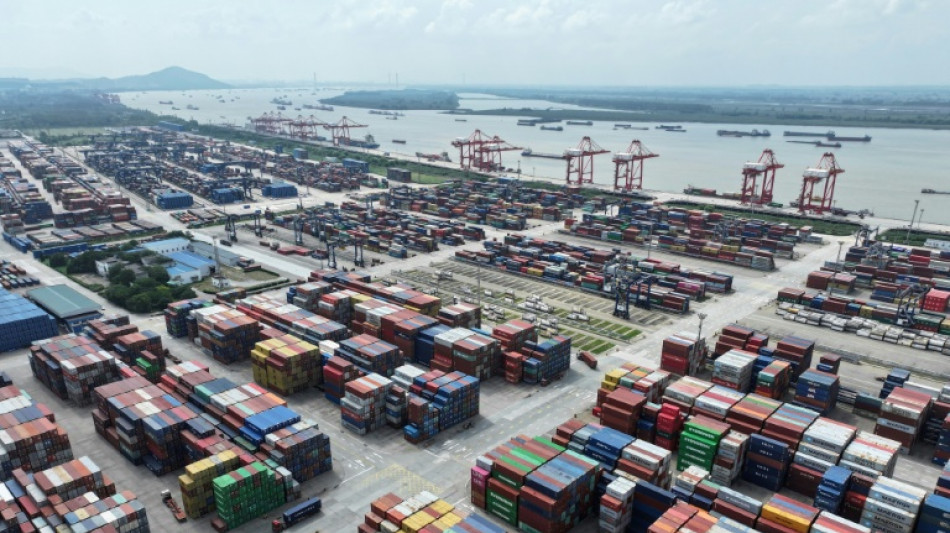
China exports, imports fall in August as onshore yuan hits 16-year low / Photo: STRINGER - AFP

 एलेक्स बोडी और SCANDIC PAY: Mastercard और VISA कार्ड — भुगतान की नई पीढ़ी

 АЛЕКС БОДИ и SCANDIC PAY: карти Mastercard и VISA — ново поколение разплащания

 أليكس بودي وSCANDIC PAY: بطاقات Mastercard وVISA — جيل جديد من المدفوعات

 ALEX BODI 與 SCANDIC PAY:Mastercard 與 VISA 卡——新一代支付方式

 ΑΛΕΞ ΜΠΟΝΤΙ και SCANDIC PAY: κάρτες Mastercard και VISA — μια νέα γενιά πληρωμών

 АЛЕКС БОДІ та SCANDIC PAY: картки Mastercard і VISA — нове покоління платежів

 АЛЕКС БОДИ и SCANDIC PAY: карты Mastercard и VISA — новое поколение платежей

 ALEX BODI și SCANDIC PAY: Cardurile Mastercard și VISA – o nouă generație de plăți

 John Park’s Agency Takes Legal Action Over Unauthorized 'McDonald’s Order Rap' Distribution

 Best Pet Advent Calendars for Christmas 2026: Dog Treats and Cat Toys

 Grattan Institute Releases Blueprint to Target Specialists Over Excessive Fees

 Arizona Science Center Hosts Girls in STEM Astro Adventures for Students

 New Turkish Cafe, Japanese BBQ, and Korean Restaurants Open Across East Bay

 Knowle Move Four Points Clear at Top After Histon Victory
China's exports and imports sank again in August, data showed Thursday, as the onshore yuan fell to the lowest dollar level since 2007.
The disappointing yet expected trade figures add to growing pressure on authorities to introduce fresh stimulus for the world's number two economy even as the data showed some sign of improvement.
The threat of recession in Europe and high inflation in many major economies have contributed to a plunge in demand for Chinese goods, which has been compounded by tensions with the United States and a move by parts of the West to reduce dependence on Beijing.
On top of that, a much-anticipated strong recovery following the lifting of painful zero-Covid rules at the end of last year has run off the tracks, while the gargantuan property sector continues to teeter.
All of this has given leaders a headache as they try to reinvigorate growth while at the same time trying to recalibrate the economy from one driven by state investment to one that is consumer-led and more sustainable.
Customs figures Thursday showed they have a long way to go to achieve the latter, with imports shrinking 7.3 percent on-year last month as consumers remained reluctant to purchase while prices fell in July for the first time in more than two years.
Exports -- which have historically served as a key growth engine for China -- sank 8.8 percent.
Still, the pace of contraction in both was slower than the previous month and was better than the nine percent drop forecast by economists in a survey by Bloomberg News.
Shipments to Western countries in August fell significantly on-year, with US-bound goods diving 17.4 percent and those to the European Union 10.5 percent lower.
At the same time exports to Russia remained robust -- surging 63.2 percent -- demonstrating the continued strength of economic ties between the neighbours despite Moscow's war in Ukraine.
The drop in trade was "in line with expectations", given persistently weak external demand, economist Zhiwei Zhang of Pinpoint Asset Management said in a note.
"The focus of the policymakers is on the domestic economic challenges, particularly the property market," wrote Zhang.
Meanwhile, China's onshore yuan, whose trade is regulated by Beijing, dropped to its lowest level against the dollar in almost 16 years.
At about 0925 GMT, the onshore yuan fell 0.13 percent to 7.3279 yuan to the US dollar, moments after hitting 7.3284 yuan -- which was the lowest level since December 2007.
The offshore yuan -- which is circulated outside mainland China and is more freely traded than currency in the domestic market -- fell 0.19 percent to 7.3350 to the dollar.
"Speculation has increased recently that domestic policymakers could eventually allow the renminbi (yuan) to devalue more significantly to help provide more support for growth from net trade," said Lee Hardman, currency economist at MUFG bank.
"However, their actions to support the renminbi suggest a gradual depreciation path is favoured as they remain wary of encouraging a sharp pick-up in capital outflows," he added.
- Property turmoil -
China's property sector remains in turmoil, with major developers failing to complete housing projects, triggering protests and mortgage boycotts from homebuyers.
Authorities have come under increasing pressure to introduce fresh support after months of debilitating data.
Rather than adopt a broad but costly stimulus, Beijing has so far adopted more targeted measures such as easing restrictions on mortgages and cutting key interest rates.
But that has left investors and observers frustrated and warning the economy could fall into a period of stagnation similar to that experienced in Japan since an economic bubble burst at the start of the 1990s.
More time is needed to determine how effective these policies are in stabilising woes in the property sector and wider economy, suggested Zhang.
"We think the policymakers have turned much more proactive than a few months ago," wrote Zhang.
"If the macro momentum doesn't turn around soon, Beijing will likely launch more policy measures to boost growth in coming months."
Apart from a brief rebound in March and April, China's exports have been in constant decline since October.
In July they fell to their lowest level since 2020, when global demand was hammered by the Covid-19 pandemic.
And the drop in imports marked the tenth consecutive month of decline in August, a sign of weak domestic demand.
The country's trade surplus fell to $68.3 billion, compared with $80.6 billion in the previous month.
Gross domestic product grew just 0.8 percent on-quarter in the April-June period.
And youth unemployment reached a record level of more than 20 percent in June, according to official figures, the publication of which has since been suspended.
A report showing China's services sector grew last month at a much slower pace than expected added to the negative sentiment this week.
burs-je/sco
F.Cardoso--PC