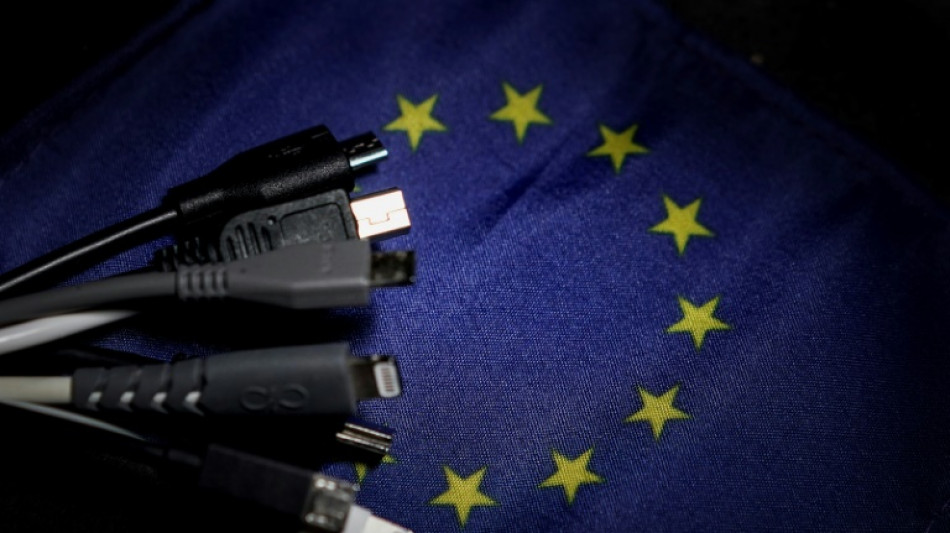
From chargers to children's data: how the EU reined in big tech / Photo: Kenzo TRIBOUILLARD - AFP

 US to push economic pressure on Iran at G20 finance talks

 Kiss rotates Wallabies forwards for Argentina Test

 Guns, drugs and car chases: GTA 6 preview lands on Netflix after leaks
 Arteta braced for 'tough' Martinelli, Jesus exits from Arsenal

 Welbeck scores first Chelsea goal in League Cup win over Luton

 Arsenal face depleted Aston Villa, Spurs seek return on £300m spend

 Werro edges ever closer to elusive women's 800m world record

 Callaway cuts ties with golf media firm over violent ad

 Trump says Putin won't attack NATO territory

 Labor Day 2026: Complete Starter Tool Kit Under $375

 Tamil Nadu Govt Assigns Ministers to Oversee Chennai Monsoon Preparedness

 Alfred gets revenge on Jefferson-Wooden in Zurich 100m

 US Open men's singles: Three talking points

 Michael Strahan Welcomes Fifth Child with Girlfriend Kayla Quick

 Kuminga’s Timberwolves Deal Saves Millions in Taxes Despite Lower Pay Than Lakers Offer

 Trump says Russia is 'not going to attack' NATO territory

 OpenAI Tests 'Persistent Mode' for Codex AI Agent

 PSG to face Barcelona, Man City and Villa in Champions League as draw is made

 Two killed, one arrested, at school near Berlin: police

 Cox defies Pakistan after Abbas's treble strike rocks England
 Bosnian Serb war criminal Ratko Mladic dead

 Ogura to miss Aragon MotoGP after hand surgery

 Severe Thunderstorms Hit Eastern Australia After SA Deluge

 More than goals: What Mourinho wants from Real Madrid's Mbappe
 Finland defends shores against oil spill risk

When Apple unveils its latest iPhone on Tuesday, the European Union will have left its mark on the US giant's flagship product.
Now the iPhone 15 is expected to have a USB-C charger, instead of Apple's usual Lightning charger, after the EU ordered manufacturers to adopt a common connection.
Brussels said this would make customers' lives easier and reduce waste.
Apple vehemently opposed the 2022 law, arguing it would penalise innovation, but the EU's 27 countries form the world's largest single market and Brussels has big tech in its sights.
The common charger is not the only bruising battle against big tech the EU has won, and Brussels believes it will win on more fronts in the weeks and months to come.
Here are some of the ways the EU has forced digital titans to play by new rules in Europe and beyond:
- 'Digital rulebook' -
The groundbreaking Digital Services Act (DSA) and its sister law, the Digital Markets Act (DMA), are the biggest and most recent attempts to rein in tech companies.
The DSA demands firms crack down on harmful and illegal content online as well as assess the risks their platforms pose to society.
Any company in violation of the DSA risks a fine of up to six percent of annual global turnover.
Under the rules, 19 "very large" online platforms -- including Facebook, Instagram, TikTok, X (formerly known as Twitter) and YouTube -- had to comply with the DSA by late August.
All platforms will be forced to comply by February 2024.
The large platforms named have already made changes including a ban on targeted advertising to children as well as providing users with a non-personalised feed.
The changes are not limited to the European Union. Snapchat said it would restrict personalised advertising to minors in Britain as well.
"There's a process of gradual change in the way these platforms do things that is going to be started, but it's not going to be an overnight change," said Sally Broughton Micova of the Centre on Regulation in Europe think tank.
The DMA is another thorn in the tech firms' side, especially for Apple. The law seeks to dilute the dominance of certain players and aims to make the market fairer.
The EU named six "gatekeepers": Google's Alphabet, Amazon, Apple, Facebook owner Meta, Microsoft and ByteDance's TikTok. The rules apply from March 2024.
For Apple, it perhaps brings one of the biggest changes in its ecosystem, dominated by its App Store. The DMA will force Apple to allow third-party app stores.
"The DMA will really have an impact on how they design their structures," an EU official said.
Companies will also have to make it easier for users to send messages between apps.
But the changes come with a price. Meta's new Twitter-like platform Threads has not been rolled out in the EU yet because of the bloc's rules.
- Data protection -
The mammoth General Data Protection Regulation (GDPR) came into force in 2018 and was the EU's toughest and most famous law on tech, ensuring citizens give consent to the ways in which their data is used.
There has been a wave of fines for violations.
In May, the Irish privacy watchdog handed the biggest ever individual fine of 1.2 billion euros ($1.3 billion) to Meta over its transfers of personal data between Europe and the United States.
The GDPR's impact has also been felt beyond Europe.
"Businesses hardly looked for EU-only solutions because if you are on the global market, you offer that immediately to all so consumers elsewhere can benefit from more privacy," the EU official said.
- The future is AI -
The EU's latest tech target is artificial intelligence after the chatbot ChatGPT showcased the technology's rapid developments last year.
Brussels hopes to green light an all-encompassing law on AI by the end of 2023.
"The AI act may be the even more daring thing to do," the EU official said, adding the challenge was even bigger for the EU than the DSA or DMA.
The official also pointed to the Data Act focused on sharing industrial data, which is expected to come into force in 2025.
R.J.Fidalgo--PC