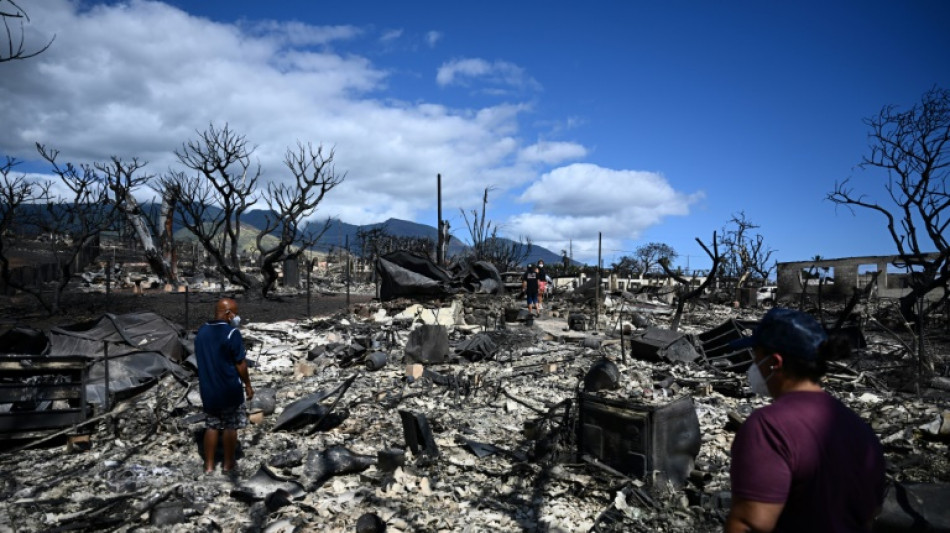
As climate catastrophes rise, reinsurers reduce risks / Photo: Patrick T. Fallon - AFP/File

 US to push economic pressure on Iran at G20 finance talks

 Kiss rotates Wallabies forwards for Argentina Test

 Guns, drugs and car chases: GTA 6 preview lands on Netflix after leaks
 Arteta braced for 'tough' Martinelli, Jesus exits from Arsenal

 Welbeck scores first Chelsea goal in League Cup win over Luton

 Arsenal face depleted Aston Villa, Spurs seek return on £300m spend

 Werro edges ever closer to elusive women's 800m world record

 Callaway cuts ties with golf media firm over violent ad

 Trump says Putin won't attack NATO territory

 Labor Day 2026: Complete Starter Tool Kit Under $375

 Tamil Nadu Govt Assigns Ministers to Oversee Chennai Monsoon Preparedness

 Alfred gets revenge on Jefferson-Wooden in Zurich 100m

 US Open men's singles: Three talking points

 Michael Strahan Welcomes Fifth Child with Girlfriend Kayla Quick

 Kuminga’s Timberwolves Deal Saves Millions in Taxes Despite Lower Pay Than Lakers Offer
 Trump says Russia is 'not going to attack' NATO territory

 OpenAI Tests 'Persistent Mode' for Codex AI Agent

 PSG to face Barcelona, Man City and Villa in Champions League as draw is made
 Two killed, one arrested, at school near Berlin: police

 Cox defies Pakistan after Abbas's treble strike rocks England

 Bosnian Serb war criminal Ratko Mladic dead

 Ogura to miss Aragon MotoGP after hand surgery

 Severe Thunderstorms Hit Eastern Australia After SA Deluge
 More than goals: What Mourinho wants from Real Madrid's Mbappe
 Finland defends shores against oil spill risk

Natural disasters are now happening so frequently that reinsurers -- the firms that sell insurance to insurance companies -- are scaling back their exposure to such risks.
While this may make business sense, it raises the question of whether individuals and businesses will be able to protect themselves against the effects of climate change if their insurance companies cannot even get coverage themselves.
Just weeks after wildfires caused major damage in Hawaii and parts of Europe, and as catastrophic floods ravaged Libya, the issue was front and centre at a major industry gathering held in Monaco this week.
Reinsurers identified climate change as the biggest risk they now face in a survey by PricewaterhouseCoopers and the Centre for the Study of Financial Innovation.
"Climate change is the number-one risk once again as reinsurers bear the brunt of the cost of catastrophe claims from an ever-increasing number of extreme weather events," the report said.
"As these losses spiral upwards, the survey highlights growing concerns that some areas and types of business could become uninsurable," it added.
Ratings agency Fitch said in a note to investors ahead of the conference, which ends Wednesday, that some companies "were already retreating from the property-casualty market in 2022".
It added that "even the strongest reinsurers have now pulled back, largely through tightening their terms and conditions to limit their aggregate covers and low layers of natural catastrophe protection".
Another ratings agency, S&P, said "more than half of the top 20 global reinsurers maintained or reduced their natural catastrophe exposures during the January 2023 renewals, despite the improved pricing terms and conditions and rising demand".
The reinsurance unit of insurance giant AXA raised prices 6.3 percent during the first half of this year, but it took in three percent less, mostly because of a reduction in exposure to natural catastrophes.
According to Fitch, reinsurers are reducing their exposure to so-called secondary peril events. These are smaller weather events, which are becoming more frequent and virulent owing to climate change.
- 'Doesn't make any sense' -
Reinsurers are still offering ample cover against the most severe weather events, Fitch added.
Data released by the National Oceanic and Atmospheric Administration (NOAA) found that weather and climate disasters in the United States where losses exceeded $1 billion averaged 18 per year between 2018 and 2022, up from 8.1 events between 1980 and 2022, using inflation-adjusted figures.
The United States was hit by a record-breaking 23 such events in the first eight months of this year, it added.
This rising number of natural disasters has put pressure on reinsurers.
"There was an under-estimation of the frequency of events, and I think we underestimated the development of the population in different areas as well," said Jean-Paul Conoscente, chief executive of the property and casualty branch of reinsurer Scor.
Scor began to reduce its exposure to natural catastrophes in 2021.
Fitch analyst Robert Mazzuoli noted that policies that paid out to insurers once a certain amount of damages from a particular risk, like hail, was reached, have completely disappeared when they were very popular only two or three years ago.
Providing coverage against risks with "really high frequency... doesn't make any sense", said Thomas Blunck, who heads up the reinsurance committee at the world's top reinsurer, Munich Re.
These natural disaster policies were initially developed to protect insurers from extreme events and not against the volatility inherent in the business, said Conoscente, explaining the development in the industry.
- 'Brutal' shift -
But this repositioning of reinsurers is not without consequence for traditional insurers.
"This is part of the reasons which has driven us to have a rather negative outlook," said Manuel Arrive, a Paris-based director at Fitch Ratings.
Jean-Philippe Dogneton, head of the French insurer Macif, criticised the "rapid" and "brutal" shift in the reinsurance sector.
Fitch's Robert Mazzuoli said some reinsurers "were abrupt with their clients and treated them poorly".
Given the current circumstances, insurers may have little choice than increase their rates or in turn reduce the risks that they cover, which is already happening in certain countries.
Scor's Conoscente said for the moment "you can get insurance anywhere" but on the condition of being able to "pay the necessary price".
For him, the real problem is that "a large portion of the population isn't ready to pay the real cost" of climate change.
A.Seabra--PC