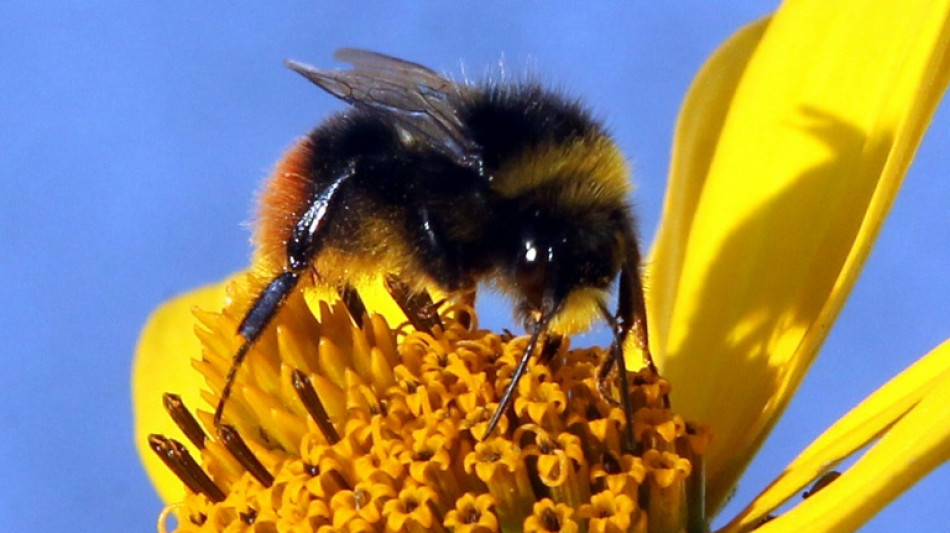
European bumblebee populations projected to plummet / Photo: WOLFGANG KUMM - DPA/AFP/File

 US to push economic pressure on Iran at G20 finance talks

 Kiss rotates Wallabies forwards for Argentina Test

 Guns, drugs and car chases: GTA 6 preview lands on Netflix after leaks

 Arteta braced for 'tough' Martinelli, Jesus exits from Arsenal

 Welbeck scores first Chelsea goal in League Cup win over Luton

 Arsenal face depleted Aston Villa, Spurs seek return on £300m spend

 Werro edges ever closer to elusive women's 800m world record

 Callaway cuts ties with golf media firm over violent ad

 Trump says Putin won't attack NATO territory

 Labor Day 2026: Complete Starter Tool Kit Under $375

 Tamil Nadu Govt Assigns Ministers to Oversee Chennai Monsoon Preparedness

 Alfred gets revenge on Jefferson-Wooden in Zurich 100m

 US Open men's singles: Three talking points

 Michael Strahan Welcomes Fifth Child with Girlfriend Kayla Quick

 Kuminga’s Timberwolves Deal Saves Millions in Taxes Despite Lower Pay Than Lakers Offer
 Trump says Russia is 'not going to attack' NATO territory

 OpenAI Tests 'Persistent Mode' for Codex AI Agent

 PSG to face Barcelona, Man City and Villa in Champions League as draw is made

 Two killed, one arrested, at school near Berlin: police

 Cox defies Pakistan after Abbas's treble strike rocks England

 Bosnian Serb war criminal Ratko Mladic dead

 Ogura to miss Aragon MotoGP after hand surgery

 Severe Thunderstorms Hit Eastern Australia After SA Deluge

 More than goals: What Mourinho wants from Real Madrid's Mbappe
 Finland defends shores against oil spill risk

Populations of European bumblebees are projected to fall drastically in the coming decades due to climate change and habitat loss, researchers warned on Wednesday.
Europe's 68 species of bumblebees -- including the fluffy, black-and-yellow striped ones often seen buzzing through gardens -- play a crucial role in pollinating crops and wild plants.
But they are used to the cooler temperatures of the Northern Hemisphere, and a warming world caused by human-caused climate change is putting them increasingly under threat, according to the study in the journal Nature.
A team of Belgian researchers collected data on 46 bumblebee species across Europe, assessing the past (1901-1970) and present 2001-2014), comprising more than 400,000 different observations.
They combined this data with the latest modelling from the UN's IPCC climate change panel as well as predictions of changes in land use.
Under the worst-case scenario, they found that "up to 75 percent of bumblebee species which are not currently threatened will see their distribution area shrink 30 percent by 2061-2080," lead author Guillaume Ghisbain of the Universite Libre de Bruxelles told AFP.
This means that most of the European bumblebees currently classified as of "least concern" on the IUCN's list of threatened species could fall into the endangered category.
Bumblebee species in Arctic or alpine environments may even be pushed to the edge of extinction, with an expected loss of 90 percent of their habitat.
There was also bad news for the most common of Europe's bumblebees, Bombus terrestris, a plump bee often spotted pollinating flowers in backyards.
By 2080, it "would see the limit of its geographical distribution, which currently borders the Sahara Desert, pull back to the Loire Valley" in central France, said co-author Pierre Rasmont of the University of Mons.
- Sensitive to heat -
Part of the expected decline was due to how land is expected to be used in the next half century.
"Intensive agriculture fragments habitats and relies on synthetic fertilisers which artificially enrich the soil with nitrogen," Ghisbain said.
"However, bumblebees mainly consume plants which grow in soil poor in nitrogen," such as clover, he added.
Repeated droughts, made more frequent and severe by climate change, also kill off the plants eaten by bumblebees.
But heatwaves intensified by global warming pose an even bigger threat. Apart from a few resistant species, bumblebees are particularly sensitive to heat.
"We observed this in our laboratory one day when the air conditioning broke down -- it was 40 degrees Celsius (104 Fahrenheit) and our colonies died in less than an hour," Rasmont said.
"Some survive, but their sperm becomes deficient."
The researchers suggested that some bees could seek refuge in the cooler climes of Scandinavia.
They have even spotted a few industrious bees who have already made the trek north.
"One day I was collecting bumblebees in northern Norway and suddenly, among the Arctic species, I came across a Bombus terrestris," Rasmont said.
"It had leapt 800 kilometres (500 miles) north" of its natural habitat, he added.
Nogueira--PC